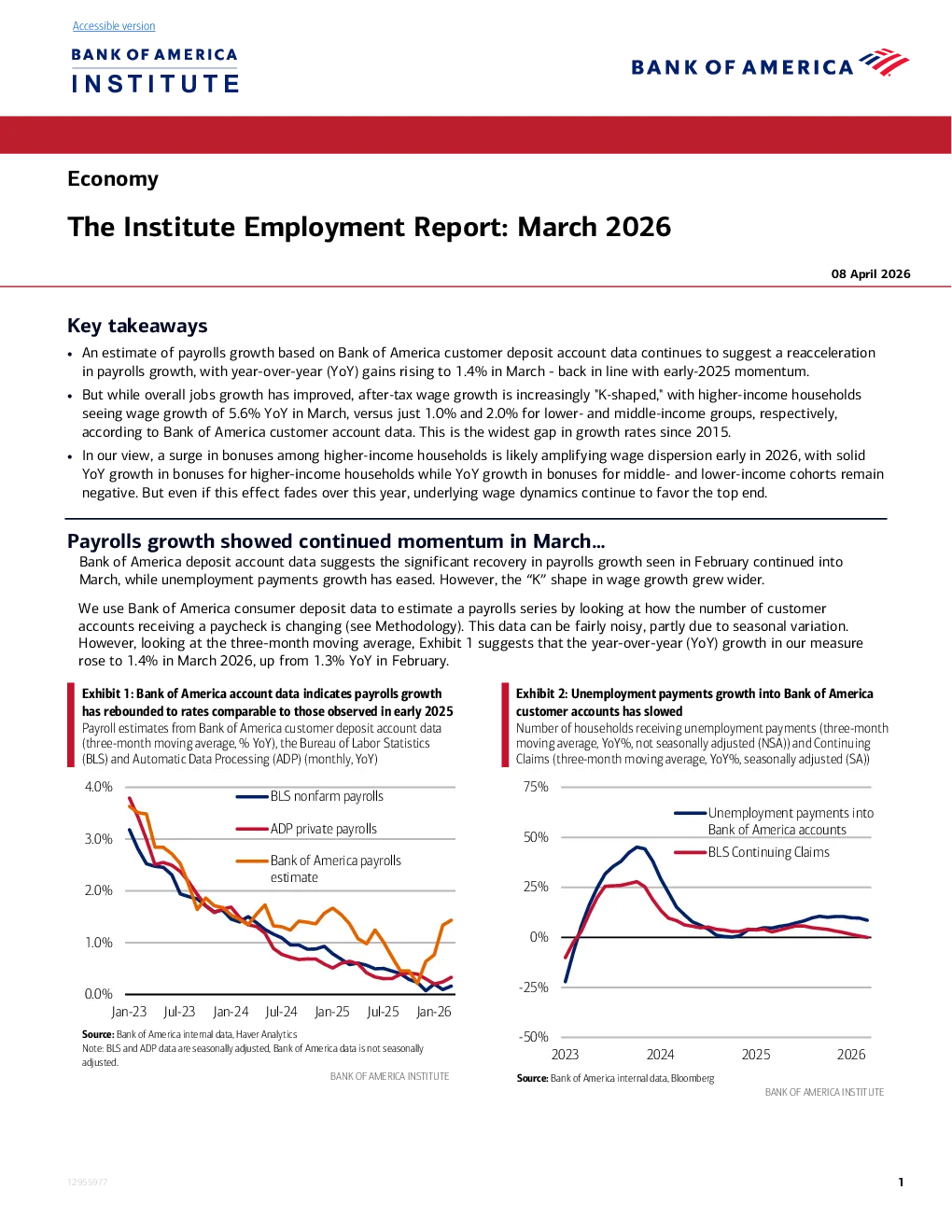
The Institute Employment Report: March 2026 Key takeaways •An estimate of payrolls growth based on Bank of America customer deposit account data continues to suggest a reaccelerationin payrolls growth, with year-over-year (YoY) gains rising to 1.4% in March - back in line with early‑2025 momentum. But while overall jobs growth has improved, after‑tax wage growth is increasingly "K‑shaped," with higher‑income householdsseeing wage growth of 5.6% YoY in March, versus just 1.0% and 2.0% for lower‑and middle‑income groups, respectively, In our view, a surge in bonuses among higher‑income households is likely amplifying wage dispersion early in 2026, with solidYoY growth in bonuses for higher-income households while YoY growth in bonuses for middle‑and lower‑income cohorts remain Payrolls growth showed continued momentum in March… Bank of America deposit account data suggests the significant recovery in payrolls growth seen in February continued intoMarch, while unemployment payments growth has eased. However, the“K”shape in wage growth grew wider. We use Bank of America consumer deposit data to estimate a payrolls series by looking at how the number of customeraccounts receiving a paycheck is changing (see Methodology). This data can be fairly noisy, partly due to seasonal variation.However, looking at the three-month moving average,Exhibit 1suggests that the year-over-year (YoY) growth in our measure Exhibit1: Bank of Americaaccountdataindicatespayrollsgrowthhas rebounded to rates comparable to those observed in early 2025 Exhibit2: Unemployment paymentsgrowthinto Bank of Americacustomer accounts has slowed Number of households receiving unemployment payments (three-monthmoving average, YoY%, not seasonally adjusted (NSA)) and ContinuingClaims (three-month moving average, YoY%, seasonally adjusted (SA)) Payroll estimates from Bank of America customer deposit account data(three-month moving average, % YoY), the Bureau of Labor Statistics(BLS) and Automatic Data Processing (ADP) (monthly, YoY) The Bureau of Labor Statistics (BLS) payrolls growth figure shows considerably weaker YoY jobs growth than the estimate basedon Bank of America data. In February, BLS payrolls dropped by 133K month-over-month (MoM), though the number of jobs wasstill up by 149K YoY. In the latest March data, the BLS estimates payrolls rose 178K MoM and are up 260K YoY, which appears Additionally, Bank of America data on unemployment payments into customer accounts shows growth has eased. In March,unemployment payments growth dropped below 9% YoY (Exhibit 2). This also appears directionally consistent with BLSContinuing Claims data, which shows YoY growth around zero. The overall household survey unemployment rate was 4.3% in … but there is a very large gap in after-tax wage growth between higher-incomehouseholds and other cohorts While it appears jobs growth momentum has improved, there is a very large gap between after-tax wage and salary growthacross income cohorts. In fact, Bank of America deposit data shows higher-income households’after-tax wage and salary growthrose to 5.6% YoY in March, up from 4.2% YoY in February. This is the highest after-tax wage growth for this cohort since August There was also a rebound in middle- and lower-income households’after-tax wage growth in March, to 2.0% and 1.0% YoY,respectively. But the gap between these cohorts’and higher-income households’wage growth still widened and is now the In our view, one driver of the current widening in after-tax wage growth between higher-income households and the othercohorts is likely bonus growth. An estimate of bonus growth (see Methodology) based on Bank of America deposit data showedhigher-income households saw solid positive growth over the first three months of 2026, while for middle- and lower-income This divergence in bonus growth may fade as we move through the year (many higher-income households receive their bonusesin the early part of the year). But, even so, the persistence in the“K”shape between higher-income wage growth and other Exhibit3:InMarch,higher-income households’after-tax wagegrowth rose to 5.6% YoY, while lower-income households’ wage Exhibit4:It appears there has been a large divergence in bonusgrowth in 2026 Estimate of average bonus payments by household income terciles (3-month moving average, YoY) After-tax wage and salary growth by household income terciles, based onBank of America aggregated consumer deposit account data (3-monthmoving average, YoY%, SA) MethodologySelected Bank of America transaction data is used to inform the macroeconomic views expressed in this report and should be considered in the context of other economic indicators and publicly available information. In certain instances, the data mayprovide directional and/or predictive value. The data used is not comprehensive; it is based onaggregated and anonymized Any payments data represents aggregated spend from US Retail, Preferred, Small Busine