您的浏览器禁用了JavaScript(一种计算机语言,用以实现您与网页的交互),请解除该禁用,或者联系我们。 [美国银行]:研究所就业报告:2026年2月 - 发现报告

研究所就业报告:2026年2月

信息技术 2026-03-01 美国银行 向向
报告封面

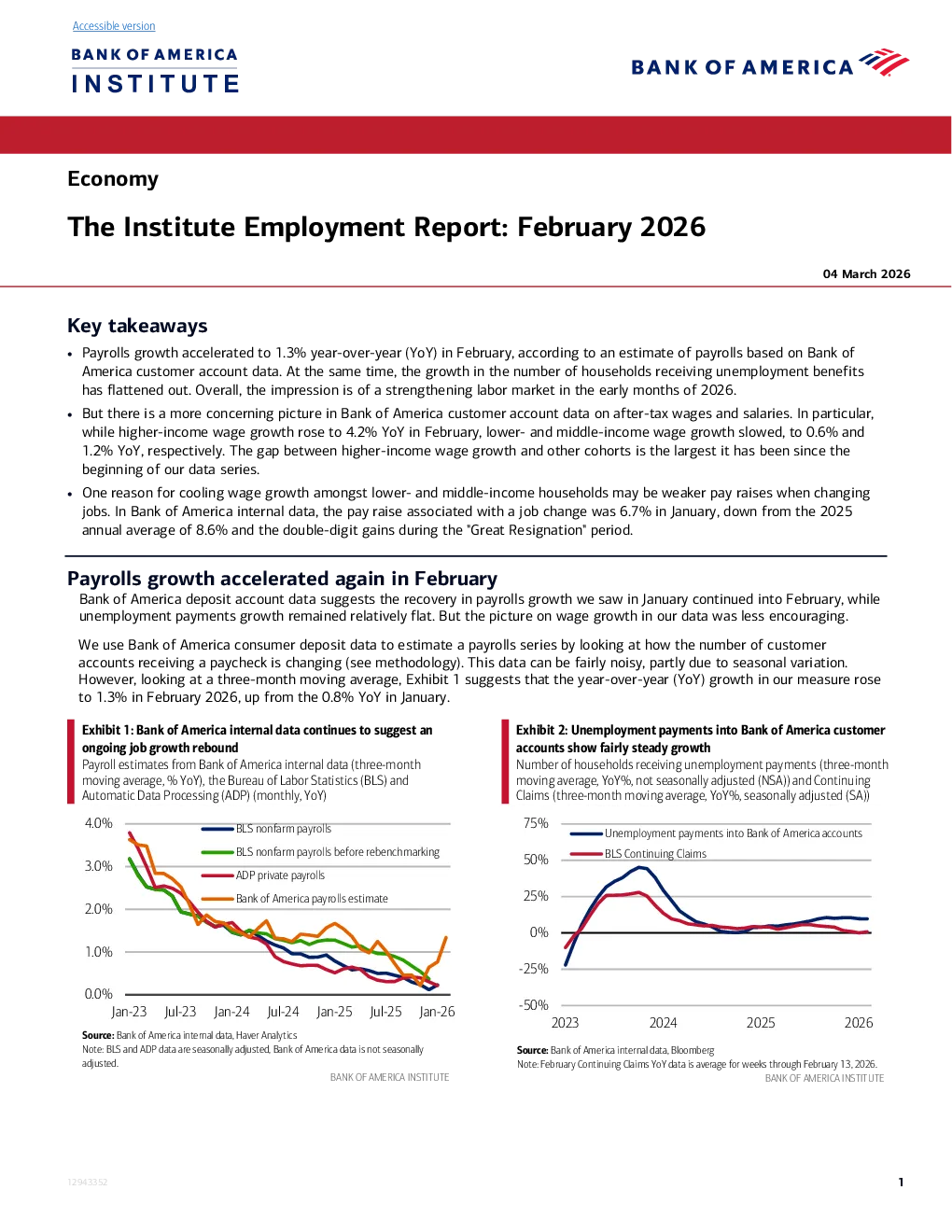
The Institute Employment Report: February 2026 04 March 2026 Key takeaways •Payrolls growth accelerated to 1.3% year-over-year (YoY) in February, according to an estimate of payrolls based on Bank ofAmerica customer account data. At the same time, the growth in the number of households receiving unemployment benefitshas flattened out. Overall, the impression is of a strengthening labor market in the early months of 2026. •But there is a more concerning picture in Bank of America customer account data on after-tax wages and salaries. In particular,while higher-income wage growth rose to 4.2% YoY in February, lower- and middle-income wage growth slowed, to 0.6% and1.2% YoY, respectively. The gap between higher-income wage growth and other cohorts is the largest it has been since thebeginning of our data series. •One reason for cooling wage growth amongst lower- and middle-income households may be weaker pay raises when changingjobs. In Bank of America internal data, the pay raise associated with a job change was 6.7% in January, down from the 2025annual average of 8.6% and the double-digit gains during the "Great Resignation" period. Payrolls growth accelerated again in FebruaryBank of America deposit account data suggests the recovery in payrolls growth we saw in January continued into February, while unemployment payments growth remained relatively flat. But the picture on wage growth in our data was less encouraging. We use Bank of America consumer deposit data to estimate a payrolls series by looking at how the number of customeraccounts receiving a paycheck is changing (see methodology). This data can be fairly noisy, partly due to seasonal variation.However, looking at a three-month moving average,Exhibit 1suggests that the year-over-year (YoY) growth in our measure roseto 1.3% in February 2026, up from the 0.8% YoY in January. Exhibit1:Bank of America internal datacontinues tosuggestanongoing job growth reboundPayroll estimates from Bank of America internal data (three-month Exhibit2: Unemployment payments into Bank of Americacustomeraccounts show fairly steady growthNumber of households receiving unemployment payments (three-month moving average, YoY%, not seasonally adjusted (NSA)) and ContinuingClaims (three-month moving average, YoY%, seasonally adjusted (SA)) moving average, % YoY), the Bureau of Labor Statistics (BLS) andAutomatic Data Processing (ADP) (monthly, YoY) The latest Bureau of Labor Statistics’(BLS) payroll estimate was revised lower following the benchmark revision process. Thisdownward adjustment means BLS payrolls growth is now estimated to be lower in 2024/25 than previously estimated, implyingour estimate of payrolls growth appears stronger than the official data over the period. Nonetheless, in our view, the positivegrowth in our estimate is a useful directional signal, indicating that the official data may have upside growth potential in comingreleases. Bank of America data on unemployment payments into customer accounts is broadly consistent with an improvement in thelabor market.Exhibit 2shows the growth in unemployment payments into Bank of America customer accounts has leveled-off atjust below 10% YoY. But the slowdown in middle-income households’ wage growth has quickenedWhile the picture on stronger payrolls growth is“good news,”there is a concerning picture coming from Bank of America deposit data on households’after-tax wage and salary growth. One concern is that the gap between higher- and lower-income households’after-tax wage growth is wide. In fact, in theFebruary data, higher-income after-tax wage growth accelerated to 4.2% YoY, while lower-income after-tax wage growthdropped back to 0.6% YoY. This means the gap between higher- and lower-income households wage growth was 3.6 percentagepoints (pp)–the highest of any point in our data, which begins in 2015. As we discussed inlast month’s Employment Report, signs that middle-income households’after-tax wage growth was softeningwere also a concern. And in the February data we have seen this trend accelerate. Middle-income after-tax wage growth fell to1.2% YoY in February, making the gap with higher-income wage growth also the widest it has been over the length of our series. What’s driving softer after-tax wage growth for lower- and middle-income households in our data? In part, it appears to besmaller raises for those changing jobs. In Bank of America deposit data, the pay raise associated with a job change was 6.7% inJanuary, down from the 2025 annual average of 8.6% and the double-digit gains during the“Great Resignation”period in 2021-22 (Exhibit 4). It could be that these softer gains from switching jobs are landing hardest on lower‑and middle-income households, given thesegroups often achieve wage progression through job moves. We also discuss job-to-job pay raises and the differences betweenmen and women in our publication:Where are women positioned in a "K-shaped” economy?. While the short-r