您的浏览器禁用了JavaScript(一种计算机语言,用以实现您与网页的交互),请解除该禁用,或者联系我们。 [美国银行]:消费者检查点:四月阵雨 - 发现报告

消费者检查点:四月阵雨

商贸零售 2026-05-01 美国银行 一抹朝阳
报告封面

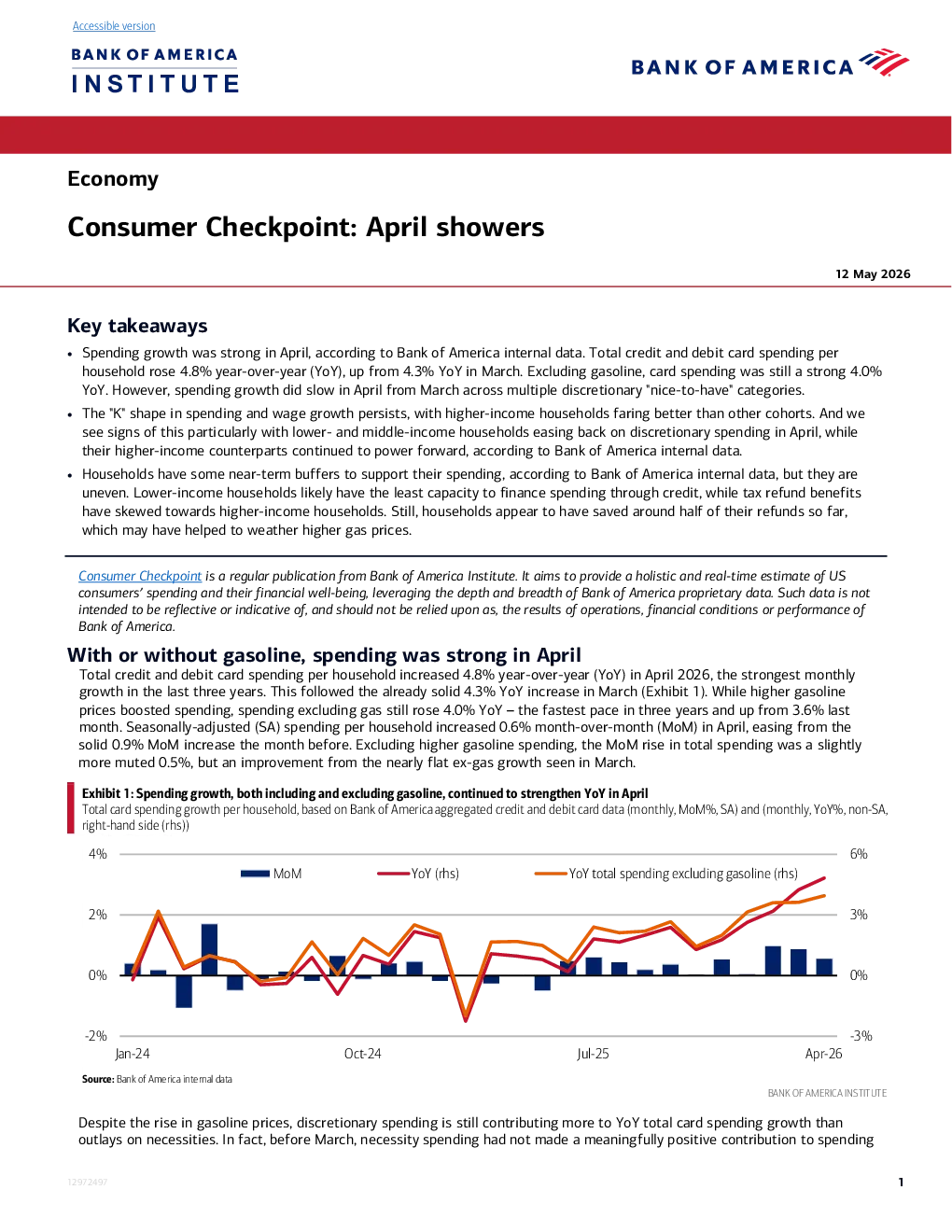
Consumer Checkpoint: April showers Key takeaways •Spending growth was strong in April, according to Bank of America internal data. Total credit and debit card spending perhousehold rose 4.8% year-over-year (YoY), up from 4.3% YoY in March. Excluding gasoline, card spending was still a strong 4.0% The "K" shape in spending and wage growth persists, with higher-income households faring better than other cohorts. And wesee signs of this particularly with lower- and middle-income households easing back on discretionary spending in April, while Households have some near-term buffers to support their spending, according to Bank of America internal data, but they areuneven. Lower-income households likely have the least capacity to finance spending through credit, while tax refund benefits Consumer Checkpointis a regular publication from Bank of America Institute. It aims to provide a holistic and real-time estimate of USconsumers’spending and their financial well-being, leveraging the depth and breadth of Bank of America proprietary data. Such data is not With or without gasoline, spending was strong in AprilTotal credit and debit card spending per household increased 4.8% year-over-year (YoY) in April 2026, the strongest monthly growth in the last three years. This followed the already solid 4.3% YoY increase in March (Exhibit 1). While higher gasolineprices boosted spending, spending excluding gas still rose 4.0% YoY–the fastest pace in three years and up from 3.6% lastmonth. Seasonally-adjusted (SA) spending per household increased 0.6% month-over-month (MoM) in April, easing from the Total card spending growth per household, based on Bank of America aggregated credit and debit card data (monthly, MoM%, SA) and (monthly, YoY%, non-SA,right-hand side (rhs)) Despite the rise in gasoline prices, discretionary spending is still contributing more to YoY total card spending growth thanoutlays on necessities. In fact, before March, necessity spending had not made a meaningfully positive contribution to spending growth since August 2024 (Exhibit 2). And while March and April have both seen upward contributions from necessities to overallspending growth, with a 1.1 percentage points (pp) contribution in April, the big picture remains that services and retail Exhibit2:Before March 2026, discretionary spending contributedall of the positive growth in spending since April 2024 Exhibit3:Services accounted for the majority of spending growthover the past two years Contribution to YoY total credit and debit card spending growth bycategory, based on Bank of America card data (monthly, SA, percentagepoints contribution) Contribution to YoY total credit and debit card spending growth bycategory, based on Bank of America card data (monthly, SA, percentagepoints contribution) Within discretionary spending, YoY spending growth on travel and restaurants improved slightly in April, while generalmerchandise and clothing saw slowing momentum relative to March (Exhibit 4). Bank of America internal card data on transactions can give us some idea whether strong spending growth is reflecting risingvolumes or higher prices. General merchandise, travel (airline and lodging), restaurants and clothing have all shown increasing However, in travel and clothing, spending growth has risen noticeably faster than transactions. In our view, this likely reflectsincreased prices in these areas from both the recent oil price shock and earlier tariff hikes. In fact, while the YoY growth intransactions was still positive for travel, it was just above zero for clothing in April. This may reflect not just higher prices butalso a possible shift in consumers purchasing their apparel through different channels, such as big box stores (general Exhibit4:Spending growth slowed for general merchandise andclothing in April, while durables decreased Exhibit5:YoY growth in transactions was positive for generalmerchandise, restaurants and travel Spending per household, based on Bank of America card data, acrossselect categories (monthly, SA, YoY%) The number of transactions per household, based on Bank of Americacard data, across select categories (monthly, SA, YoY%) Looking at the 7-day moving average of total card spending per household through the end of April suggests that spendinggrowth may have eased more significantly towards the end of the month, particularly for discretionary spending. However, the Exhibit6:Spending growthslowedmore at the end of April than it did in March, but it wasin-line with the decrease seen at the end of FebruaryTotal card and discretionary spending per household, based on Bank of America data (7-day moving average, YoY%,non-SA) Lower- and middle-income households eased their discretionary spendingAcross income cohorts, April card spending rose 3.1% YoY for lower-income households and 3.6% YoY for middle-income households, while higher-income households saw stronger growth at 4.9% YoY (Exhibit 7). Despite impro