您的浏览器禁用了JavaScript(一种计算机语言,用以实现您与网页的交互),请解除该禁用,或者联系我们。 [世界银行]:关注增长:让工业工作为女性服务——越南工业园区附近负担得起的优质儿童保育政策建议 - 发现报告

关注增长:让工业工作为女性服务——越南工业园区附近负担得起的优质儿童保育政策建议

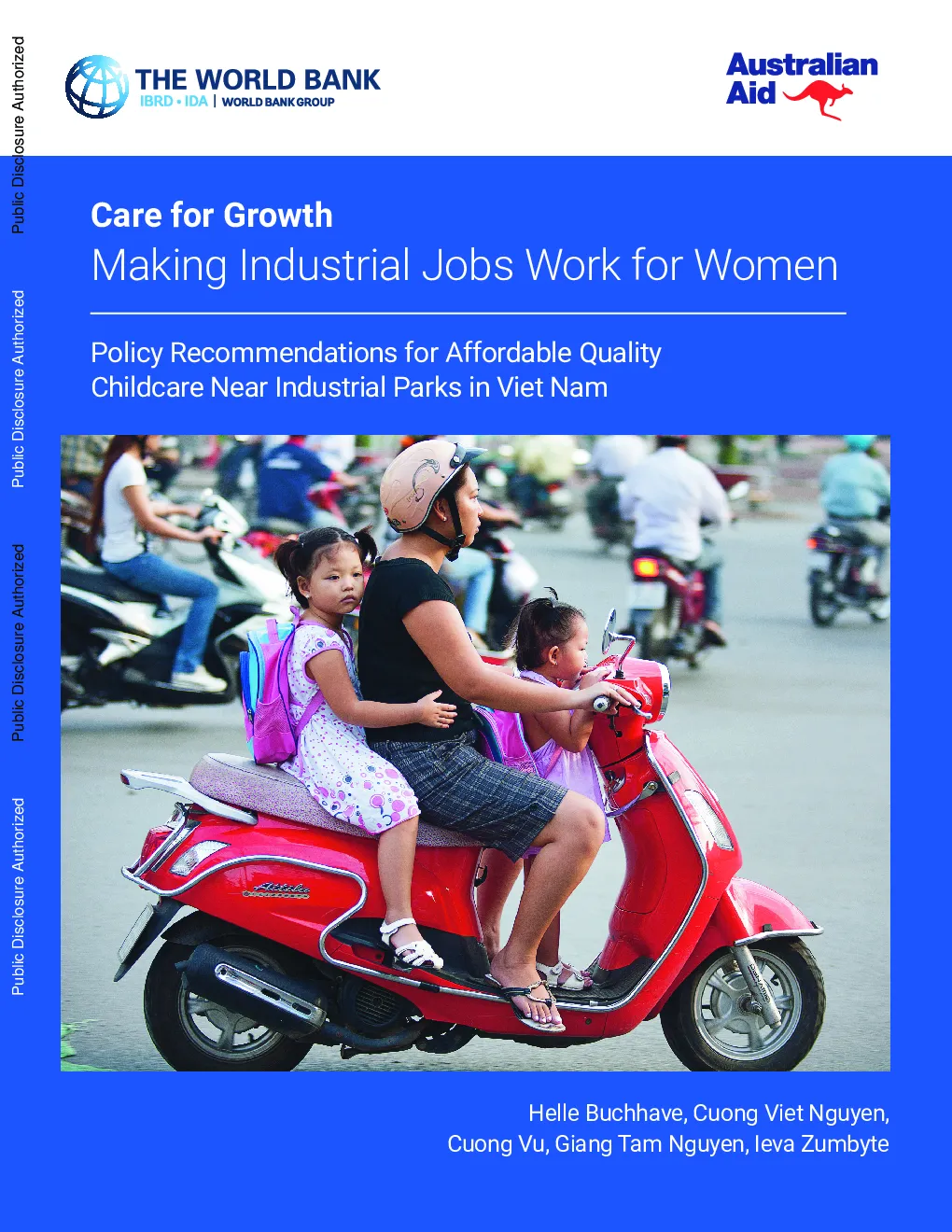
报告封面

Policy Recommendations for Affordable QualityChildcare Near Industrial Parks in Viet Nam Helle Buchhave, Cuong Viet Nguyen,Cuong Vu, Giang Tam Nguyen, Ieva Zumbyte Care for GrowthMaking Industrial Jobs Work for Women Policy Recommendations for Affordable QualityChildcare Near Industrial Parks in Viet Nam © 2026 The World Bank1818 H Street NW, Washington DC 20433Telephone: 202-473-1000; Internet: www.worldbank.org Some rights reserved. This work is a product of The World Bank. The findings, interpretations, and conclusions expressed in thiswork do not necessarily reflect the views of the Executive Directors of The World Bank or the governmentsthey represent. The World Bank does not guarantee the accuracy, completeness, or currency of the data included in thiswork and does not assume responsibility for any errors, omissions, or discrepancies in the information, orliability with respect to the use of or failure to use the information, methods, processes, or conclusions setforth. The boundaries, colors, denominations, links/footnotes and other information shown in this work donot imply any judgment on the part of The World Bank concerning the legal status of any territory or theendorsement or acceptance of such boundaries. The citation of works authored by others does not meanThe World Bank endorses the views expressed by those authors or the content of their works. Nothing herein shall constitute or be construed or considered to be a limitation upon or waiver of theprivileges and immunities of The World Bank, all of which are specifically reserved. Rights and Permissions The material in this work is subject to copyright. Because The World Bank encourages dissemination of itsknowledge, this work may be reproduced, in whole or in part, for noncommercial purposes as long as fullattribution to this work is given. Attribution—Please cite the work as follows: Buchhave, Helle; Nguyen, Viet Cuong; Vu, Cuong;Nguyen, Tam Giang, Zumbyte, Ieva (2026): Care for Growth - Making Industrial Jobs Work for Women.Policy Recommendations for Affordable Quality Childcare Near Industrial Parks in Viet Nam.World Bank.Washington DC. © World Bank. Any queries on rights and licenses, including subsidiary rights, should be addressed to World BankPublications, The World Bank, 1818 H Street NW, Washington, DC 20433, USA; fax: 202-522-2625;e-mail: pubrights@worldbank.org. Abbreviations Acknowledgments Executive Summary 1Introduction 1.1Women’s Work and Viet Nam’s Growth Model21.2High Participation, Low Quality: The Gendered Structure of Work21.3Demographic Change and the Rising Cost of Inaction31.4Childcare as Economic Infrastructure31.5Objectives and Contribution of this Report4 2Methodology 5 2.1Insights from Households, Care Providers, and Policymakers7 3Childcare and Women’s Work 9 3.1Women at the Core of the Low-Skilled Manufacturing Workforce103.2The Hidden Cost of Motherhood133.3How Childcare Unlocks More and Better Jobs for Women163.4Investing in Childcare Pays Off for Firms, Families, and the Economy17 4Early Childhood Education and Care in Viet Nam: An Overview ofProvision and Coverage 21 4.1Mapping the Options Available for ECEC outside the Home214.2Enrollment Rates224.3Family Care Arrangements264.4ECEC Demand Near Industrial Parks28 5Demand-side Constraints: Challenges Preventing Families fromAccessing Childcare29 5.1There is a Lack of Affordable Services305.2Parents have Concerns about Quality315.3There is a Shortage of Spots for Toddlers345.4There is a Lack of Compatibility between IP Working Hours and Public Childcare Hours 385.5Household Registration is Negatively Impacting Migrants405.6Subsidies Will Not Benefit All Those Who Need Them the Most41 6Supply-side Constraints: Challenges Facing Childcare Providers43 6.1Budget Constraints and a Lack of Prioritization Are Affecting the Public Sector446.2Private Sector Incentives Are Limited in Relation to Tax and Land Use446.3Facilitation of Public-Private Partnerships is Ineffective466.4Current Subsidies Fall Short of What Is Needed to Expand Non-Public Childcare Supply476.5Regulatory Gaps and Disparities in Childcare Quality Exist48 7Policy Recommendations55 7.1Pillar One: Expanding Affordable and Equitably Supply577.2Pillar Two: Strengthening Quality, Workforce Professionalism, and System Stewardship 617.3Pillar Three: Aligning the Labor Market with Family Policies647.4From Access Gap to Systemic Fix: A Roadmap for Action65 References 67 Annexes77 Annex 1. Matrix of Policy Options77Annex 2. Maps79Annex 3. Comparing Household Survey and LFS Survey (2021) Means forKey Demographic Characteristics84Annex 4. Regressions on Women’s Employment and Childcare Choices86Annex 5. Simulation of Cost and Benefit of Childcare95Annex 6. Correlation Between Different Demographic Groups99Annex 7. Different Types of Childcare Providers and Regulatory Differences99Annex 8. Construction of Structural Quality Index101 Box Figures Figure B1.1Provincial distrib