您的浏览器禁用了JavaScript(一种计算机语言,用以实现您与网页的交互),请解除该禁用,或者联系我们。 [世界银行]:新物流绩效指标2.0(LPI 2.0):方法论和用户指南 - 发现报告

新物流绩效指标2.0(LPI 2.0):方法论和用户指南

交通运输 2026-04-30 世界银行 Z.zy
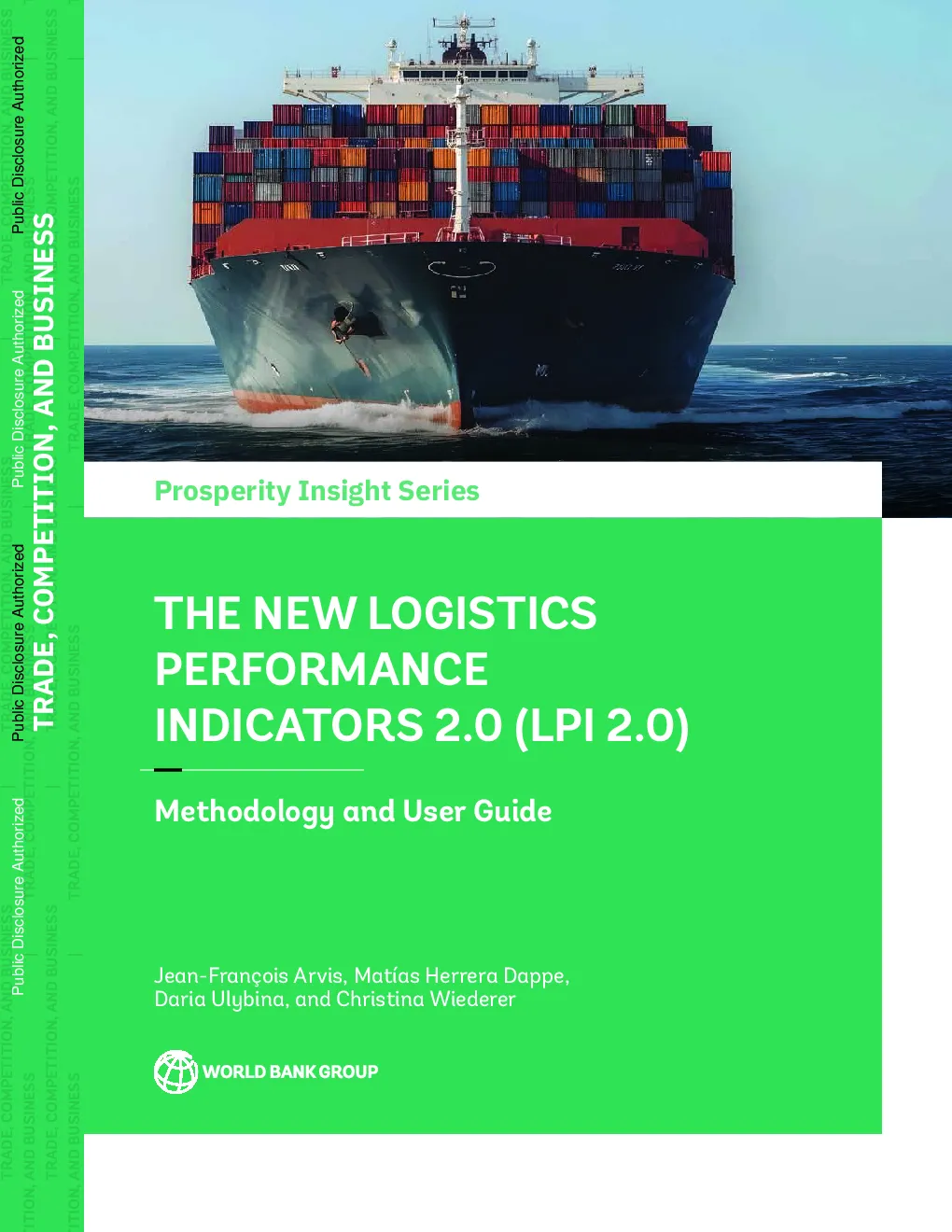
报告封面

THE NEW LOGISTICSPERFORMANCEINDICATORS 2.0 (LPI 2.0)TRADE, COMPETITION, AND BUSINESSTRADE, COMPETITION, AND BUSINESSTRADE, COMPETITION, AND BUSINESSPublic Disclosure Authorized Methodology and User Guide Jean-François Arvis, Matías Herrera Dappe,Daria Ulybina, and Christina WiedererPublic Disclosure Authorized TRADE, COMPETITION, AND BUSINESSTHE NEW LOGISTICSPERFORMANCEINDICATORS 2.0 (LPI 2.0) Methodology and User Guide Jean-François Arvis, Matías Herrera Dappe,Daria Ulybina, and Christina Wiederer © 2026 The World Bank1818 H Street NW, Washington DC 20433Telephone: 202-473-1000; Internet:www.worldbank.org Some rights reserved This work is a product of The World Bank. The findings, interpretations, and conclusions expressed inthis work do not necessarily reflect the views of the Executive Directors of The World Bank or the gov-ernments they represent. The World Bank does not guarantee the accuracy, completeness, or currency of the data included in thiswork and does not assume responsibility for any errors, omissions, or discrepancies in the information,or liability with respect to the use of or failure to use the information, methods, processes, or conclusionsset forth. The boundaries, colors, denominations, links/footnotes and other information shown in thiswork do not imply any judgment on the part of The World Bank concerning the legal status of any territoryor the endorsement or acceptance of such boundaries. The citation of works authored by others doesnot mean the World Bank endorses the views expressed by those authors or the content of their works. Nothing herein shall constitute or be construed or considered to be a limitation upon or waiver of theprivileges and immunities of The World Bank, all of which are specifically reserved. Rights and Permissions The material in this work is subject to copyright. Because The World Bank encourages dissemination ofits knowledge, this work may be reproduced, in whole or in part, for noncommercial purposes as long asfull attribution to this work is given. Attribution—Please cite the work as follows: Arvis, Jean-François, Matías Herrera Dappe, Daria Ulybina,and Christina Wiederer. 2026. The New Logistics Performance Indicators 2.0 (LPI 2.0): Methodology andUser Guide. © World Bank.” Any queries on rights and licenses, including subsidiary rights, should be addressed to World Bank Pub-lications, The World Bank, 1818 H Street NW, Washington, DC 20433, USA; fax: 202-522-2625; e-mail:pubrights@worldbank.org. Photos: Cover, Aung Thu Yein Tun/Vecteezy.com; page vi, Roman Bulatov/Vecteezy.com; page 3, Muham-mad Nur/Vecteezy.com; page 11, Siraphol Siricharattakul/Vecteezy.com; page 14, Woranuch Athiwata-kara/Vecteezy.com; page 20, Serhiy Kuzmin/Vecteezy.com. Further permission required for reuse.Cover design: World Bank. A reproducibility package is available for thisbook in the Reproducible Research Repository athttps://reproducibility.worldbank.org/catalog/514 Contents AcknowledgementsvAbbreviationsviAbstractviiExecutive summary1Conceptual framework of the Logistics PerformanceIndicators 2.03The new indicators4Data source11Maritime12Aviation13Postal13Methodology14MDS Transmodal14MarineTraffic15Major global shipping line16Cargo iQ18Universal Postal Union18User guide20Interpretation and use of the LPI 2.020 How to use the LPI 2.0 to benchmark country performance21Potential interpretation issues with tracking indicators21Local data to complement country-level indicators22 References 23 Figures 1Supply chain phases in a maritime container voyage52Milestones in the air cargo supply chain63The sequence of standardized postal events74The relationship between turnaround time and import dwell time95Slicing a container voyage into dwell time and lead timeobservations96Elements of ship turnaround time167Egypt’s connectivity compares favorably with that of itsregional and income group peers218Time indicators reveal some weaknesses in Egypt relative toregional and income group peers21 Tables 1The six core indicators of the LPI 2.052Supplementary indicators of the LPI 2.083Data sources, coverage, and nature of the LPI 2.012 Acknowledgements This report was prepared by the World Bank’s Trade Policy and Facilitation Unit inthe Trade, Competition, and Business Department, under the guidance of MonaHaddad (former Global Director), Denis Medvedev (Global Director), Aart Kraay(Chief Economist), and Sébastien Dessus (Practice Manager). The project leaderswere Christina Wiederer and Jean-François Arvis. Daria Ulybina was instrumen-tal in analyzing the data and authoring the report. Matías Herrera Dappe joinedas coauthor during the finalizing stage. The Logistics Performance Indicators 2.0 (LPI 2.0) benefited from funding fromthe Umbrella Facility for Trade 2.0, a World Bank–administered multidonor trustfund that supports the World Bank’s work on trade through funding that, amongothers, expands testing, experimenting, research, and sharing of new ideas ontrade— an