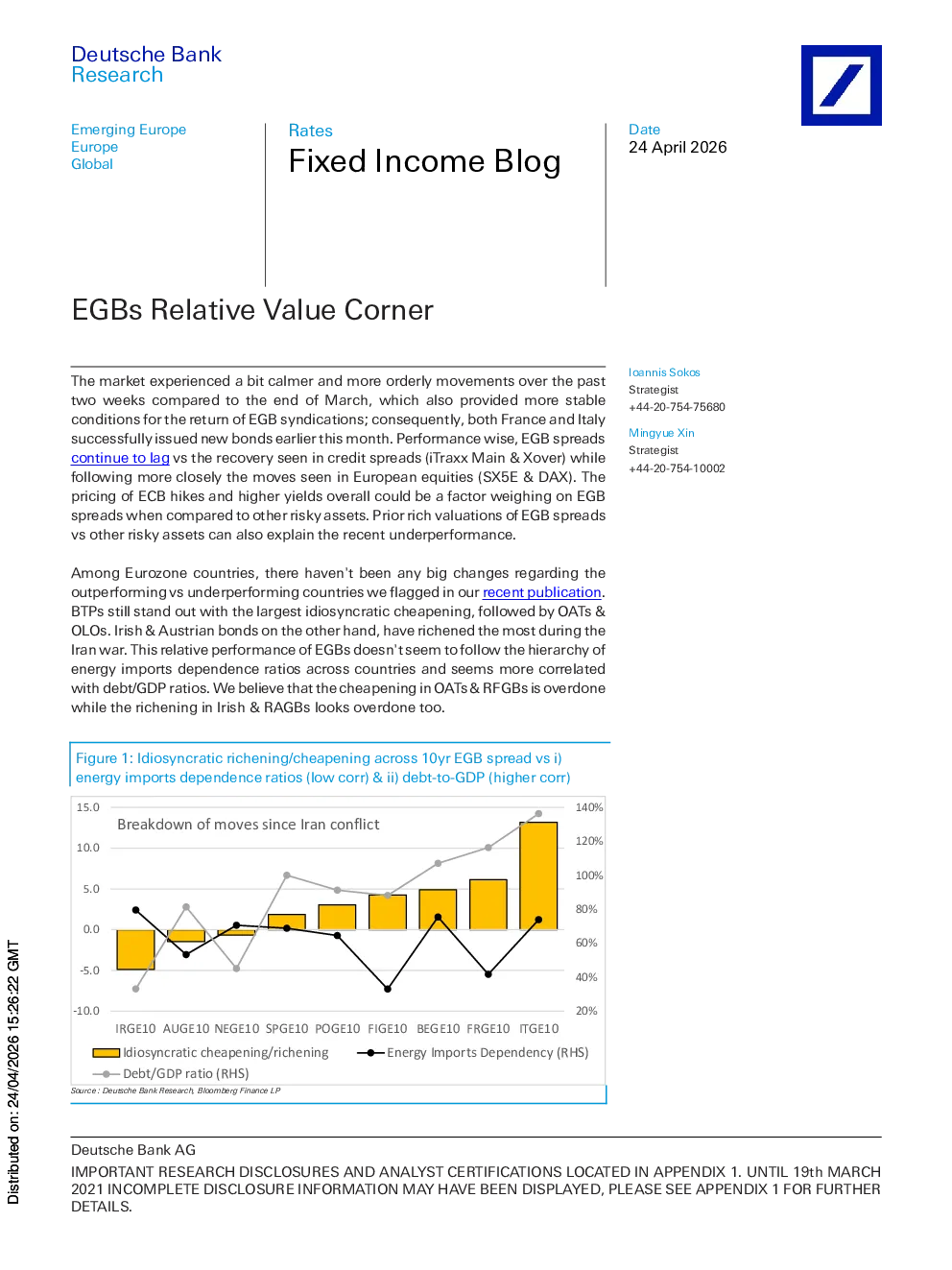
EGBs Relative Value Corner Ioannis SokosStrategist+44-20-754-75680 The market experienced a bit calmer and more orderly movements over the pasttwo weeks compared to the end of March, which also provided more stableconditions for the return of EGB syndications; consequently, both France and Italysuccessfully issued new bonds earlier this month. Performance wise, EGB spreadscontinue to lag vs the recovery seen in credit spreads (iTraxx Main & Xover) whilefollowing more closely the moves seen in European equities (SX5E & DAX). Thepricing of ECB hikes and higher yields overall could be a factor weighing on EGBspreads when compared to other risky assets. Prior rich valuations of EGB spreadsvs other risky assets can also explain the recent underperformance. Mingyue XinStrategist+44-20-754-10002 Among Eurozone countries, there haven't been any big changes regarding theoutperforming vs underperforming countries we flagged in our recent publication.BTPs still stand out with the largest idiosyncratic cheapening, followed by OATs &OLOs. Irish & Austrian bonds on the other hand, have richened the most during theIran war. This relative performance of EGBs doesn't seem to follow the hierarchy ofenergy imports dependence ratios across countries and seems more correlatedwith debt/GDP ratios. We believe that the cheapening in OATs & RFGBs is overdonewhile the richening in Irish & RAGBs looks overdone too. 24 April 2026Fixed Income Blog EGBs Recent Moves Source: Deutsche Bank, Bloomberg Finance LP Source: Deutsche Bank, Bloomberg Finance LP Note: We're using the ISINs of the on-the-run 10yr bonds at the 1stday of the year.This means that the roll-down on the curve is part of the YTD yield change. 10y EGB spreads vs Bund - Rich/Cheap country analysisrelative to the past 1y beta to all other EGB spreads Framework:We are using the past 1-year sample to estimate the beta of eachcountry's spread (to Bund) vs the average spread of all other countries (on levels).Hence, the cumulative residual of each country's spread is zero over that 1-yearsample. Intuitively, current residuals show whether a country spread is trading richor cheap today vs its past 1-year relationship to all other EGB spreads. We also showthe change in these residuals over the past 5/10/20 days to identify which spreadshave been richening/cheapening lately. By construction, if there is a structuralrepricing of a country's spread (for example due to political uncertainty), thiscountry's spread would appear cheap while other countries' spreads would richen. Comment:Recent exogenous shocks continued to affect EGB spreads over thepast two weeks. However, the cumulative effects were minimal for most countries'spreads compared to their past one-year beta, which now excludes last year'svolatile Liberation Day market movements. Ireland and Austria were clear outliers:Ireland's residuals cheapened the most, while Austria's richened. Nevertheless,both still appear rich when assessed via current residuals, and BTPs remain thecheapest after beta adjustment. 24 April 2026Fixed Income Blog EGB spreads (GDPW/avg) vs Credit spreads (iTraxx Main) Framework: In this section, we are assessing EGB spreads (10yr GDP-weightedEGB yield vs Bund, as well as average EGB spreads vs Bund) versus iTraxx Main(using an interpolated constant maturity time series to solve for the rolls). We arebasing this on a rolling 6m window regression (hence, the cumulative residuals isnot zero). The rolling 6m window R-squared of these regressions is also shown inorder to assess the strength of the residuals' signal. We are also showing the samefor ITA/SPA/POR and FRA/BEL/AUS/FIN/IRE, ie., average peripheral versus semi-core spreads. Figure 23: Rolling 6m Rsq. - explanatory power - AvgPeriph & Semi-core vs iTraxx Main Figure 22: Residuals of a 6m rolling regression - AvgPeriph & Semi-core vs iTraxx Main Comment:Unlike their typical resilience during prior risk-off episodes (e.g., AIconcerns), EGB spreads have now erased their outperformance versus iTraxxamidst the recent energy shock, attributable to EGBs' greater exposure to suchshocks. However, caution is warranted when interpreting residual evolution, giventhe highly unstable correlation. The widening gap in correlation between peripheryand core/semi-core countries reflects the increasing credit-like reaction propertiesof peripheral spreads during stress periods. 24 April 2026Fixed Income Blog PCA risky assets: EGB spreads, DAX, SX5E, Main & Xover Framework: In this section, we apply a PCA on 10yr average EGB spreads vs Bundalong with SX5E & DAX equity indices, iTraxx Main & Crossover credit spreads. Weuse a 1-year sample for this analysis. We isolate the 1stprincipal component whichexplains the bulk of cross-variation among these risky assets. We present theresiduals for 10yr average EGB spreads, as well as the rolling 3m explanatory powerof PC1 and the time series of PC1 itself. Comment:It is notable that the variance explained by