您的浏览器禁用了JavaScript(一种计算机语言,用以实现您与网页的交互),请解除该禁用,或者联系我们。 [德意志银行]:EGBs相对价值观察 - 发现报告

EGBs相对价值观察

2026-02-20 - 德意志银行 SaintL
报告封面

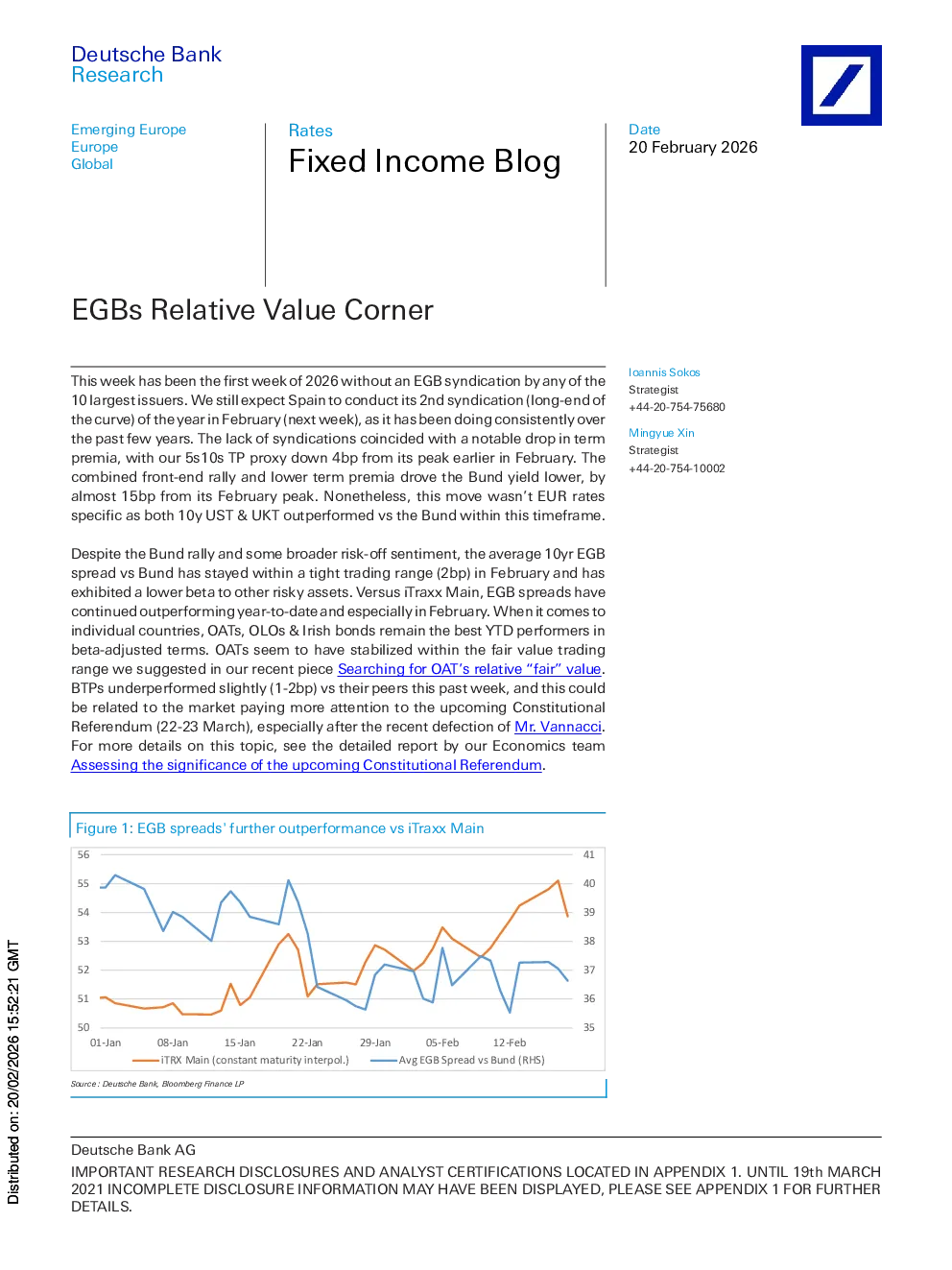
20 February 2026Date Fixed Income Blog EGBs Relative Value Corner Ioannis SokosStrategist+44-20-754-75680Mingyue XinStrategist This week has been the first week of 2026 without an EGB syndication by any of the10 largest issuers. We still expect Spain to conduct its 2nd syndication (long-end ofthe curve) of the year in February (next week), as it has been doing consistently overthe past few years. The lack of syndications coincided with a notable drop in termpremia, with our 5s10s TP proxy down 4bp from its peak earlier in February. The Despite the Bund rally and some broader risk-off sentiment, the average 10yr EGBspread vs Bund has stayed within a tight trading range (2bp) in February and hasexhibited a lower beta to other risky assets. Versus iTraxx Main, EGB spreads havecontinued outperforming year-to-date and especially in February. When it comes toindividual countries, OATs, OLOs & Irish bonds remain the best YTD performers inbeta-adjusted terms. OATs seem to have stabilized within the fair value tradingrange we suggested in our recent piece Searching for OAT’s relative “fair” value. BTPs underperformed slightly (1-2bp) vs their peers this past week, and this could EGBs Recent Moves Source: Deutsche Bank, Bloomberg Finance LP Source: Deutsche Bank, Bloomberg Finance LP Source : Deutsche Bank, Bloomberg Finance LP Source : Deutsche Bank, Bloomberg Finance LP Note: We're using the ISINs of the on-the-run 10yr bonds at the 1stday of the year.This means that the roll-down on the curve is part of the YTD yield change. 10y EGB spreads vs Bund - Rich/Cheap country analysisrelative to the past 1y beta to all other EGB spreads Framework:We are using the past 1-year sample to estimate the beta of eachcountry's spread (to Bund) vs the average spread of all other countries (on levels).Hence, the cumulative residual of each country's spread is zero over that 1-yearsample. Intuitively, current residuals show whether a country spread is trading richor cheap today vs its past 1-year relationship to all other EGB spreads. We also showthe change in these residuals over the past 5/10/20 days to identify which spreads Comment:Since this is a relative value framework across EGBs, mean reversionproperties require the absence of idiosyncratic drivers and a ceteris paribusassumption on macro. This hasn't been the case over the past couple of yearsthough, with France (and Belgium to a smaller extent) cheapening idiosyncraticallyand Italy erasing its prior cheapness. Hence, this framework is mostly used for Source : Deutsche Bank, Bloomberg Finance LP Source : Deutsche Bank, Bloomberg Finance LP Source : Deutsche Bank, Bloomberg Finance LP Source :Deutsche Bank, Bloomberg Finance LP Source : Deutsche Bank, Bloomberg Finance LP Source : Deutsche Bank, Bloomberg Finance LP Source : Deutsche Bank, Bloomberg Finance LP Source : Deutsche Bank, Bloomberg Finance LP EGB spreads (GDPW/avg) vs Credit spreads (iTraxx Main) Framework: In this section, we are assessing EGB spreads (10yr GDP-weightedEGB yield vs Bund, as well as average EGB spreads vs Bund) versus iTraxx Main(using an interpolated constant maturity time series to solve for the rolls). We arebasing this on a rolling 6m window regression (hence, the cumulative residuals isnot zero). The rolling 6m window R-squared of these regressions is also shown in Source : Deutsche Bank, Bloomberg Finance LP Source : Deutsche Bank, Bloomberg Finance LP Comment:As we've explained in many recent publications, the correlationbetween EGB spreads & iTraxx Main has weakened lately. This is due to manyfactors such as, the idiosyncratic moves in France which has a large weight in theGDP-weighted EGB spreads, the idiosyncratic cheapening of the Bund which PCA risky assets: EGB spreads, DAX, SX5E, Main & Xover Framework: In this section, we apply a PCA on 10yr average EGB spreads vs Bundalong with SX5E & DAX equity indices, iTraxx Main & Crossover credit spreads. Weuse a 1-year sample for this analysis. We isolate the 1stprincipal component which explains the bulk of cross-variation among these risky assets. We present theresiduals for 10yr average EGB spreads, as well as the rolling 3m explanatory power Source : Deutsche Bank Source : Deutsche Bank Source : Deutsche Bank Comment:Give that the nature of the recent risk-off is very industry specific, theexplanatory power of PC1 across risky assets has been declining lately, I.e. anindication of idiosyncratic moves. EGB spreads continue outperforming vs broaderrisky assets, and seem to have stabilized around their richest levels outside theLiberation day period. This makes sense given that the source of the latest investors' 10y EGB spreads - Mapping vs credit ratings Framework: We use the average credit rating score (of S&P, Fitch, Moody's andDBRS) as the single explanatory variable for 10yr EGB spreads vs Bund. This leadsto the creation of the credit rating slope, i.e., the amount of extra yield pickup thatcorre