您的浏览器禁用了JavaScript(一种计算机语言,用以实现您与网页的交互),请解除该禁用,或者联系我们。 [PitchBook]:绘制人工智能超级周期 - 发现报告

绘制人工智能超级周期

信息技术 2026-04-24 PitchBook Fanfan(关放)
报告封面

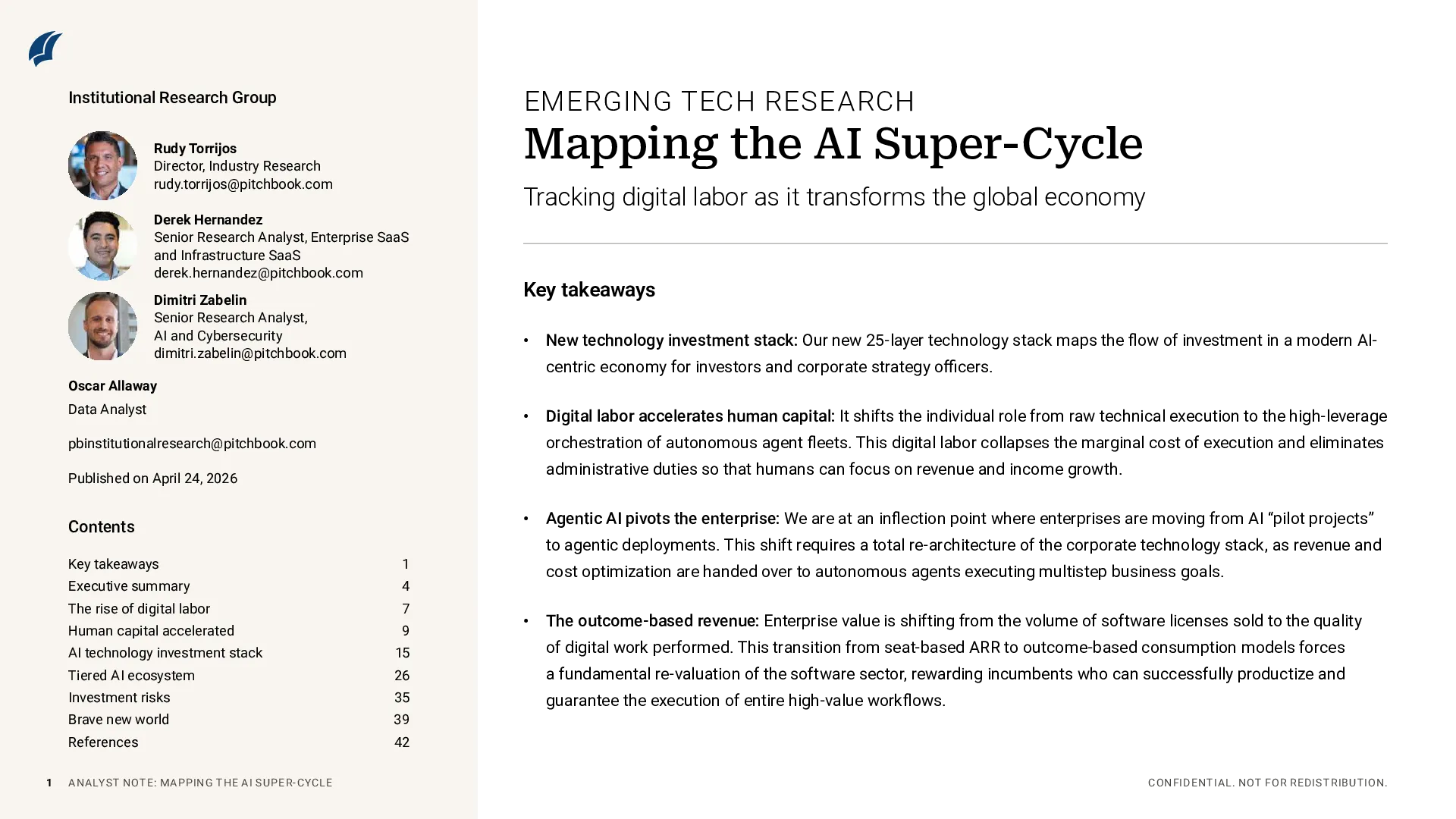
Institutional Research Group Mapping the AI Super-Cycle Rudy TorrijosDirector, Industry Researchrudy.torrijos@pitchbook.com Tracking digital labor as it transforms the global economy Derek Hernandez Senior Research Analyst, Enterprise SaaSand Infrastructure SaaSderek.hernandez@pitchbook.com Key takeaways Dimitri ZabelinSenior Research Analyst,AI and Cybersecuritydimitri.zabelin@pitchbook.com •New technology investment stack:Our new 25-layer technology stack maps the flow of investment in a modern AI-centric economy for investors and corporate strategy officers. Oscar Allaway Data Analystpbinstitutionalresearch@pitchbook.comPublished on April 24, 2026 •Digital labor accelerates human capital:It shifts the individual role from raw technical execution to the high-leverageorchestration of autonomous agent fleets. This digital labor collapses the marginal cost of execution and eliminatesadministrative duties so that humans can focus on revenue and income growth. •Agentic AI pivots the enterprise:We are at an inflection point where enterprises are moving from AI “pilot projects”to agentic deployments. This shift requires a total re-architecture of the corporate technology stack, as revenue andcost optimization are handed over to autonomous agents executing multistep business goals. Contents Key takeaways1Executive summary4The rise of digital labor7Human capital accelerated9AI technology investment stack15Tiered AI ecosystem26Investment risks35Brave new world39References42 •The outcome-based revenue:Enterprise value is shifting from the volume of software licenses sold to the qualityof digital work performed. This transition from seat-based ARR to outcome-based consumption models forcesa fundamental re-valuation of the software sector, rewarding incumbents who can successfully productize andguarantee the execution of entire high-value workflows. •Edge AI and distributed intelligence:True industrial-grade physical AI cannot occur until expert-level intelligence isfully distributed across the lower tiers of the stack, enabling ultra-low-latency autonomous machines. •The human premium:As expert-level technical execution becomes instantaneous and commoditized, innatehuman traits—creativity, empathy, flexibility, and trust building—become the only remaining variables for marketdifferentiation. The ultimate killer app of the AI era is the human capable of building customer trust and identifyingnovel growth opportunities. •The rise of individuals as platforms:We are entering an era where a single human professional scales their impactexponentially by orchestrating fleets of agents. In this paradigm, market value is determined by an individual’sorchestration capacity rather than their personal execution speed. This individual-as-a-platform model is aprerequisite to the WaaS economy. •WaaS as the new atomic unit:By 2030, the fundamental unit of economic production will shift from “billable hours”to guaranteed outcomes secured by SLAs. This transforms industries into proactive, recurring revenue engines,enabling higher-margin business models for professional and trade services and higher wages for AI-acceleratedemployees. •Structural inversion of defensibility:Durable technology moats are aggressively bifurcating to the extremes ofthe architecture. True defensibility now resides either in the physical computing tiers (owning gigawatt-scalefactories, thermal IP, and leading-edge silicon) or the proprietary intelligence tiers (owning customer context andbusiness logic). •Sovereign capital as a durable demand layer:AI infrastructure is no longer purely market-driven; it is increasinglyunderwritten by long-duration state investment. Governments are active buyers and financiers, treating thetechnology stack as a national security priority and a prerequisite for technological self-sufficiency. •The geopolitical decoupling of the stack:The AI ecosystem is splitting into geopolitically aligned stacks, anchoredby a dominant US-centric architecture and a rapidly developing Chinese alternative. In this scenario, capital flowsare determined by political alignments and incentives rather than by market forces. Likewise, supply chains areexpanded based on geographical logistics of two unaligned groups rather than optimal service continuity andredundancy for the entire system. •The foundation of the next super-cycle:Over the next decade, market leadership will belong to companies focusedon platforms that enable comprehensive SaS digital labor and empower human orchestration. To capture thisgrowth, investors and strategy officers must actively pursue investments across all levels of the stack that balancehuman-to-human trust building with guaranteed repeatable outcomes. Companies led by management that do notsee a future WaaS economy face certain replacement by those that do. Executivesummary In this note, we launch a new 25-layer technology stack that maps the flow of investment in a modern AI-centriceconomy. We se