您的浏览器禁用了JavaScript(一种计算机语言,用以实现您与网页的交互),请解除该禁用,或者联系我们。 [ITIF]:解释美国汽车工业的相对竞争力下降 - 发现报告

解释美国汽车工业的相对竞争力下降

交运设备 2026-04-20 ITIF 晓燚
报告封面

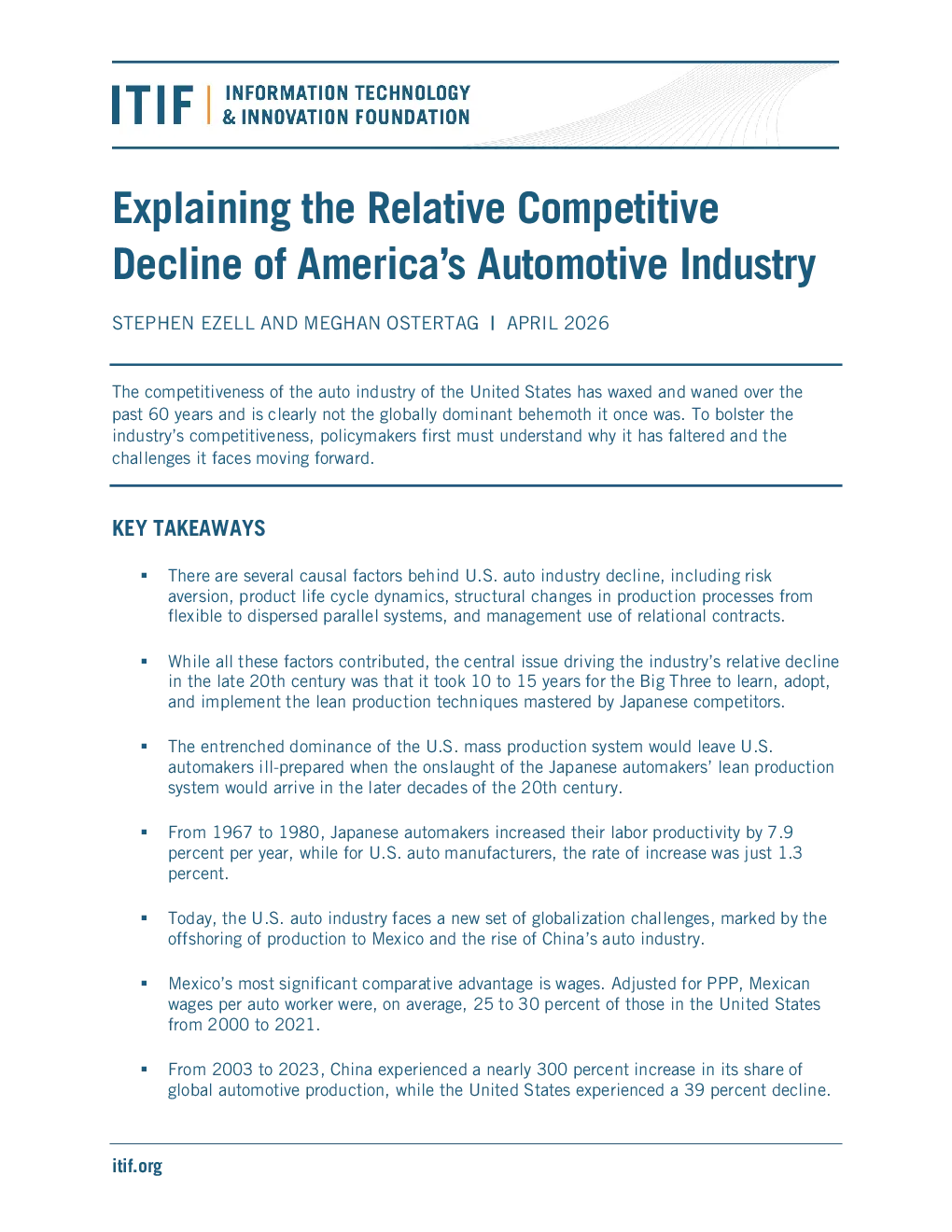
STEPHEN EZELL AND MEGHAN OSTERTAG|APRIL 2026 The competitiveness of the auto industry of the United States has waxed and waned over thepast 60 years and is clearly not the globally dominant behemoth it once was. To bolster theindustry’s competitiveness, policymakers first must understand why it has faltered and thechallenges it faces moving forward. KEY TAKEAWAYS There are several causal factors behind U.S. auto industry decline, including riskaversion, product life cycle dynamics, structural changes in production processes fromflexible to dispersed parallel systems, and management use of relational contracts. While all these factors contributed, the central issue driving the industry’s relative declinein the late 20th century was that it took 10 to 15 years for the Big Three to learn, adopt,and implement the lean production techniques mastered by Japanese competitors. The entrenched dominance of the U.S. mass production system would leave U.S.automakers ill-prepared when the onslaught of the Japanese automakers’ lean productionsystem would arrive in the later decades of the 20th century. From 1967 to 1980, Japanese automakers increased their labor productivity by 7.9percent per year, while for U.S. auto manufacturers, the rate of increase was just 1.3percent. Today, the U.S. auto industry faces a new set of globalization challenges, marked by theoffshoring of production to Mexico and the rise of China’s auto industry. Mexico’s most significant comparative advantage is wages. Adjusted for PPP, Mexicanwages per auto worker were, on average, 25 to 30 percent of those in the United Statesfrom 2000 to 2021. From 2003 to 2023, China experienced a nearly 300 percent increase in its share ofglobal automotive production, while the United States experienced a 39 percent decline. itif.org CONTENTS Key Takeaways ................................................................................................................. 1Introduction ..................................................................................................................... 3Recapping Faltering U.S. Auto Industry Competitiveness....................................................... 3Explaining Evolving U.S. Auto Industry Competitiveness: 1960s to 2010................................ 7Overview of Auto Import and Transplant Competition in the Late 20th Century ..................... 7Risk Aversion (and Hubris) as a Result of Oligopolistic Market Dominance ........................... 9Bespoke U.S. Auto Marketplace .................................................................................... 11Product Life Cycle Theory ............................................................................................. 13Flexible vs. Parallel Dispersed Production Systems .......................................................... 14Failing to Timely Respond to Foreign Competition ........................................................... 17The Role of Management Practices and Relational Contracts With Labor and Suppliers ....... 19Employee Relationships ............................................................................................ 21Supplier Relationships .............................................................................................. 22Unable to Scale Learnings Across the Organization....................................................... 23Inferior Vehicle Quality................................................................................................. 24Explaining Evolving U.S. Auto Industry Competitiveness: 2010 to the present ....................... 24The Rise of Mexico ...................................................................................................... 25The Emergence of China as the World’s Largest Auto Producer ......................................... 30Growth of China’s Auto Industry ................................................................................. 30China’s Innovation in Autos/EVs ................................................................................. 32The Current State of the U.S. Auto Industry.................................................................... 36Conclusion ..................................................................................................................... 38Endnotes ....................................................................................................................... 39 INTRODUCTION The competitiveness of the auto industry of the United States (that is, considering allmanufacturers, domestic and foreign alike, producing autos or auto parts in America) has waxedand waned over the past 60 years—and certainly has declined from its zenith in the post-WorldWar II years. This is the second in a series of three reports exploring the evolving globalcompetitiveness of the U.S. automotive industry. The first report examines what happened to thecompetitiveness of the auto industry of the Unit