道明银行美股招股说明书(2026-04-15版)
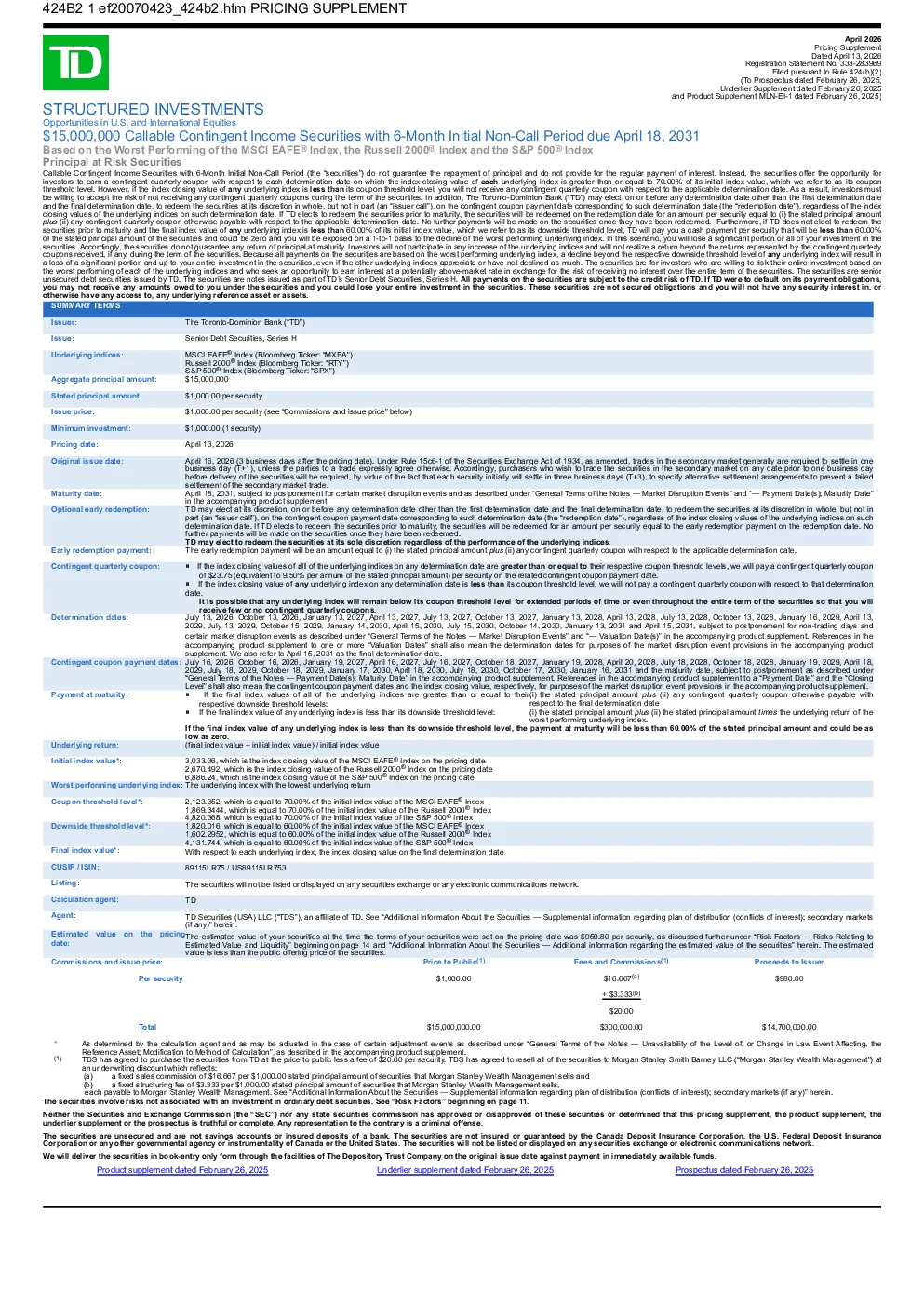
STRUCTURED INVESTMENTS $15,000,000 Callable Contingent Income Securities with 6-Month Initial Non-Call Period due April 18, 2031Based on the Worst Performing of the MSCI EAFE®Index, the Russell 2000®Index and the S&P 500®Index Principal at Risk Securities Callable Contingent Income Securities with 6-Month Initial Non-Call Period (the “securities”) do not guarantee the repayment of principal and do not provide for the regular payment of interest. Instead, the securities offer the opportunity forinvestors to earn a contingent quarterly coupon with respect to each determination date on which the index closing value ofeachunderlying index is greater than or equal to 70.00% of its initial index value, which we refer to as its couponthreshold level. However, if the index closing value ofanyunderlying index isless thanits coupon threshold level, you will not receive any contingent quarterly coupon with respect to the applicable determination date. As a result, investors mustbe willing to accept the risk of not receiving any contingent quarterly coupons during the term of the securities. In addition, The Toronto-Dominion Bank (“TD”) may elect, on or before any determination date other than the first determination dateand the final determination date, to redeem the securities at its discretion in whole, but not in part (an “issuer call”), on the contingent coupon payment date corresponding to such determination date (the “redemption date”), regardless of the indexclosing values of the underlying indices on such determination date. If TD elects to redeem the securities prior to maturity, the securities will be redeemed on the redemption date for an amount per security equal to (i) the stated principal amountplus(ii) any contingent quarterly coupon otherwise payable with respect to the applicable determination date. No further payments will be made on the securities once they have been redeemed.Furthermore, if TD does not elect to redeem thesecurities prior to maturity and the final index value ofanyunderlying index isless than60.00% of its initial index value, which we refer to as its downside threshold level, TD will pay you a cash payment per security that will beless than60.00%of the stated principal amount of the securities and could be zero and you will be exposed on a 1-to-1 basis to the decline of the worst performing underlying index. In this scenario, you will lose a significant portion or all of your investment in thesecurities. Accordingly, the securities do not guarantee any return of principal at maturity. Investors will not participate in any increase of the underlying indices and will not realize a return beyond the returns represented by the contingent quarterlycoupons received, if any, during the term of the securities. Because all payments on the securities are based on the worst performing underlying index, a decline beyond the respective downside threshold level ofanyunderlying index will result ina loss of a significant portion and up to your entire investment in the securities, even if the other underlying indices appreciate or have not declined as much. The securities are for investors who are willing to risk their entire investment based onthe worst performing of each of the underlying indices and who seek an opportunity to earn interest at a potentially above-market rate in exchange for the risk of receiving no interest over the entire term of the securities. The securities are seniorunsecured debt securities issued by TD. The securities are notes issued as part of TD’s Senior Debt Securities, Series H.All payments on the securities are subject to the credit risk of TD. If TD were to default on its payment obligations,you may not receive any amounts owed to you under the securities and you could lose your entire investment in the securities. These securities are not secured obligations and you will not have any security interest in, orotherwise have any access to, any underlying reference asset or assets. $1,000.00 per security (see “Commissions and issue price” below) April 16, 2026 (3 business days after the pricing date). Under Rule 15c6-1 of the Securities Exchange Act of 1934, as amended, trades in the secondary market generally are required to settle in onebusiness day (T+1), unless the parties to a trade expressly agree otherwise. Accordingly, purchasers who wish to trade the securities in the secondary market on any date prior to one business daybefore delivery of the securities will be required, by virtue of the fact that each security initially will settle in three business days (T+3), to specify alternative settlement arrangements to prevent a failedsettlement of the secondary market trade.April 18, 2031, subject to postponement for certain market disruption events and as described under “General Terms of the Notes — Market Disruption Events” and “— Payment Date(s); Maturity Date” TD may elect at its discretion, on or before any determination date other than the first determi