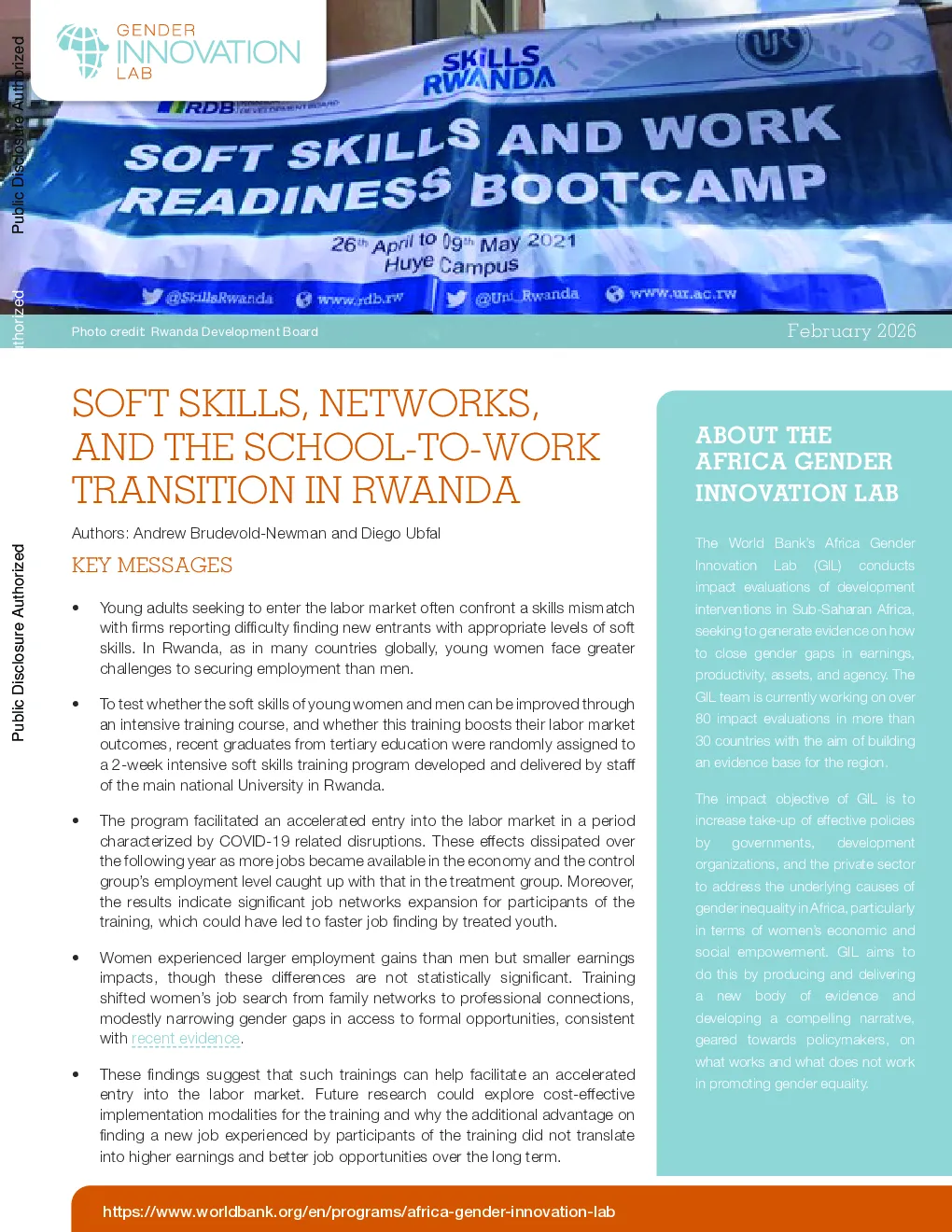
February 2026 SOFT SKILLS, NETWORKS, ABOUT THEAFRICA GENDER Authors: Andrew Brudevold-Newman and Diego Ubfal TheWorld Bank’s Africa GenderInnovationLab(GIL)conductsimpact evaluations of developmentinterventions in Sub-Saharan Africa,seeking to generate evidence on how KEY MESSAGES •Young adults seeking to enter the labor market often confront a skills mismatchwith firms reporting difficulty finding new entrants with appropriate levels of softskills. In Rwanda, as in many countries globally, young women face greater •To test whether the soft skills of young women and men can be improved throughan intensive training course, and whether this training boosts their labor marketoutcomes, recent graduates from tertiary education were randomly assigned toPublic Disclosure Authorized The impact objective of GIL is toincrease take-up of effective policiesbygovernments,developmentorganizations, and the private sectorto address the underlying causes ofgender inequality in Africa, particularly •The program facilitated an accelerated entry into the labor market in a periodcharacterized by COVID-19 related disruptions. These effects dissipated overthe following year as more jobs became available in the economy and the control •Women experienced larger employment gains than men but smaller earningsimpacts,though these differences are not statistically significant.Trainingshifted women’s job search from family networks to professional connections,Public Disclosure Authorized •These findings suggest that such trainings can help facilitate an acceleratedentryinto the labor market.Future research could explore cost-effectiveimplementation modalities for the training and why the additional advantage on WHAT WE FOUND CONTEXT Overall, our results indicate that the soft-skills trainingboosted labor market outcomes: individuals assigned totreatment report a 9 percent increase in the likelihood ofearning any income (an increase of 6 percentage pointsover a control mean of 69%), a 17 percent increase inearnings, and a 12-percent increase in hours worked inthe main job, on average over the 15 months after thetraining. However, these averages obscure significant andconsistent time trends in the impacts, with large positiveshort-term impacts waning over time. Four months afterthe training, individuals assigned to the training were14-percentage points (23 percent) more likely to report anactive income generating activity than the control group, The school-to-work transition is a challenging period foryoung people, with youth unemployment rates often farexceeding those of adults. In many countries, this periodcan be more difficult for young women. In Rwanda, 35%of young women are not in education, employment ortraining, compared to 27% of young men. Young adultsseeking to enter the labor market often confront a skills WHAT WE DID In collaboration with the Rwanda Development Board andthe University of Rwanda, we implemented a randomizedcontrol trial for a 13-day, in-person soft-skills trainingfor recent university graduates. The curriculum focusedoneffective communication,networking,and bothinterpersonal (teamwork, collaboration, trust, empathy,andnegotiation)and intrapersonal(self-awareness,personalinitiative,and perseverance)skills,and wasdesigned to address employers’ perceptions that tertiaryeducationcurricula produced technically proficient We measure impacts using a baseline survey and threeonline follow-up surveys: the first about 4 months afterthe conclusion of the training; the second about 10 MECHANISMS Analysis of intermediate outcomes suggests that networkexpansion was the dominant mechanism for acceleratedlabor market entry. The program did not yield persistentimprovementsin self-reported soft skills,nor did itconsistently boost job search activity, though short-term GENDER HETEROGENEITY The paper finds that the soft-skills training had nuancedgender-specific effects on labor market outcomes andthetypes of networks used for job search.Womenexperienced a larger increase in employment likelihood andhours worked than men, but the impact on their earningswas smaller, though these differences are not statisticallysignificant. In terms of occupational choice, women weremore likely to work as employees, while men were more POLICY IMPLICATIONS Our findings suggest that soft-skills training can accelerate youth entry into thelabor market, but may not yield lasting improvements in earnings or job quality.Although the program was not cost-effective at its pilot scale—given the highdelivery costs of an intensive residential format—our findings highlight its potentialvalue when adapted for broader implementation. Participants expressed a strong FOR MORE INFORMATION,PLEASE CONTACT Andrew Brudevold-Newmanabrudevoldnewman@worldbank.org For more information on the study, see the journal articlehere. Diego Ubfaldubfal@worldbank.org Africa Gender Innovation Labafrgenderlab@worldbank.org 1818 H St NWWashington, DC 20