您的浏览器禁用了JavaScript(一种计算机语言,用以实现您与网页的交互),请解除该禁用,或者联系我们。 [世界银行]:繁荣、健康和尊严:发展中国家老年妇女的政策途径(英)2026 - 发现报告

繁荣、健康和尊严:发展中国家老年妇女的政策途径(英)2026

文化传媒 2026-04-07 世界银行 华仔
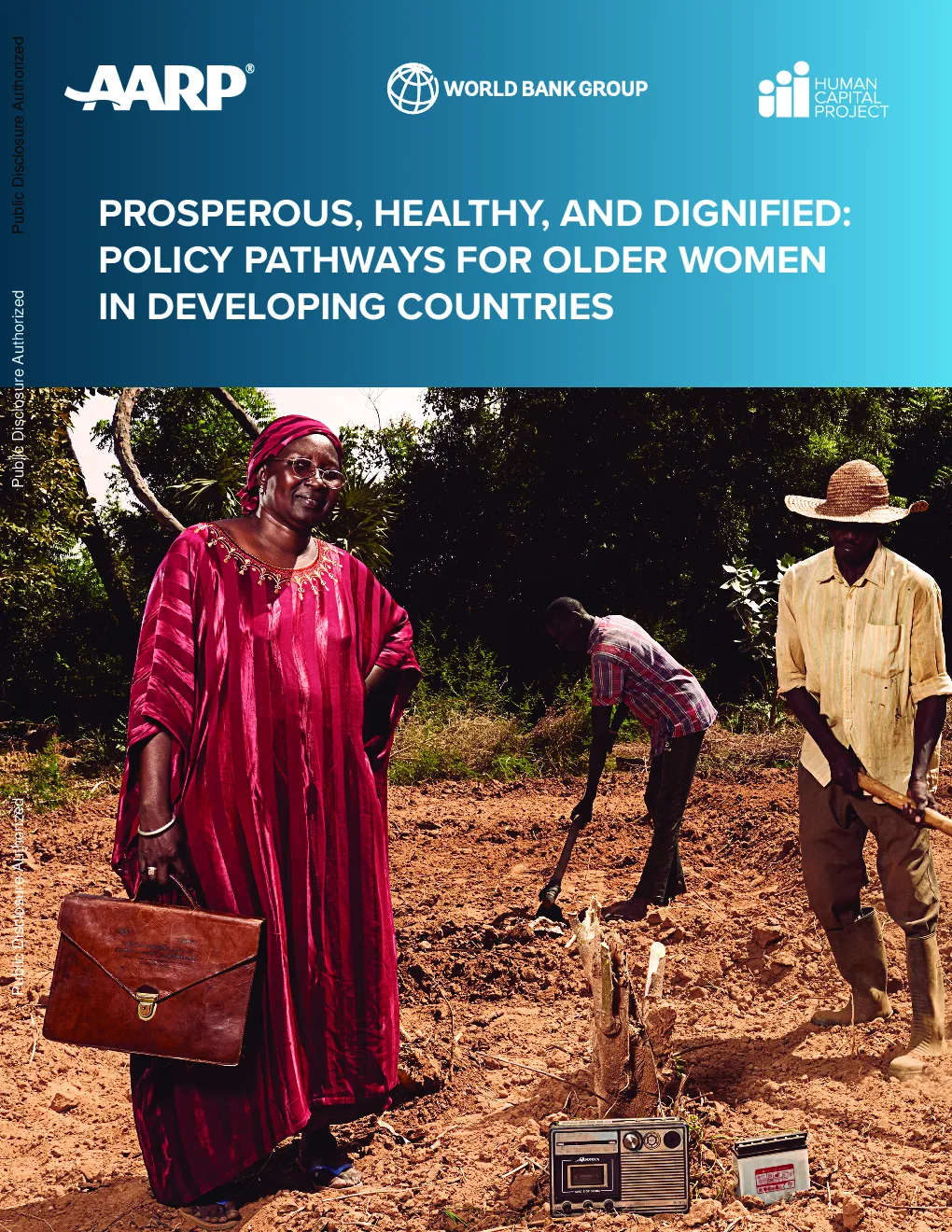
报告封面

PROSPEROUS, HEALTHY, AND DIGNIFIED:POLICY PATHWAYS FOR OLDER WOMENPublic Disclosure Authorized In developing countries, women live longer than ever and make up the majorityof older people. Many play central roles in their families and communitieswell into advanced ages, both as income earners and as unpaid carers ofgrandchildren, spouses, and even their own parents. Older women’s wellbeingis being compromised, however, by economic insecurity, weak health, unmetcare needs, and a high burden of care responsibilities. These challenges stem Acknowledgements This paper was prepared by a World Bank team. Sara Johansson de Silva and WendyCunningham were the lead authors. Malena Arcidiacono provided the data analysis,Sarah Comer provided wordsmithing and Daniela Avila Ungaro provided the layoutand design. The paper has benefited greatly from comments by Daniel Halim, IndhiraSantos, Benedicte Leroy, Gisela Garcia, and Gabriel Demombynes. We are grateful to Contents INTRODUCTION WOMEN ARE LIVING LONGER BUT NOT BETTER OLDER WOMEN PROVIDE VITAL CONTRIBUTIONS - BUT FACEFINANCIAL, HEALTH, AND CARE CHALLENGES Older women contribute significant market and non-market workWomen are at risk of poverty in old ageWomen age with poor health POLICIES CAN HELP WOMEN LIVE LONGER AND BETTERProsperous agingHealthy aging CONCLUSIONS32 REFERENCES34 01.Executive Summary Developing countries face unique challengesin supporting women in their old age.Economic, social, and institutional contextsvary across countries at different incomelevels. In poorer countries, multigenerationalhouseholds are more common, affectingthe way families can support one another.Financial markets and health and care systemsremain underdeveloped, and fiscal resourcesto implement reforms are limited. More people 01.Introduction Beyond headlines about global aging lies amore nuanced truth: women are shaping thestory of old age across developing countries.Today, individuals above age 60 comprise 11percent of the population in low- and middle-income countries. By 2050, 20 percent of thepopulation in these countries will be age 60 orolder.iMore than half of this population groupwill be women. Today, women outlive men in all Focusing on older women’s welfare iseverybody’s gain. Older women contributesignificantly to their families, communities,and countries. Some work and earn money,others volunteer for their communities, andmany assume a heavy responsibility for Population aging is taking place against thebackdrop of two other megatrends: climatechange and urbanization. Higher temperaturesand more frequent and severe natural disasters household chores and care for children,grandchildren, older spouses, and theirown parents. Without their contributions,household and community support systemswould weaken significantly, affecting younger are having profound negative impacts onliving standards in developing countries,and especially on poorer population groups.iiiHealth conditions common to older peoplecan make them particularly sensitive to heat PROSPEROUS, HEALTHY, AND DIGNIFIED: POLICY PATHWAYS FOR OLDER WOMEN IN DEVELOPING COUNTRIES identifies policies to help them thrive as theyage. Like gender, aging permeates virtually allpolicy areas, including labor markets and skills,social protection, health and care systems,innovation and private sector development, and fiscal policy. Several excellent studiesexplore a specific facet of older women’s lives,such as economic empowerment or, especially, assessed programs. We do not define ageneric age cut-off, allowing for the fact thatresearchers use different age cut-offs, drivenby data availability or the research question. To place older women’s situation in context, theanalysis references older men as a comparatorgroup, which brings its own challenges. Mostsignificantly, men, on average, die earlierthan women. The gender gap in longevityaffects some of our female-male comparisons,which we discuss in the presentation of thedata. Similarly, men face distinct challenges The analysis highlights four key messagesabout women’s wellbeing in older age in low-and middle-income countries, where the roleof older women remains under-researched.First, older women contribute important butoften unrecognized market and non-marketwork. Second, women live longer than menbut in poorer conditions. Third, older womenare vulnerable to poverty and at risk of unmet The remainder of the paper is organized asfollows. The next section provides an overviewof patterns of aging and gender in low- andmiddle-income countries. The followingsections discuss older women’s welfare from The paper backs up its messages throughnew data analysis and the research literature.The new analysis uses publicly availabledata sources. To the extent possible, policyrecommendations are drawn from analytically Women are livinglonger but not02 Women account for a disproportionate share of the world’s olderpopulation. They make up an increasing share