消费人工智能领域的风险投资
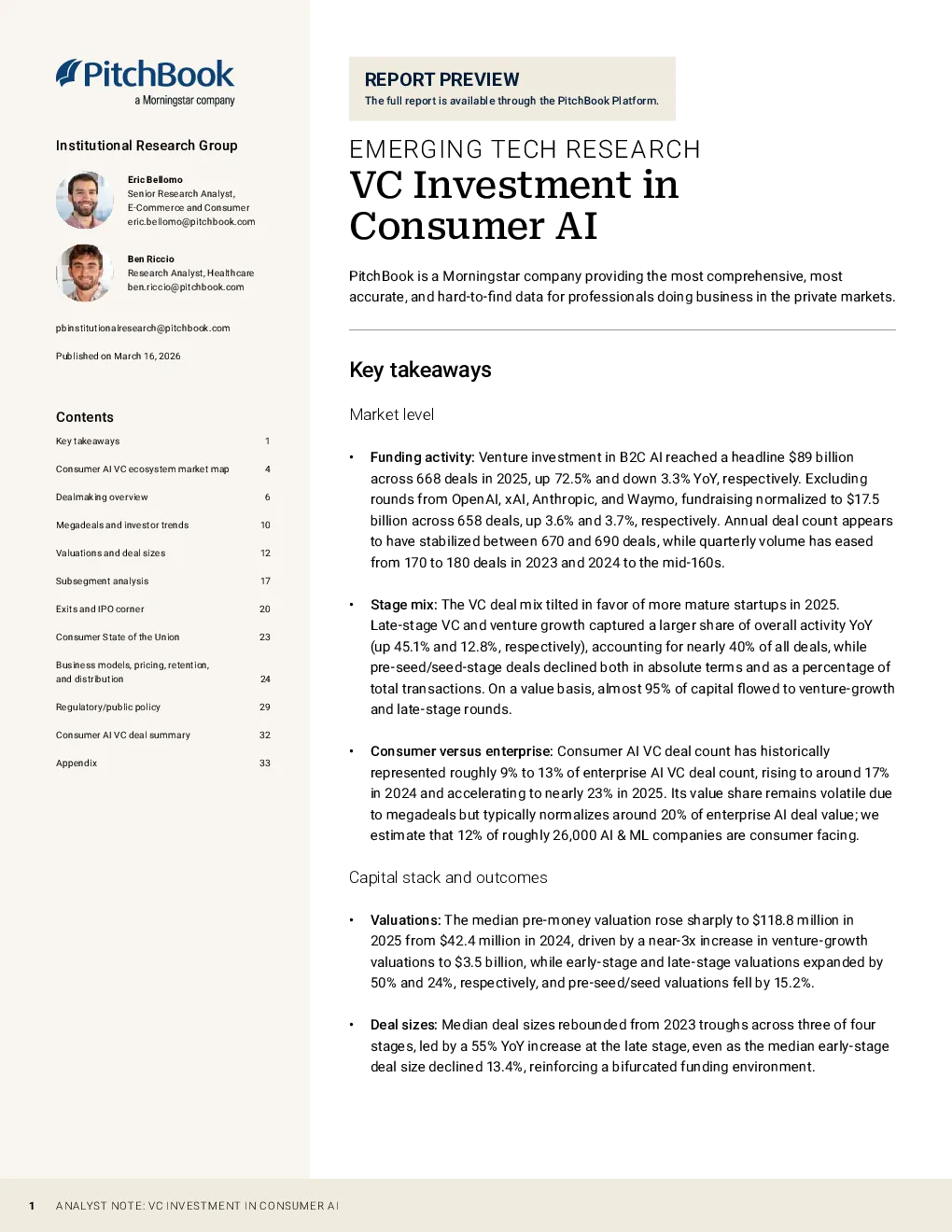
EMERGING TECH RESEARCHVC Investment inConsumer AI Institutional Research Group Eric BellomoSenior Research Analyst,E-Commerce and Consumereric.bellomo@pitchbook.com Ben RiccioResearch Analyst, Healthcareben.riccio@pitchbook.com PitchBook is a Morningstar company providing the most comprehensive, mostaccurate, and hard-to-find data for professionals doing business in the private markets. pbinstitutionalresearch@pitchbook.com Published on March 16, 2026 Key takeaways Market level Contents •Funding activity:Venture investment in B2C AI reached a headline $89 billionacross 668 deals in 2025, up 72.5% and down 3.3% YoY, respectively. Excludingrounds from OpenAI, xAI, Anthropic, and Waymo, fundraising normalized to $17.5billion across 658 deals, up 3.6% and 3.7%, respectively. Annual deal count appearsto have stabilized between 670 and 690 deals, while quarterly volume has easedfrom 170 to 180 deals in 2023 and 2024 to the mid-160s. •Stage mix:The VC deal mix tilted in favor of more mature startups in 2025.Late-stage VC and venture growth captured a larger share of overall activity YoY(up 45.1% and 12.8%, respectively), accounting for nearly 40% of all deals, whilepre-seed/seed-stage deals declined both in absolute terms and as a percentage oftotal transactions. On a value basis, almost 95% of capital flowed to venture-growthand late-stage rounds. •Consumer versus enterprise:Consumer AI VC deal count has historicallyrepresented roughly 9% to 13% of enterprise AI VC deal count, rising to around 17%in 2024 and accelerating to nearly 23% in 2025. Its value share remains volatile dueto megadeals but typically normalizes around 20% of enterprise AI deal value; weestimate that 12% of roughly 26,000 AI & ML companies are consumer facing. Appendix33 Capital stack and outcomes •Valuations:The median pre-money valuation rose sharply to $118.8 million in2025 from $42.4 million in 2024, driven by a near-3x increase in venture-growthvaluations to $3.5 billion, while early-stage and late-stage valuations expanded by50% and 24%, respectively, and pre-seed/seed valuations fell by 15.2%. •Deal sizes:Median deal sizes rebounded from 2023 troughs across three of fourstages, led by a 55% YoY increase at the late stage, even as the median early-stagedeal size declined 13.4%, reinforcing a bifurcated funding environment. •Exits:Combined VC and PE exit value for B2C AI remained below $9 billion annuallyfrom 2022 to 2024 before rebounding to $26.4 billion in 2025, while the 2025 exitcount reached 62, surpassing the prior 2021 high of 60. 2026 outcomes will hingeon interest rates; valuation resets; policy clarity; and potential IPOs from OpenAI orAnthropic, which could skew headline figures. •Cyclicality:The synchronous recovery across valuations, deal sizes, and exitsin recent years is consistent with the cyclical pattern driven by rate sensitivity,improved risk appetites, and technological breakthroughs. However, capitalconcentration in a small cohort of emergent AI-native winners is amplifying aventure-growth rebound. •Secondaries:Consumer platforms have lagged in secondary markets; in Q1 2025,Hiive’s consumer index trailed all tracked indexes,1and among the 50 highest-valued companies on Caplight, the 15 consumer-facing platforms trade at a medianpremium of around 2% to their last valuations tracked by PitchBook.2 Unit economics •Distribution:Distribution remains a critical bottleneck as digital supply hasexploded—between 2000 and 2018, active websites grew nearly 100x from 17million to 1.6 billion—and rising customer acquisition costs (as seen with MonopolyGo! spending roughly $1.3 billion, or 36% of revenue, on user acquisition) elevatethe strategic value of owned or embedded channels.3, 4 •Monetization:Despite strong engagement, monetization remains constrained, withonly around 5% of OpenAI’s roughly 800 million weekly active users paying for theservice, aggregate AI mobile app conversion at 2.8%,5and just 9% of consumerssubscribing to more than one LLM.6 •Pricing:Leading consumer AI platforms are testing unprecedented price points—up to $200 per month (OpenAI) and $167 per month (Perplexity) versus less than$10 per month for legacy consumer platforms—though we expect few nonleadingapplications will sustain such pricing. •Economics:Business model durability remains unproven as application-layercompanies absorb variable token costs to support infrastructure-layer valuations,although continued token price deflation and efficiency gains offer cautiousmedium-term margin upside. Investors and policy •Investor composition:Corporate VCs played an outsized role in consumer AI VCdealmaking in 2025, participating in 82.8% of consumer AI deal value (the highestshare since 2016) and 23.5% of deals, versus 68.1% of value and 19.1% of deal countacross the broader US AI & ML VC ecosystem.•IP risk:IP exposure appears increasingly manageable at scale, exemplified byAnthropic’s $1.5 billion copyright settlement followed da