您的浏览器禁用了JavaScript(一种计算机语言,用以实现您与网页的交互),请解除该禁用,或者联系我们。[香港科技大学利丰供应链研究院]:思想领袖简报系列:加速电子提单采用——解析企业是否采用的关键阻碍 - 发现报告

思想领袖简报系列:加速电子提单采用——解析企业是否采用的关键阻碍

思想领袖简报系列:加速电子提单采用——解析企业是否采用的关键阻碍

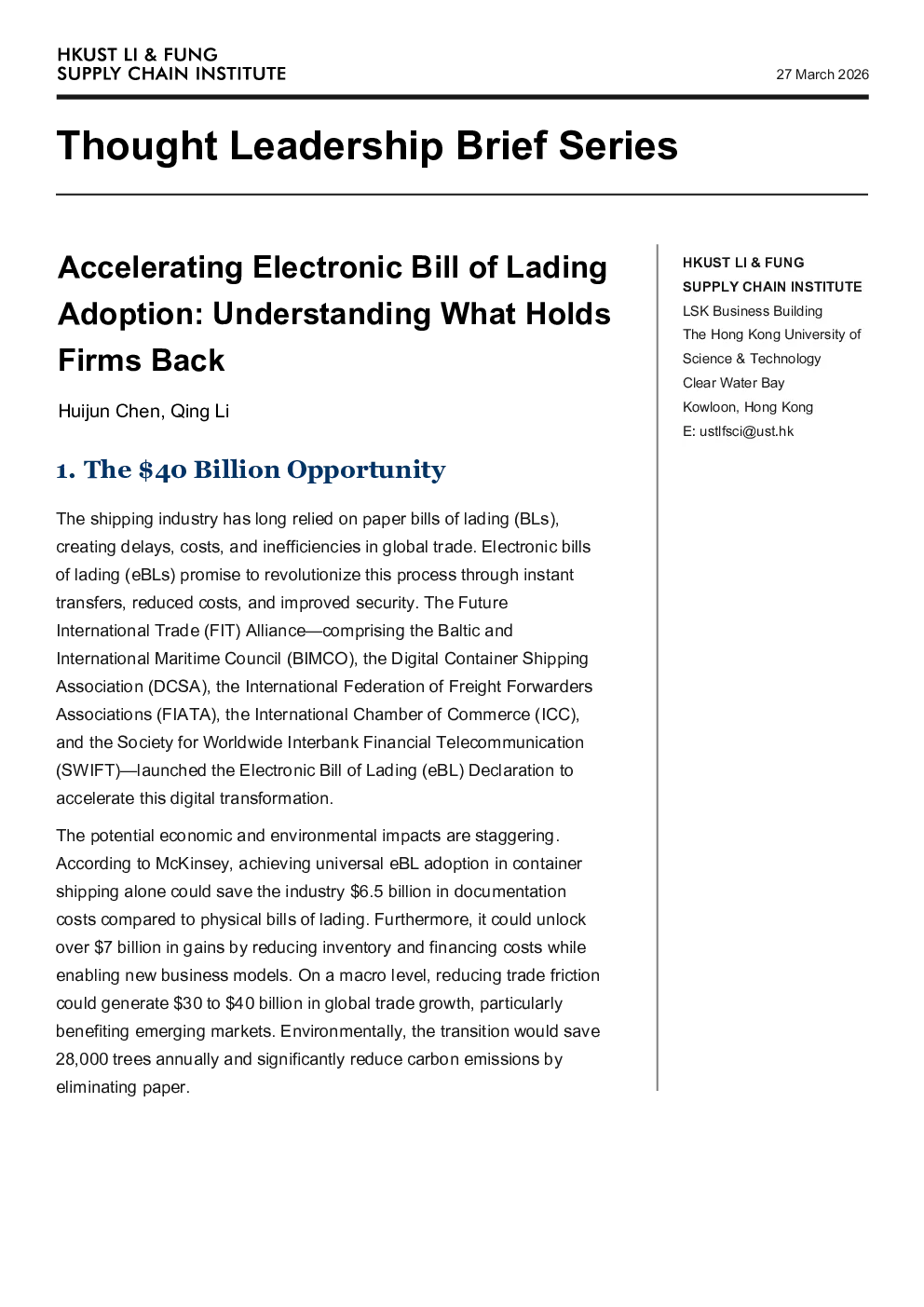
Accelerating Electronic Bill of LadingAdoption:Understanding What Holds HKUST LI & FUNGSUPPLY CHAIN INSTITUTE LSK Business Building Huijun Chen, Qing Li 1.The $40 Billion Opportunity The shipping industry has long relied on paper bills of lading (BLs),creating delays, costs, and inefficiencies in global trade. Electronic billsof lading (eBLs) promise to revolutionize this process through instanttransfers, reduced costs, and improved security. The Future The potential economic and environmental impacts are staggering.According to McKinsey, achieving universal eBL adoption in containershipping alone could save the industry $6.5 billion in documentationcosts compared to physical bills of lading. Furthermore, it could unlock Despite these compelling benefits and strong industry commitments—such as 9 of the top 10 ocean carriers pledging to switch throughDCSA’s “100% eBL by 2030” initiative, and 26 FIATA members alreadydis tributing the eFBL—adoption remains stubbornly low. According to 2.The Awareness Paradox Using the survey data, new research from HKUST Li & Fung SupplyChain Institute reveals a counterintuitive finding regarding industry hesitation. The survey data shows that firms with the highest awarenessof eBLs do not necessarily exhibit the highest adoption rates. Figure 1illustrates this awareness paradox. As expected, firms with noawareness rely exclusively on paper BLs. However, among firms 3.Two Types of Firms, Two DifferentChallenges Through rigorous statistical analysis of survey data, researchersidentified two distinct firm profiles with dramatically different adoptiondynamics. The findings reveal not just that firms face different barriers, The first group consists of “Intrinsic-Resistance” firms, which arepredominantly banks and financial institutions. These organizations facestructural roadblocks that no amount of information can overcome. Theirprimary barriers are systemic rather than informational. Regulatoryuncertainty is the top concern, cited by 17%ofthesefirmsastheir primary In stark contrast are the “Awareness-Driven” firms, primarily consistingof carriers and shippers. These firms are generally ready and willing toadopt but lack sufficient practical knowledge and supportinginfrastructure. Their barriers are deeply operational. They frequently citea lack of interoperability between platforms, with 13% expressing 4.The Data Speaks for Itself The research moves beyond merely identifying these profiles—itquantifies their starkly different responses to awareness campaigns. For financial institutions, the data reveal a striking reality: awarenesshas zero measurable impact on eBL adoption. Institutions barely familiarwith eBLs and those acting as industry experts share identical adoptionrates. Because awareness explains none of the variation in their Carriers and shippers follow a different logic. In this group, awarenessexplains nearly 80% of the gap between adopters and non-adopters.Awareness ranges from “nothing at all” to “a great deal” on a four-pointscale, while adoption intensity moves from paper-based to hybrid toeBL-only on a three-point scale. Each step up in awareness adds 0.68 5.Strategic Imperative: OptimizingResource Allocation The strategic implications of these data are definitive. To accelerate eBLadoption, the industry must abandon a one-size-fits-all approach andallocate resources where they actually drive results. For carriers andshippers, education directly drives execution. Every dollar invested in legal frameworks, developing platform interoperability, and driving The Bottom Line: A $40 billion global trade opportunity—alongside$6.5 billion in direct documentation savings—is within reach. Capturingthis value requires a bifurcated strategy: aggressively educatingoperational stakeholders while systematically dismantling structural HKUST Li & Fung Supply Chain Institute The HKUST Li & Fung Supply Chain Institute accelerates the creation,global dissemination, and practical application of new knowledge andtechnologies for managing supply chains. Jointly established byinternational research university HKUST and supply chain industry © Copyright 2026 HKUST Li & Fung Supply Chain Institute. All rights reserved. Though HKUST Li& Fung Supply Chain Institute endeavours to ensure the information provided in this publication is