您的浏览器禁用了JavaScript(一种计算机语言,用以实现您与网页的交互),请解除该禁用,或者联系我们。[-]:金砖国家内部贸易二十年:趋势、模式与政策 - 发现报告

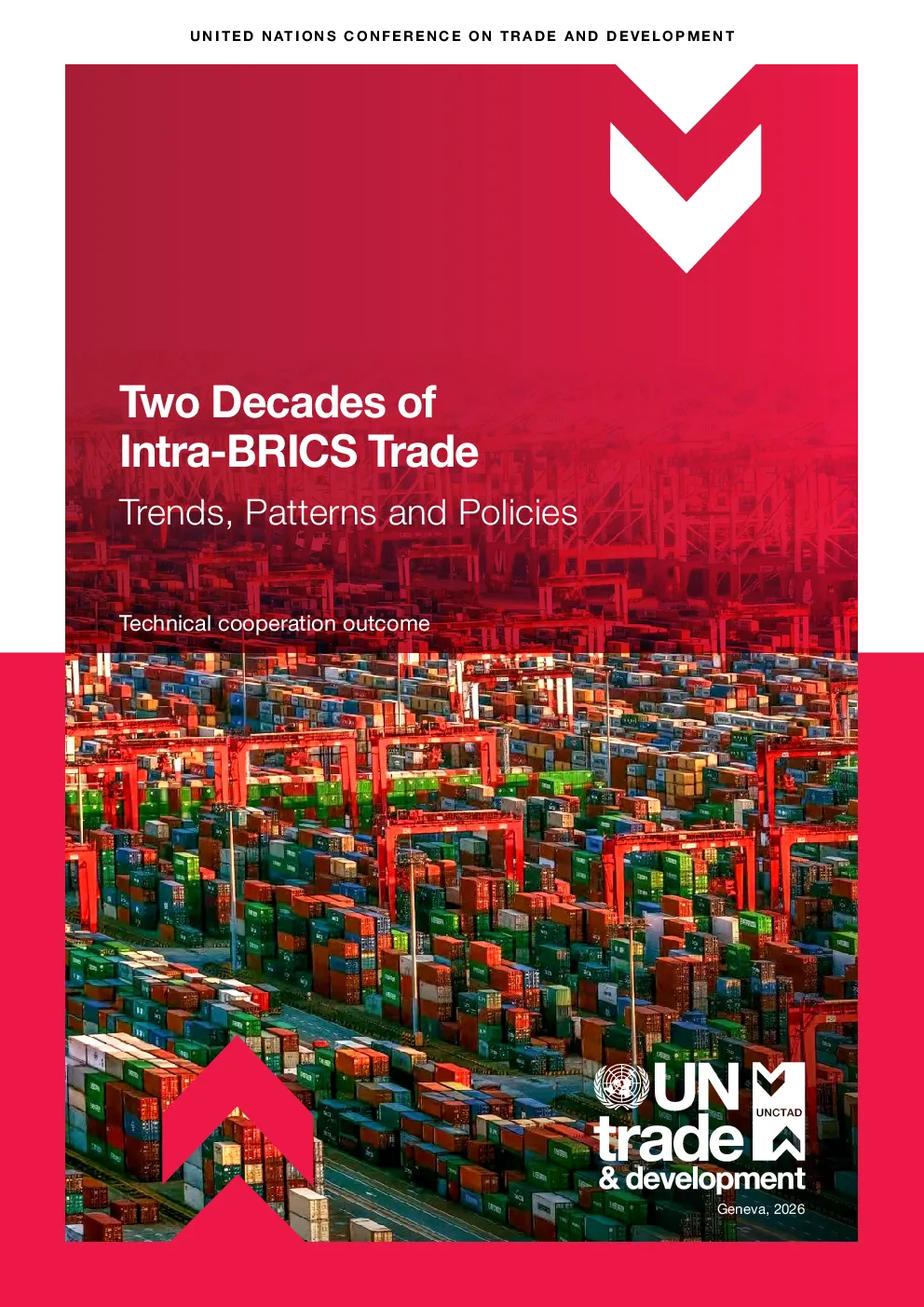
金砖国家内部贸易二十年:趋势、模式与政策

综合2026-03-16--C***
金砖国家内部贸易二十年:趋势、模式与政策

Trends, Patterns and Policies Technical cooperation outcome © 2026, United Nations Conference on Trade and Development The findings, interpretations and conclusions expressed herein are those of the authors and donot necessarily reflect the views of the United Nations or its officials or Member States. The designations employed and the presentation of material on any map in this work do not implythe expression of any opinion whatsoever on the part of the United Nations concerning the legalstatus of any country, territory, city or area or of its authorities, or concerning the delimitation ofits frontiers or boundaries. Mention of any firm or licensed process does not imply the endorsement of the United Nations. This publication has not been formally edited. UNCTAD/TCS/GDS/INF/2025/2 Acknowledgements This publication was prepared, under the overall guidance of Anastasia Nesvetailova, Head ofBranch, by the UNCTAD Division on Globalization and Development Strategies. Research forthe report was led and conducted by Dawei Wang, with substantive support from Jie Ouyang(UNCTAD Intern). The publication benefited from internal review and feedback from UNCTADcolleagues at the Office of the Secretary-General of UNCTAD and the Division on InternationalTrade and Commodities, including Saidali Abdoulkarim, Anida Yupari Aguado, Andrés MiguelRondón Anzola, Taisuke Ito, Clovis Freire Junior, Alexandra Laurent, Peter Lunenborg andAlessandro Nicita. UNCTAD gratefully acknowledges the inputs contributed by Dan Lu (The Chinese Universityof Hong Kong, China) and Jingxin Ning (University of International Business and Economics ofChina). The report aims to update, in the context of the expansion of BRICS, previous UNCTAD analysespresented at meetings of the BRICS Contact Group on Economic and Trade Issues in 2022and 2023. The report was prepared under an UNCTAD project titled “Policy strategies research and sharingto promote sustainable development for the global South”. Ivonne Paredes-Ayma of UNCTAD provided administrative support. Cover design and desktoppublishing were undertaken by the UNCTAD Communication and External Relations Section. Major trends •The expanded BRICS is one of the world’s most important economiccooperation platforms and a leading mechanism for advancing the globalSouth cooperation. Collectively, the ten member countries account for 27 percent of world output, 24 per cent of merchandise exports, and 22 per cent ofFDI inflow by 2024. This brings fresh opportunities, avenues for cooperationand vast potential. •In the last two decades, intra-BRICS trade in goods has increased over13-fold, from $84.2 billion in 2003 to $1.17 trillion in 2024 (on export side).This substantial expansion underscores the growing importance of BRICScountries in global trade and reflects the continuous strengthening of tradeconnections within BRICS. •Despite the rapid expansion, the scale of intra-BRICS trade remains limitedcompared to their economic size or their trade capacity. Intra-BRICS tradeaccounted for about 5 per cent of world trade or 20 per cent of South-Southtrade. •China plays a central role in intra-BRICS trade networks. Alongside Brazil,India, Indonesia, the Russian Federation, and the United Arab Emirates,it significantly accounts for the most dynamic share of trade flows withinBRICS. •The structure of intra-BRICS trade has evolved. Many BRICS membersdemonstrate persistent dependence on primary products exports whileimporting manufactured goods with higher technology intensity, thoughsome of them show mixed pictures with exports of technology intensiveproducts as well. India has seen moderate progress in export diversification.China represents the case of successful industrial upgrading, markedby transformation from labor-intensive to higher technology intensivemanufactured goods exports. •There is widespread lowering of tariff levels among BRICS countries overthe past two decades, but substantial heterogeneity across these countriesexists too. Policy takeaways Despite the rapid growth and vast potential of intra-BRICS trade, policy-levelcooperation has not been fully aligned with the dynamics. So far, BRICSmembers rely on soft initiatives to lay groundwork for deeper and moreconcrete cooperation. The ten BRICS member countries have joined numerous preferential tradearrangements, but a comprehensive trade agreement encompassing theentire bloc has yet to be established. This report suggests that BRICS may adopt a Trade+ strategy to build politicalwillingness, initiate a region-wide trade agreement, foster linkages betweentrade and other policy action areas and reform BRICS trade workstreams. UNCTAD and other relevant international organizations can assist BRICSto strengthen the institutional capacities for stronger economic and tradecooperation with their expertise, experiences and networks. Table of contents Acknowledgements......................................................................