中国经济学:良好开局
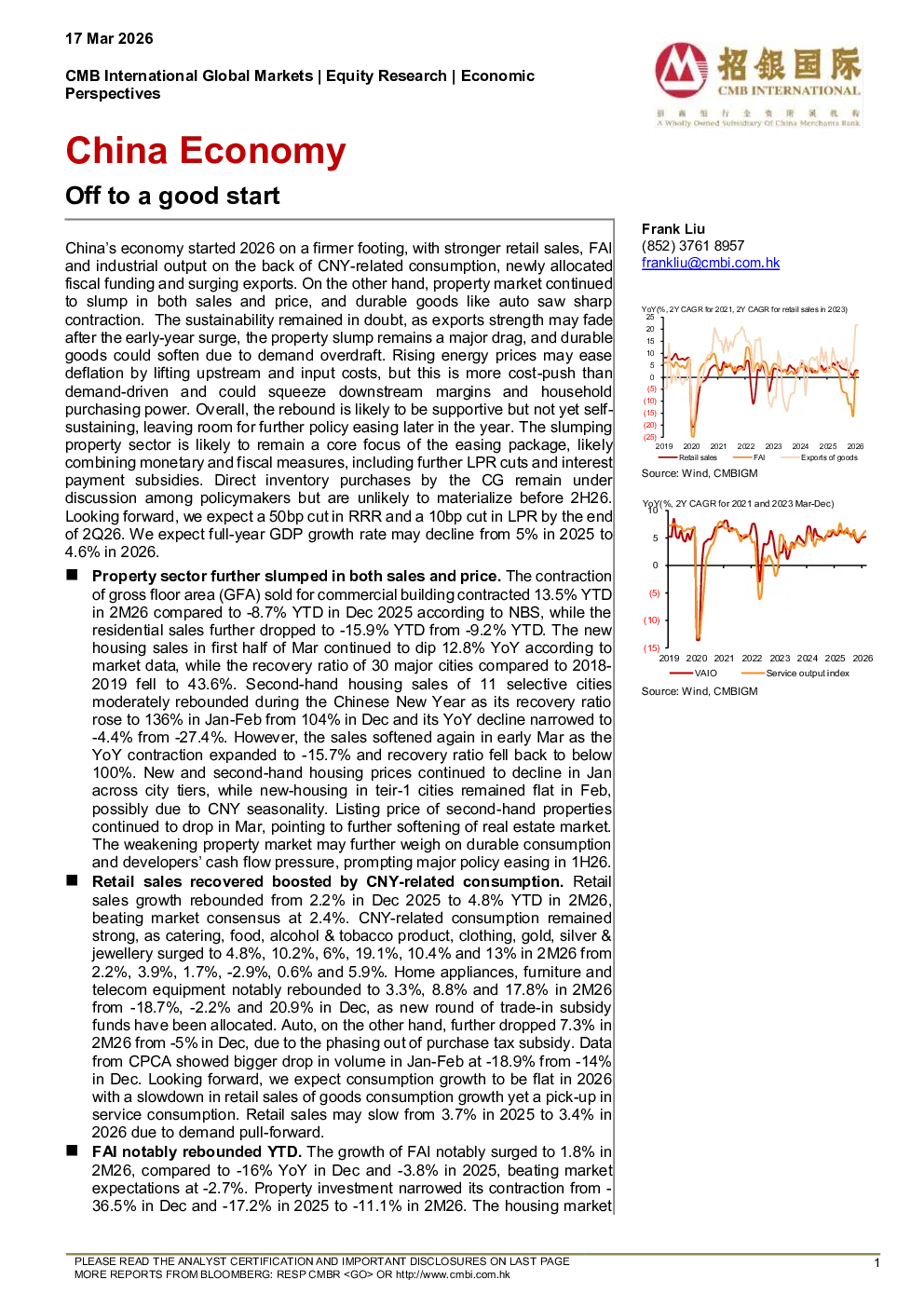
Off to a goodstart Frank Liu(852) 3761 8957frankliu@cmbi.com.hk China’seconomy started 2026 on a firmer footing, with stronger retail sales, FAIand industrial output on the back of CNY-related consumption, newly allocatedfiscal funding and surgingexports. On the other hand, property marketcontinuedto slump in both sales and price, and durable goods like auto saw sharpcontraction. The sustainability remained in doubt, as exportsstrength may fadeafter the early-year surge, the property slump remains a major drag, and durablegoods couldsoften due to demand overdraft. Rising energy prices may easedeflation by lifting upstream and input costs, but this is more cost-push thandemand-driven and could squeeze downstream margins and householdpurchasing power. Overall, the reboundis likely to besupportive but not yet self-sustaining, leaving room for further policy easing later in the year. The slumpingproperty sector is likely to remain a core focus of the easing package, likely Source:Wind, CMBIGM Property sectorfurther slumped in both sales and price.The contractionofgross floor area (GFA) sold forcommercialbuildingcontracted13.5% YTDin 2M26 compared to-8.7% YTD in Dec 2025 according to NBS, while theresidential sales further dropped to-15.9% YTD from-9.2% YTD.The newhousing sales in first half of Mar continued to dip 12.8% YoY according tomarket data, while the recovery ratio of 30 major cities compared to 2018-2019fell to 43.6%.Second-hand housing sales of 11 selective citiesmoderately rebounded during the Chinese New Year as its recovery ratiorose to 136% in Jan-Feb from 104% in Dec and its YoY decline narrowed to-4.4% from-27.4%. However, thesales softened again in early Mar as the Source:Wind,CMBIGM and developers’ cash flow pressure, prompting major policy easingin1H26.Retail salesrecovered boosted by CNY-related consumption.Retailsales growthrebounded from 2.2% in Dec 2025 to 4.8% YTD in 2M26,beatingmarket consensus at 2.4%.CNY-related consumption remainedstrong, as catering, food, alcohol & tobacco product, clothing, gold, silver &jewellerysurged to 4.8%, 10.2%, 6%, 19.1%, 10.4% and 13% in 2M26 from2.2%, 3.9%, 1.7%,-2.9%, 0.6% and 5.9%. Home appliances, furniture andtelecomequipmentnotably rebounded to 3.3%, 8.8% and 17.8% in 2M26from-18.7%,-2.2% and 20.9% in Dec, as new round of trade-in subsidyfunds have been allocated. Auto, on the other hand, further dropped 7.3% in2M26 from-5% in Dec,due to thephasingoutofpurchase tax subsidy.Data FAInotably reboundedYTD.Thegrowthof FAInotably surged to 1.8% in2M26, compared to-16% YoY in Dec and-3.8% in 2025,beating marketexpectations at-2.7%.Property investmentnarrowed its contraction from- remained over-supplywhile the advance payment and mortgage loans infunding source both declined by22% and 42% in2M26.Infrastructureinvestmentrebounded to 9.8% in 2M26 from-16%in Decand-1.5% in 2025,asnewly allocated fiscal funding drove the surge ininvestmentofpublicutility,waterconservancy&public facility,and transportation. Manufacturinginvestmentrecoveredto3.1% in 2M26 from-10.6%in Decand 0.6% in 2026.Looking forward,FAIgrowthmayrecoverfrom-3.8% in 2025 to2.5% in 2026aspolicymakersvowed to stabilize investmentwith RMB800bn additionalfunding innew policy financing tools through policy banks to stabilize Industrial outputedged up.VAIO growthpicked upto 6.3% in 2M26 from5.2% inDecand 5.9% in 2025,beatingmarket consensusat 5.2%.Bothminingandpublic utilityedged up to 6.3% and 4.7% in 2M26 from5.4%and0.8%in Dec.VAIO of manufacturingaccelerated to6.5% from5.7%,asdelivery value for exports rebounded to6.3% in 2M26 from3.2% in Dec.Food,rubber&plastic products,metal products,transport equipmentexcluding auto and electricalequipmentnotably picked up whilechemicalproducts,autoand non-ferrous metal smelting & pressingslowed down. Off to a good startbut sustainability remained in question.Theeconomystarted2026 with better-than-expectedmomentum, but the recovery is stillnot self-sustaining. Exportsstrength may fadeafter the early-year surge, theproperty slump remains a major drag, and durable goods could softendueto demand overdraft. Rising energy prices may temporarily ease deflation bylifting upstream and input costs, but this is more cost-push than demand-driven and could squeeze downstream margins and household purchasingpower. Overall, the reboundis likely to be supportive but not yet self-sustaining, leaving room for further policy easing later in the year.Supportfor the struggling property sector is expected to form a core part of the easing Source: Wind, CMBIGM Source:Wind, CMBIGM Source: Wind, CMBIGMNote:The 11 cities include Beijing,Shenzhen,Hangzhou,Nanjing,Chengdu, Qingdao, Suzhou, Xiamen, Wuxi, Dongguan and Foshan Source: Wind, CMBIGM Source: Wind, CMBIGM Source: Wind, CMBIGM Source: Wind, CMBIGM Source: Wind, CMBIGM Source: Wind, CMBIGM Source:Wind, CMBIGM Source: Wind, CMBIGM Source: Wind, CMBIGM Source: Wind, CMBIGM Source: Wind, CMBIGM Source: Wi