加拿大帝国商业银行美股招股说明书(2026-03-16版)
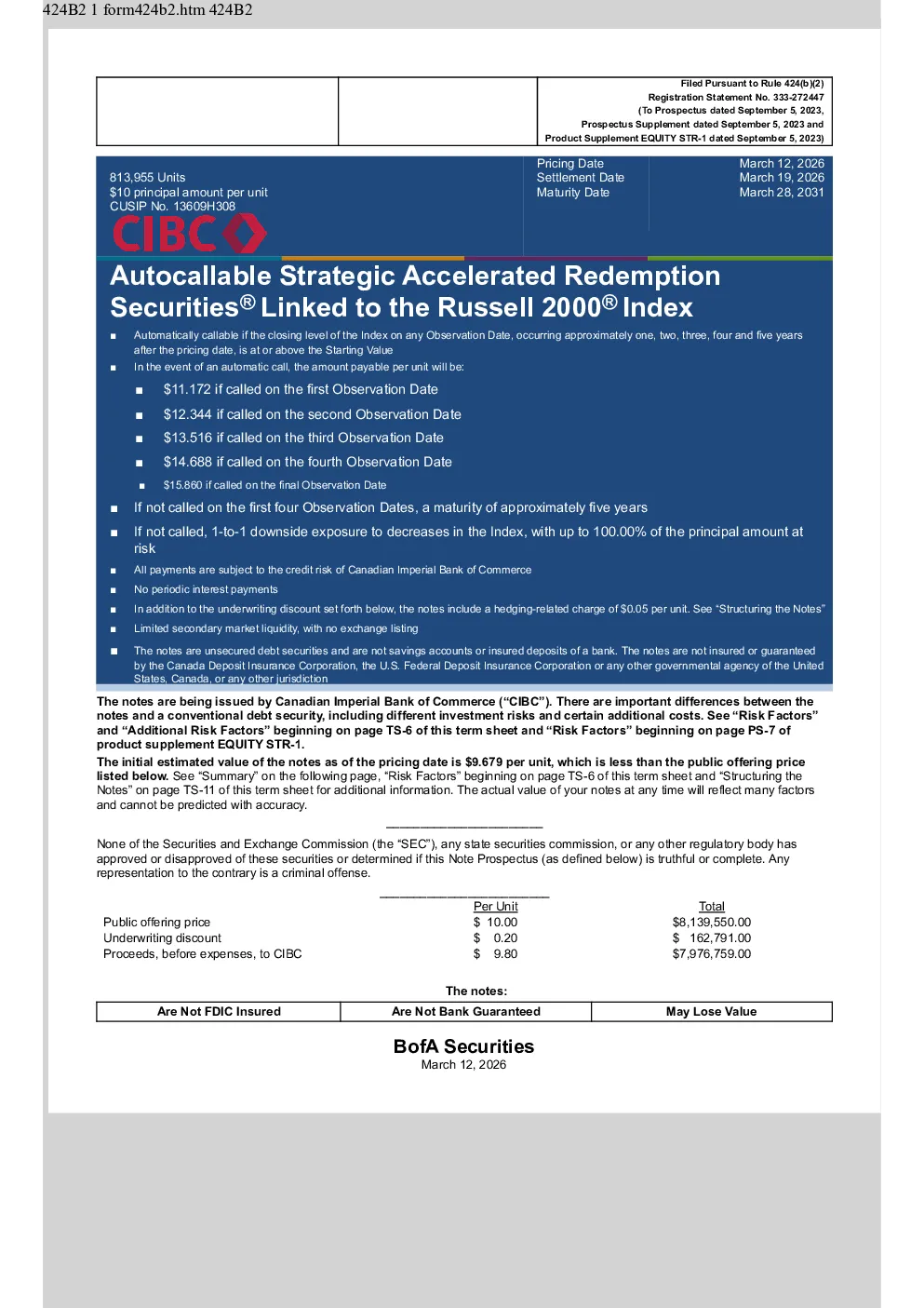
■Automatically callable if the closing level of the Index on any Observation Date, occurring approximately one, two, three, four and five yearsafter the pricing date, is at or above the Starting Value■In the event of an automatic call, the amount payable per unit will be: ■$11.172 if called on the first Observation Date■$12.344 if called on the second Observation Date■$13.516 if called on the third Observation Date■$14.688 if called on the fourth Observation Date■$15.860 if called on the final Observation Date ■If not called on the first four Observation Dates, a maturity of approximately five years ■If not called, 1-to-1 downside exposure to decreases in the Index, with up to 100.00% of the principal amount atrisk ■All payments are subject to the credit risk of Canadian Imperial Bank of Commerce ■The notes are unsecured debt securities and are not savings accounts or insured deposits of a bank. The notes are not insured or guaranteedby the Canada Deposit Insurance Corporation, the U.S. Federal Deposit Insurance Corporation or any other governmental agency of the UnitedStates, Canada, or any other jurisdiction The notes are being issued by Canadian Imperial Bank of Commerce (“CIBC”). There are important differences between thenotes and a conventional debt security, including different investment risks and certain additional costs. See “Risk Factors”and “Additional Risk Factors” beginning on page TS-6 of this term sheet and “Risk Factors” beginning on page PS-7 ofproduct supplement EQUITY STR-1. The initial estimated value of the notes as of the pricing date is $9.679 per unit, which is less than the public offering pricelisted below.See “Summary” on the following page, “Risk Factors” beginning on page TS-6 of this term sheet and “Structuring theNotes” on page TS-11 of this term sheet for additional information. The actual value of your notes at any time will reflect many factorsand cannot be predicted with accuracy._______________________ None of the Securities and Exchange Commission (the “SEC”), any state securities commission, or any other regulatory body hasapproved or disapproved of these securities or determined if this Note Prospectus (as defined below) is truthful or complete. Anyrepresentation to the contrary is a criminal offense. Public offering priceUnderwriting discountProceeds, before expenses, to CIBC Autocallable Strategic Accelerated Redemption Securities®Linked to the Russell 2000®Index, due March 28, 2031 Summary TheAutocallableStrategic Accelerated Redemption Securities®Linked to the Russell 2000®Index, due March 28, 2031 (the “notes”) are our senior unsecureddebt securities. The notes are not guaranteed or insured by the Canada Deposit Insurance Corporation, the U.S. Federal Deposit Insurance Corporation or anyother governmental agency of the United States, Canada or any other jurisdiction or secured by collateral. The notes are not bail-inable debt securities (as definedon page 6 of the prospectus).The notes will rank equally with all of our other unsecured and unsubordinated debt. Any payments due on the notes,including any repayment of principal, will be subject to the credit risk of CIBC.The notes will be automatically called at the applicable Call Amount if theclosing level of the Market Measure, which is the Russell 2000®Index (the “Index”), on any Observation Date is equal to or greater than the Starting Value. You willnot receive any notice from us if the notes are automatically called. If your notes are not called, you will lose all or a portion of the principal amount of your notes.Any payments on the notes will be calculated based on the $10 principal amount per unit and will depend on the performance of the Index, subject to our creditrisk. See “Terms of the Notes” below. The economic terms of the notes (including the Call Premiums and the Call Amounts) are based on our internal funding rate, which is the rate we would pay toborrow funds through the issuance of market-linked notes, and the economic terms of certain related hedging arrangements. Our internal funding rate is typicallylower than the rate we would pay when we issue conventional fixed rate debt securities. This difference in funding rate, as well as the underwriting discount and thehedging-related charge and certain service fee described below, reduced the economic terms of the notes to you and the initial estimated value of the notes on thepricing date. Due to these factors, the public offering price you pay to purchase the notes is greater than the initial estimated value of the notes. On the cover page of this term sheet, we have provided the initial estimated value for the notes. This initial estimated value was determined based on our pricingmodels, and was based on our internal funding rate on the pricing date, market conditions and other relevant factors existing at that time, and our assumptionsabout market parameters. For more information about the initial estimated value and the structurin