流媒体:从涓涓细流到洪流
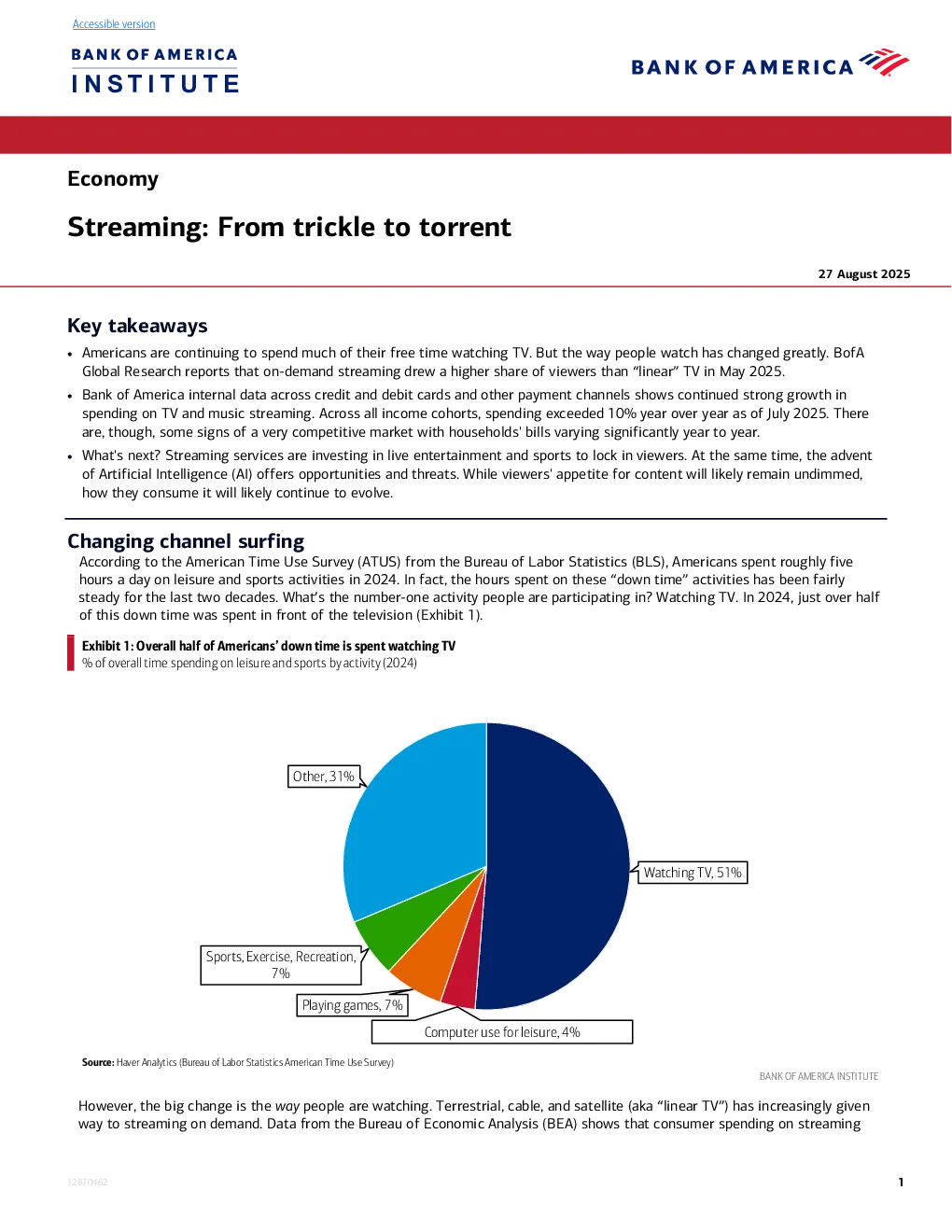
Streaming: From trickle to torrent 27 August 2025 Key takeaways •Americans are continuing to spend much of their free time watching TV. But the way people watch has changed greatly. BofAGlobal Research reports that on-demand streaming drew a higher share of viewers than“linear”TV in May 2025. •Bank of America internal data across credit and debit cards and other payment channels shows continued strong growth inspending on TV and music streaming. Across all income cohorts, spending exceeded 10% year over year as of July 2025. Thereare, though, some signs of a very competitive market with households' bills varying significantly year to year. •What's next? Streaming services are investing in live entertainment and sports to lock in viewers. At the same time, the adventof Artificial Intelligence (AI) offers opportunities and threats. While viewers' appetite for content will likely remain undimmed,how they consume it will likely continue to evolve. Changing channel surfingAccording to the American Time Use Survey (ATUS) from the Bureau of Labor Statistics (BLS), Americans spent roughly five hours a day on leisure and sports activities in 2024. In fact, the hours spent on these“down time”activities has been fairlysteady for the last two decades. What’s the number-one activity people are participating in? Watching TV. In 2024, just over halfof this down time was spent in front of the television (Exhibit 1). Exhibit1:Overall half of Americans’ down time is spent watching TV% of overall time spending on leisure and sports by activity(2024) However, the big change is thewaypeople are watching. Terrestrial, cable, and satellite (aka“linear TV”) has increasingly givenway to streaming on demand. Data from the Bureau of Economic Analysis (BEA) shows that consumer spending on streaming video and audio is now close to overtaking spending on cable and satellite services (Exhibit 2). And BofA Global Research hasfound that streaming’s share of total viewing surpassed the combined share of broadcast and cable in May 2025. Exhibit2: Streaming spending is closing in on linear TV and radioHousehold consumption expenditure on Cable/Satellite TV and Radio and Exhibit3: Spendinggrowthon streaming services has outpacedentertainment since 2023Spending on entertainment and TV/audio streaming services across all expenditure on Video/Audio streaming (seasonally adjusted annualizedrate (SAAR), $m) payment channels in Bank of America internal data (monthly, index2022=100) Streaming still moving fast forwardLooking at Bank of America internal data across credit and debit cards and other payment channels, we find that the growth in average payments for (both video and audio) streaming has outpaced that of entertainment in general since 2023 (Exhibit 3).When we examine this by income, we find a similar increase across lower-, middle- and higher-income cohorts. However, we seethat lower-income households spend around 8% less per month on streaming than the average household, while higher-incomehouseholds spend around 9% more than average. Exhibit4:Growth in streaming spendingwassimilar across income cohorts,though lower-incomehousehold spentlesson averageAverage payment per household for streaming services by income cohort (% YoY) and average payment relative to overall average across all income cohorts (%), When we look at the distribution of payments, we find that two-thirds of households paid less than $40 a month on streamingTV and music in the May-July 2025 period. (Exhibit 5). On the other hand, around 16% of viewers paid over $80 per month. It isworth pointing out that households getting streaming accounts bundled in with, for example, a cable subscription or on freetrials may have more services than this data suggests, and those services are not included in this data. But, in our view, thisrelatively large distribution of payments may represent opportunities for streaming providers to boost future growth byattracting more light users to scale up. Do households tend to hang onto their services? To gain insight into this, we examined the share of households seeing increasesand decreases in their streaming payments relative to a year earlier. While smaller increases in payments in the range $6 to $14per month are, in our view, likely to largely reflect price hikes by steaming providers, larger rises or declines above and below$15 per month may reflect households taking on new or cancelling existing subscriptions (Exhibit 6). Overall, the data suggestssome“churn”with a significant proportion of households subscribing or cancelling services each year. Exhibit6:There is considerable volatility in what households arepaying for streaming one year to the yearShare of regular streaming* households, by YoY changes in their August- Exhibit7:Around 18% of respondentstothe Insights Studyeithercancelled or started a new streaming subscription in the last month% responses to the question, “what things were you able to do last Jul