您的浏览器禁用了JavaScript(一种计算机语言,用以实现您与网页的交互),请解除该禁用,或者联系我们。 [美国银行]:区域综述:南方国家支出增长乏力 - 发现报告

区域综述:南方国家支出增长乏力

房地产 2025-09-01 美国银行 王月
报告封面

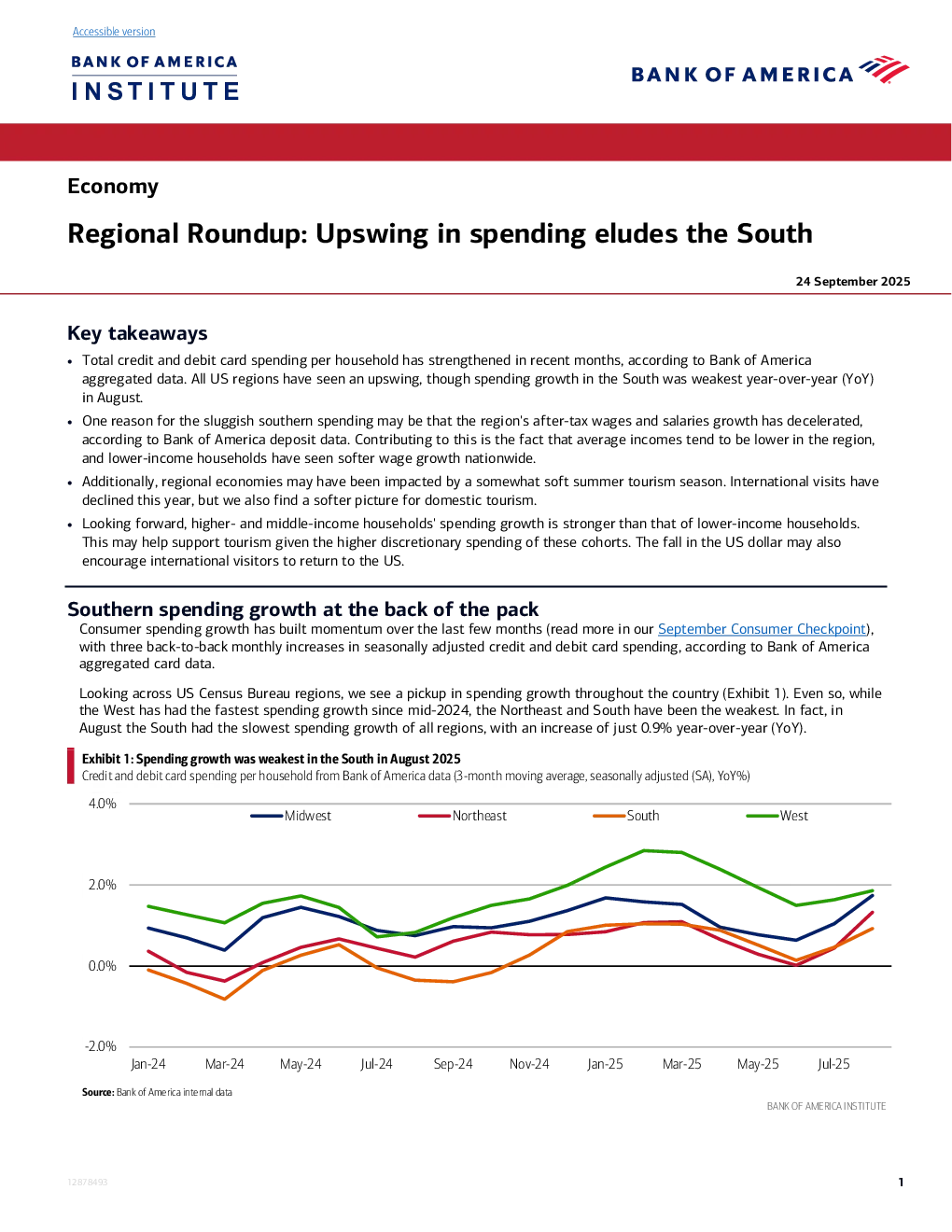
Regional Roundup: Upswing in spending eludes the South 24 September 2025 Key takeaways •Total credit and debit card spending per household has strengthened in recent months, according to Bank of Americaaggregated data. All US regions have seen an upswing, though spending growth in the South was weakest year-over-year (YoY)in August. •One reason for the sluggish southern spending may be that the region's after-tax wages and salaries growth has decelerated,according to Bank of America deposit data. Contributing to this is the fact that average incomes tend to be lower in the region,and lower-income households have seen softer wage growth nationwide. •Additionally, regional economies may have been impacted by a somewhat soft summer tourism season. International visits havedeclined this year, but we also find a softer picture for domestic tourism. •Looking forward, higher- and middle-income households' spending growth is stronger than that of lower-income households.This may help support tourism given the higher discretionary spending of these cohorts. The fall in the US dollar may alsoencourage international visitors to return to the US. Southern spending growth at the back of the packConsumer spending growth has built momentum over the last few months (read more in ourSeptember Consumer Checkpoint), with three back-to-back monthly increases in seasonally adjusted credit and debit card spending, according to Bank of Americaaggregated card data. Looking across US Census Bureau regions, we see a pickup in spending growth throughout the country (Exhibit 1). Even so, whilethe West has had the fastest spending growth since mid-2024, the Northeast and South have been the weakest. In fact, inAugust the South had the slowest spending growth of all regions, with an increase of just 0.9% year-over-year (YoY). Exhibit1: Spending growthwas weakest in the South in August 2025Credit and debit card spending per household from Bank of America data (3-month moving average, seasonallyadjusted(SA), YoY%) At face value, it may be surprising that spending growth in the West is strong, and softer in the South. But the trend aligns withsome of the population changes we are seeing, with outflows of younger households who tend to spend less coming out of theWest (for more on this, seeOn the Move: Still Waiting for the thaw), which, in turn, boosts average spending of thosehouseholds remaining. Conversely, average spending in the South may be being somewhat lowered by relatively younger households moving into theregion. But this is not likely to be the whole story, as the South already tends to have a lower average income than other regions.Those moving from the West to the South, for example, aren’t as likely to be pulling down southern average spending (Exhibit 2). Exhibit2:Median post-tax household income in the South wasaround $64,000 in 2023Median post-tax income by region (2023, $) Exhibit3:Wage growth has been weakeningin the South recentlyAfter-tax wage and salary growth by region, based on Bank of Americaaggregated consumer deposit data (%YoY, 3-month moving average,SA) Weak wage growth is a factor in the SouthAnother factor contributing to regional differences is wage growth, and it appears wage increases are cooling more in the South than other regions. In Bank of America deposit data on after-tax wages and salaries, wage growth in the South was the weakestof all the regions in August 2025, increasing just 2% YoY (Exhibit 3). In our September Consumer Checkpoint, we noted that across the US, lower-income households have seen a slowdown in wagegrowth (Exhibit 4). This may be reflected particularly in the South as the region has a higher share of these households. It could also be that some softness around discretionary services spending over the spring and the earlier part of the summerhas had an impact on the labor market in the South (seeConsumer Checkpoint: Summer temperature check). According toBureau of Economic Analysis (BEA) data, the Southeast region (see methodology for definition) accounts for around a quarter ofall US jobs in leisure and hospitality, so some parts of the South could be sensitive to slowdowns in spending in thesediscretionary areas (Exhibit 5). Exhibit4:InAugust,higher-income wage growth rose to 3.6%YoY,while it moderated to 0.9% YoY for lower-income householdsAfter-tax wage and salary growth by household income terciles, based on Exhibit5:Thesoutheast accounts for around a quarter ofall USjobsin leisure and hospitalityShare of BEA regions’ leisure and hospitality jobs in US total leisure and Bank of America aggregated consumer deposit data (3-month movingaverage, YoY%, SA) hospitality (2022, %) Tourists staying home this summer may also be playing a roleAn important source of demand for the leisure and hospitality industry comes from domestic and international tourism–and the data has been relatively weak here (Exhibit 6). In fact, the number of visitors from overseas (exclu