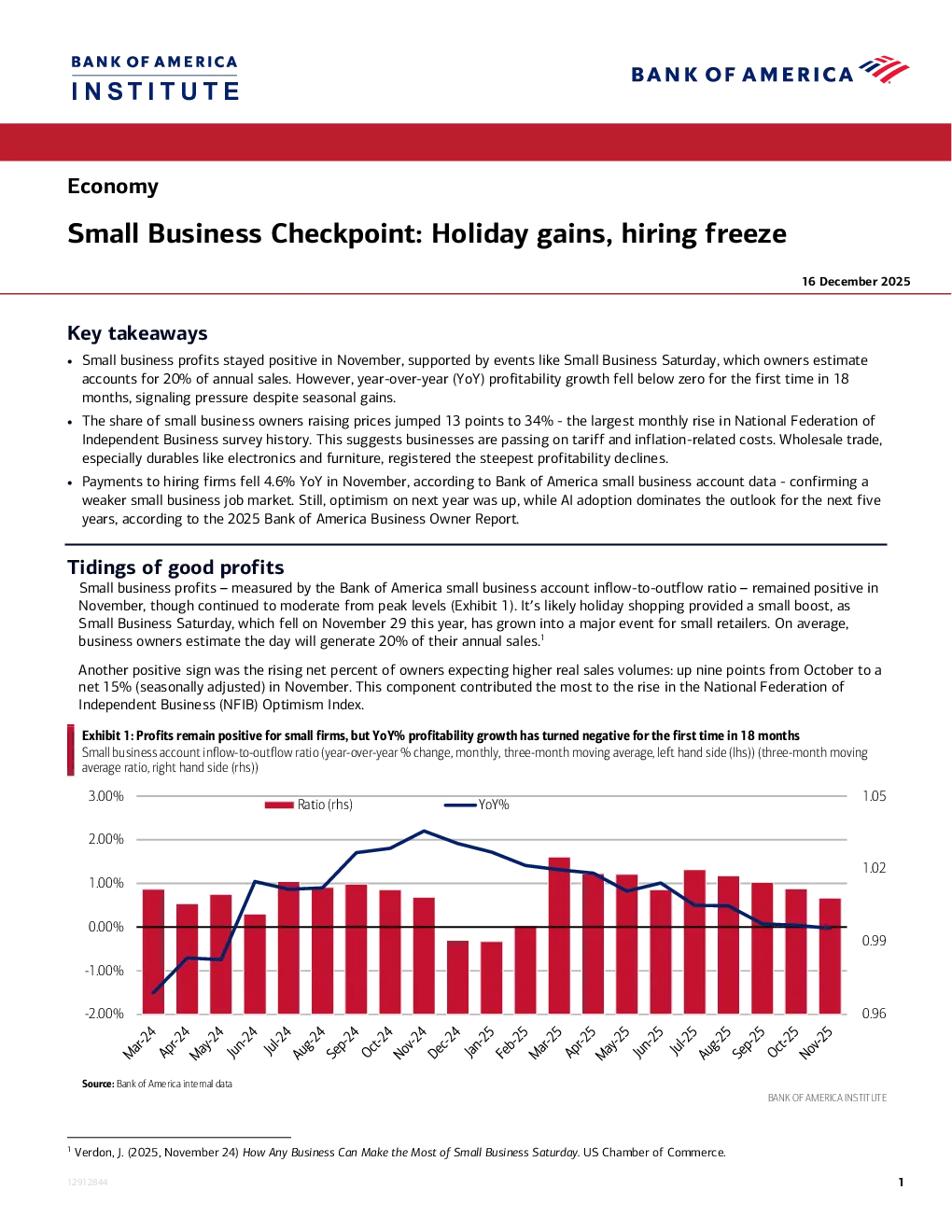
Small Business Checkpoint: Holiday gains, hiring freeze 16 December 2025 Key takeaways •Small business profits stayed positive in November, supported by events like Small Business Saturday, which owners estimateaccounts for 20% of annual sales. However, year-over-year (YoY) profitability growth fell below zero for the first time in 18months, signaling pressure despite seasonal gains. •The share of small business owners raising prices jumped 13 points to 34% - the largest monthly rise in National Federation ofIndependent Business survey history. This suggests businesses are passing on tariff and inflation-related costs. Wholesale trade,especially durables like electronics and furniture, registered the steepest profitability declines. •Payments to hiring firms fell 4.6% YoY in November, according to Bank of America small business account data - confirming aweaker small business job market. Still, optimism on next year was up, while AI adoption dominates the outlook for the next fiveyears, according to the 2025 Bank of America Business Owner Report. Tidings of good profitsSmall business profits–measured by the Bank of America small business account inflow-to-outflow ratio–remained positive in November, though continued to moderate from peak levels (Exhibit 1). It’s likely holiday shopping provided a small boost, asSmall Business Saturday, which fell on November 29 this year, has grown into a major event for small retailers. On average,business owners estimate the day will generate 20% of their annual sales.1 Another positive sign was the rising net percent of owners expecting higher real sales volumes: up nine points from October to anet 15% (seasonally adjusted) in November. This component contributed the most to the rise in the National Federation ofIndependent Business (NFIB) Optimism Index. Exhibit1:Profits remain positive for small firms, but YoY%profitability growth has turned negative for the first time in18monthsSmall business account inflow-to-outflow ratio (year-over-year % change, monthly, three-month moving average, left hand side (lhs)) (three-month moving average ratio, right hand side (rhs)) Small wholesale trade firms feeling the tariff squeezeHowever, small business year-over-year (YoY) profitability growth turned negative for the first time since May 2024 on a three- month moving average basis in November. While the reading was just below zero (at -0.02%), this highlights the pressure somesmall businesses are under. And consumer holiday shopping seemed to lose some momentum over the Black Friday longweekend (read more on this in the December Consumer Checkpoint), suggesting holiday spending and the related boost to smallfirms may not be as robust as hoped. One issue may be that some small businesses are hiking prices due to the need to pass through more of the cost increases fromtariffs and other pressures. In November, the net percent of owners raising average selling prices increased 13 points fromOctober to a net 34% (seasonally adjusted), the highest reading since March 2023 and the largest monthly jump in the NFIBsurvey’s history. This is also evident in Bank of America small business profitability growth by sector, where wholesale trade has declined themost over the year, down 1% in November (Exhibit 2). And within wholesale, durables (i.e., electronics and furniture) have drivenmost of the decline in the second half of the year, although non-durables like apparel are also down so far this quarter (Exhibit3). Construction and services declined in November, too. Small manufacturers have grown the most, although they facecrosscurrents (read more on this in November’s Midwestern pop). Exhibit2:Wholesale tradeprofitabilitydeclined the mostacrosssmall business sectorsSmall business inflow-outflowratio by sector (monthly, YoY%) Exhibit3:For durables, the second half of the yearbroughtnegativeprofitability growthSmall business inflow-to-outflow ratio bysubsector (quarterly, YoY%) Hiring for small businesses has been weak in the second half of the yearTheNovember Institute Employment Reportand Automatic Data Processing (ADP) Employment Report revealed a decline in payrolls, with small business job losses driving most of the pullback. With nearly half of the US workforce employed by suchfirms, this underscores the importance of the small business bedrock. As discussed in ourNovember Small Business Checkpoint, Bank of America data suggested small business hiring has cooled, butnot collapsed. This month, we find that small business payments to hiring firms fell 4.6% YoY on a three-month moving averagebasis in November (Exhibit 4). But not all small businesses are slashing payroll or putting the brakes on hiring. In fact, the percentage of NFIB respondentsreporting plans to increase hiring remains above the 20-year historical average. Some 9% of owners plan to create new jobs inthe next three months, up four points from October and the highest reading of the year (Exhibit 5). T