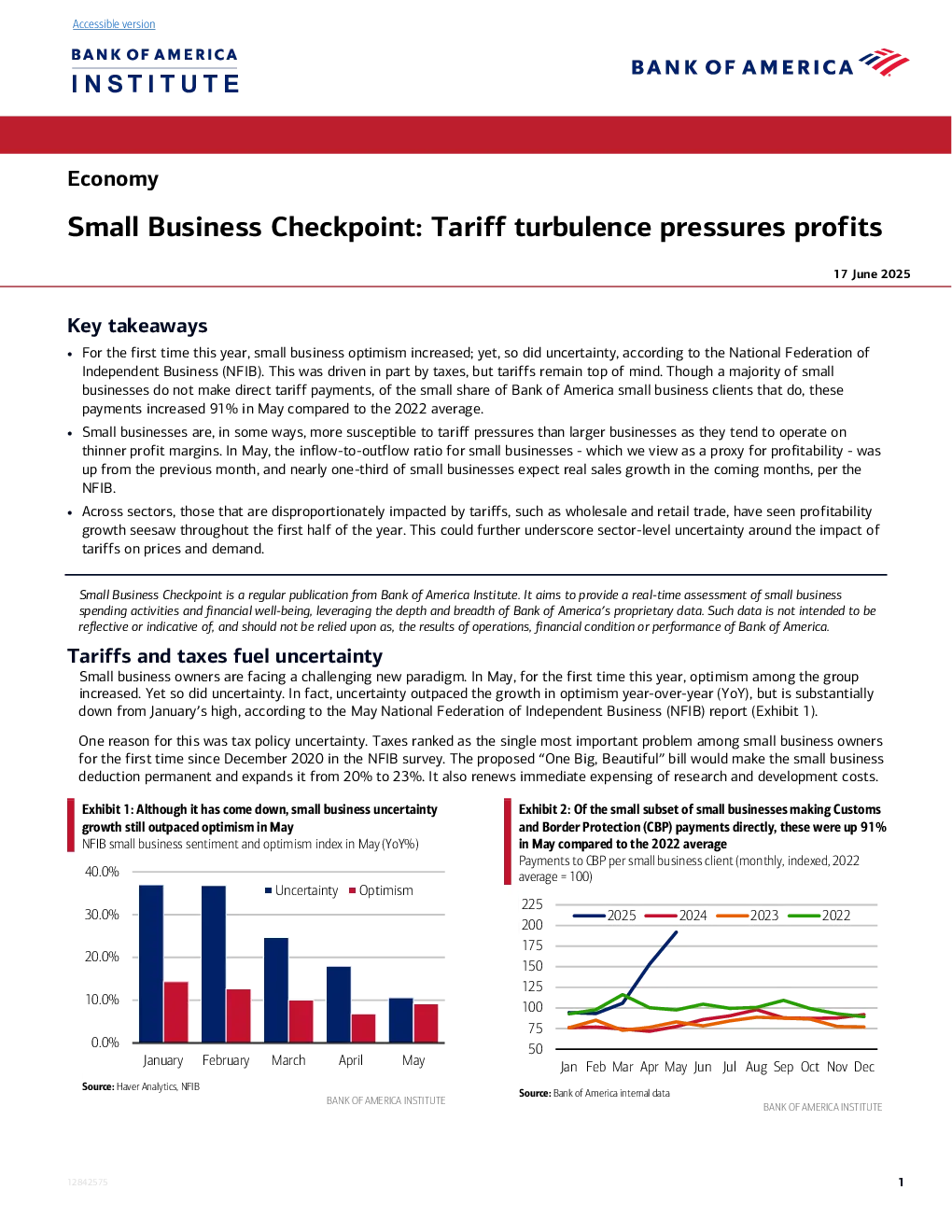
Small Business Checkpoint: Tariff turbulence pressures profits 17 June 2025 Key takeaways •For the first time this year, small business optimism increased; yet, so did uncertainty, according to the National Federation ofIndependent Business (NFIB). This was driven in part by taxes, but tariffs remain top of mind. Though a majority of smallbusinesses do not make direct tariff payments, of the small share of Bank of America small business clients that do, thesepayments increased 91% in May compared to the 2022 average. •Small businesses are, in some ways, more susceptible to tariff pressures than larger businesses as they tend to operate onthinner profit margins. In May, the inflow-to-outflow ratio for small businesses - which we view as a proxy for profitability - wasup from the previous month, and nearly one-third of small businesses expect real sales growth in the coming months, per theNFIB. •Across sectors, those that are disproportionately impacted by tariffs, such as wholesale and retail trade, have seen profitabilitygrowth seesaw throughout the first half of the year. This could further underscore sector-level uncertainty around the impact oftariffs on prices and demand. Small Business Checkpoint is a regular publication from Bank of America Institute. It aims to provide a real-time assessment of small businessspending activities and financial well-being, leveraging the depth and breadth of Bank of America’s proprietary data. Such data is not intended to bereflective or indicative of, and should not be relied upon as, the results of operations, financial condition or performance of Bank of America. Tariffs and taxes fuel uncertaintySmall business owners are facing a challenging new paradigm. In May, for the first time this year, optimism among the group increased. Yet so did uncertainty. In fact, uncertainty outpaced the growth in optimism year-over-year (YoY), but is substantiallydown from January’s high, according to the May National Federation of Independent Business (NFIB) report (Exhibit 1). One reason for this was tax policy uncertainty. Taxes ranked as the single most important problem among small business ownersfor the first time since December 2020 in the NFIB survey. The proposed“One Big, Beautiful”bill would make the small businessdeduction permanent and expands it from 20% to 23%. It also renews immediate expensing of research and development costs. Exhibit2: Of the small subset of small businesses makingCustomsand Border Protection (CBP) payments directly, these were up 91%in May compared to the 2022 averagePayments to CBP per small business client (monthly, indexed, 2022 Exhibit1:Although it has come down, small business uncertaintygrowth still outpaced optimism in MayNFIB small business sentiment and optimism index in May (YoY%) average = 100) But, of course, tariffs remain a looming and predominant component of business uncertainty too. Using Bank of America internaldata, we examined payments to US Customs and Border Protection (CBP) to better understand the impact of such levies onsmall businesses. Note that only a small subset of small business clients makes direct tariff payments as many small businesses do not havesubstantial international exposure, while some will often use customs brokers as opposed to making payments directly to CBPand are not captured in this analysis. Therefore, these payments represent a very small share of overall small business clients. InMay, of those small businesses making payments to CBP, tariff payments per small business client surged 91% compared to the2022 average (Exhibit 2). How does the tariff impact on small businesses differ from larger firms? According to the Census Bureau, of the 242,515 total importers in the US in 2023, 97%—or 236,045—were small businesseswith fewer than 500 employees, though large importers accounted for over two-thirds of the known import value, as was thecase with large exporters. Across firm size, there has been an uptick in direct CBP payments by firms since April 2025, though the transaction and clientcount has remained fairly steady, implying this trend is mostly a price signal of tariff pass-throughs. Of the subset of businessesmaking tariff payments to CBP, small businesses saw smaller month-over-month (MoM) increases in such payments in Maycompared to large firms. The reaction to tariff increases from different countries varies depending on the size of the companiesand their differing abilities to anticipate imports, smooth price increases, and preserve market share. Do tariff costs get passed on to consumers?Given the rise in tariff payments, should we expect to see these costs passed on to consumers? According to a recent New York Fed survey, 75% of firms that saw tariff-induced cost increases plan to pass on at least some onto their customers. Small businesses may be, in some ways, more susceptible to tariff pressures than larger businesses, given their access to capitalis more limited, among