您的浏览器禁用了JavaScript(一种计算机语言,用以实现您与网页的交互),请解除该禁用,或者联系我们。[美国银行]:小企业检查站:控制成本,提高收入 - 发现报告

小企业检查站:控制成本,提高收入

AI智能总结
查看更多
小企业检查站:控制成本,提高收入

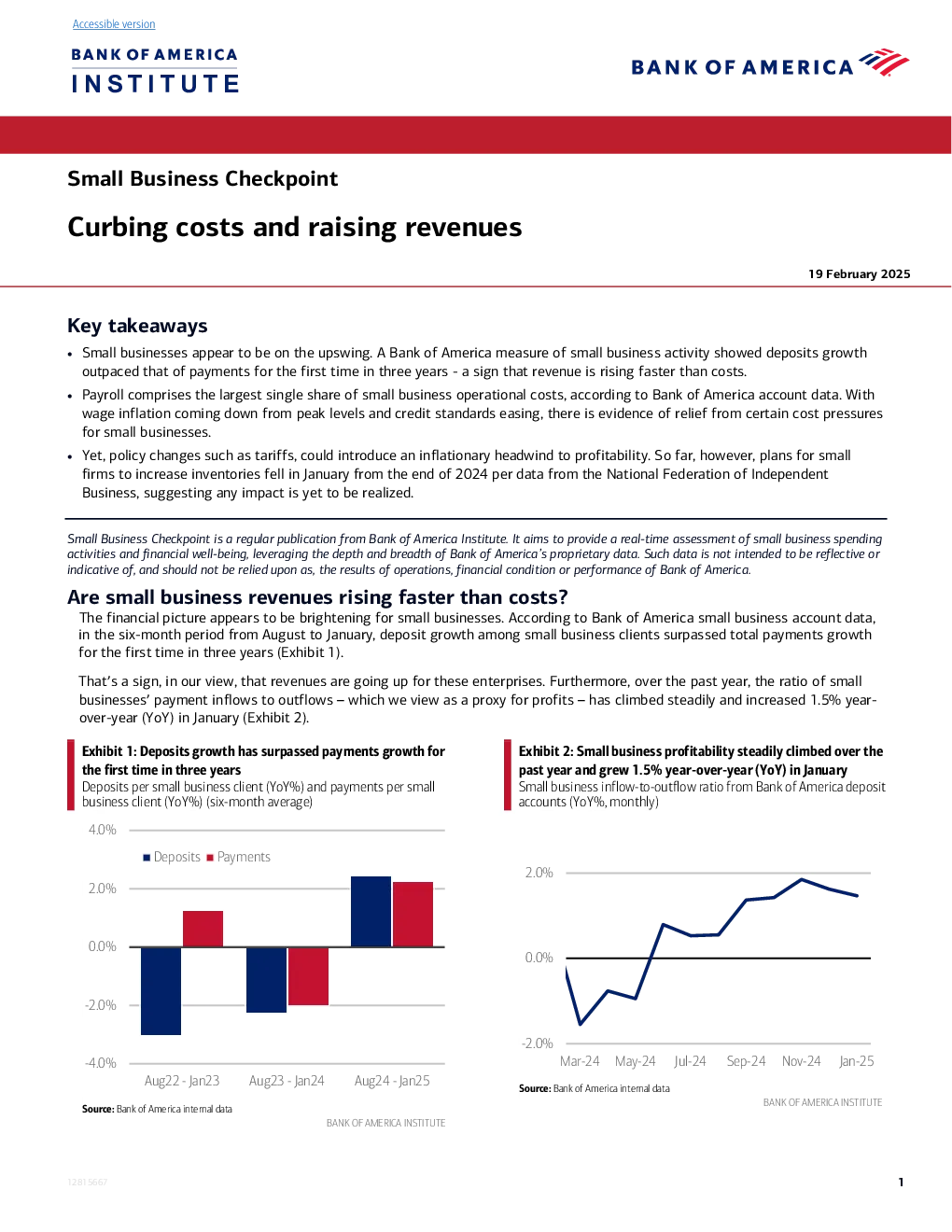
Curbing costs and raising revenues Key takeaways •Small businesses appear to be on the upswing. A Bank of America measure of small business activity showed deposits growthoutpaced that of payments for the first time in three years - a sign that revenue is rising faster than costs. •Payroll comprises the largest single share of small business operational costs, according to Bank of America account data. Withwage inflation coming down from peak levels and credit standards easing, there is evidence of relief from certain cost pressuresfor small businesses. •Yet, policy changes such as tariffs, could introduce an inflationary headwind to profitability. So far, however, plans for smallfirms to increase inventories fell in January from the end of 2024 per data from the National Federation of IndependentBusiness, suggesting any impact is yet to be realized. Small Business Checkpoint is a regular publication from Bank of America Institute. It aims to provide a real-time assessment of small business spendingactivities and financial well-being, leveraging the depth and breadth of Bank of America’s proprietary data. Such data is not intended to be reflective orindicative of, and should not be relied upon as, the results of operations, financial condition or performance of Bank of America. Are small business revenues rising faster than costs?The financial picture appears to be brightening for small businesses. According to Bank of America small business account data, in the six-month period from August to January, deposit growth among small business clients surpassed total payments growthfor the first time in three years (Exhibit 1). That’s a sign, in our view, that revenues are going up for these enterprises. Furthermore, over the past year, the ratio of smallbusinesses’payment inflows to outflows–which we view as a proxy for profits–has climbed steadily and increased 1.5% year-over-year (YoY) in January (Exhibit 2). Exhibit1:Deposits growth has surpassed payments growth forthe first time in three yearsDeposits per small business client (YoY%) and payments per small Exhibit2: Small business profitability steadily climbed overthepast year and grew 1.5% year-over-year (YoY) in JanuarySmall business inflow-to-outflow ratio from Bank of America deposit accounts (YoY%, monthly) business client (YoY%) (six-month average) It’s important to note, however, that even as revenues seem to be rising, costs don’t appear to be declining. In fact, our datashows that while deposits are up, so are payments, suggesting it is possible certain cost pressures are weighing on smallbusinesses. And given that these companies typically operate on very small profit margins, it’s important to understand theextent to which costs might impact profits. Wage inflation has slowed, easing labor costsA broader view of small business operating expenses can be seen in automated clearing house (ACH) payments. And when we look at what’s driving total average costs from January 2024 to January 2025, the three highest volume ACH categories arepayroll, tax, and credit card, respectively (Exhibit 3). Perhaps unsurprisingly, payroll comprises the largest single share of smallbusiness operational costs, according to Bank of America account data. To what extent is this due to wage inflation? According to the Bureau of Labor Statistics (BLS), the average weekly wage growth is still growing, but at a much slower ratethan in recent years. For example, the average weekly wage growth at the smallest firms, those with less than 50 employees,peaked in 2023 at 8.2% YoY (Exhibit 4). And for firms with less than 500 employees–a small business as defined by the SmallBusiness Administration–average weekly wage growth peaked in 2022 at 7.4%. While wage growth at smaller firms outpacedoverall growth in 2022 and 2023, smaller firms’wage growth is now growing at a slightly slower pace. Exhibit3: Payroll comprised 20% of total payments for smallbusinessesSmall business ACH payments volume (%, average of Jan24-Jan25) Exhibit4: Smaller firms’weekly wagesfell below the overallaverage in 2024, down from 2023 and 2022 peaksAverage weekly wage by employment size for all industries (annual, YoY%) Additionally, within Bank of America internal account data, payroll payment growth per small business client was up 4.5% YoY inJanuary, largely flat from December (Exhibit 5). This is in line with the findings from the February National Federation of Independent Business (NFIB) survey which hasindicated little change in the percentage of firms raising worker compensation over the past three months. The survey alsofound that the percentage of business owners reporting labor costs as the single most important problem for business ownersfell once again and is now four percentage points below the highest reading of 13% reached in December 2021. Yet, that survey also indicates that finding quality labor remains a top concern, a topic discussed in ourJanuary Small BusinessCheckp