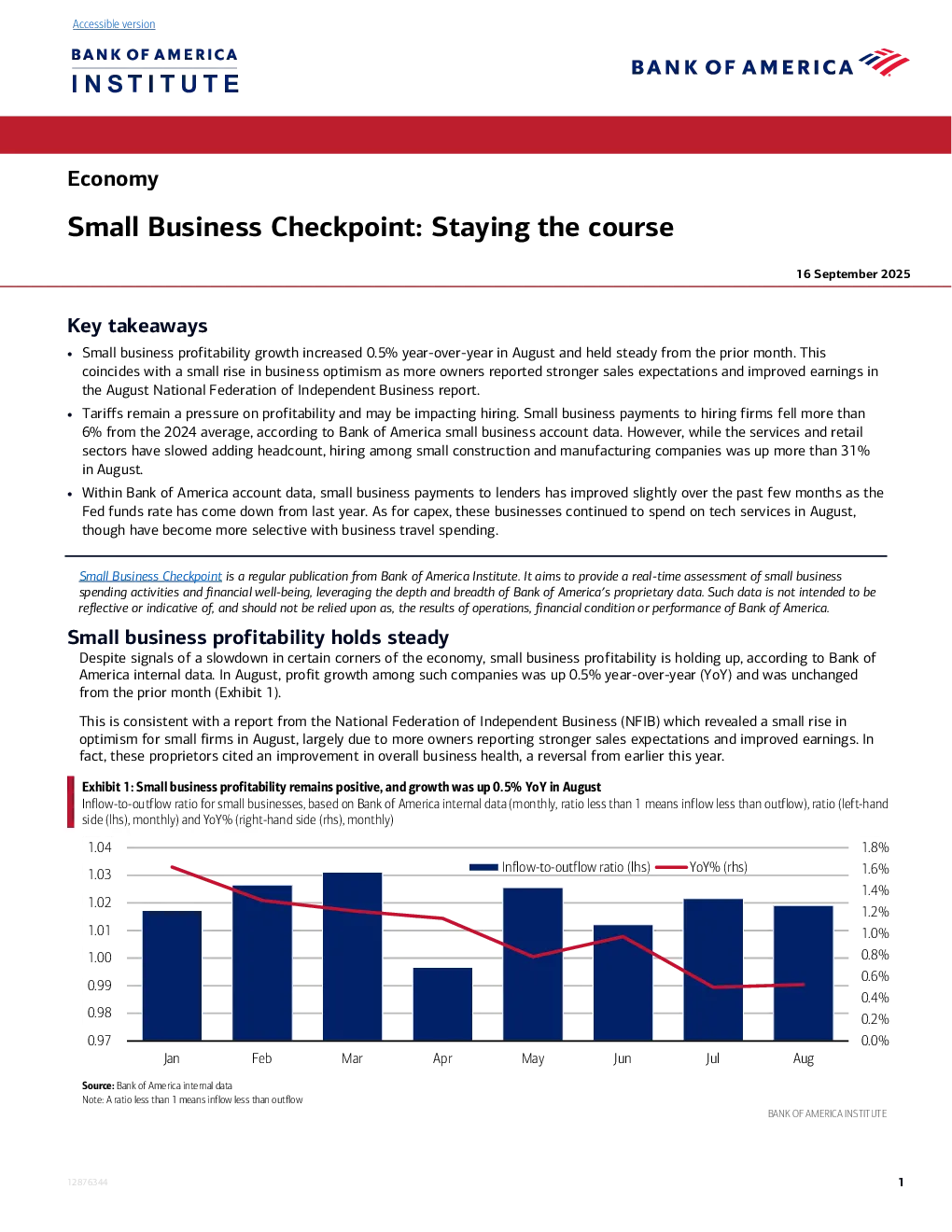
Small Business Checkpoint: Staying the course 16 September 2025 Key takeaways •Small business profitability growth increased 0.5% year-over-year in August and held steady from the prior month. Thiscoincides with a small rise in business optimism as more owners reported stronger sales expectations and improved earnings inthe August National Federation of Independent Business report. •Tariffs remain a pressure on profitability and may be impacting hiring. Small business payments to hiring firms fell more than6% from the 2024 average, according to Bank of America small business account data. However, while the services and retailsectors have slowed adding headcount, hiring among small construction and manufacturing companies was up more than 31%in August. •Within Bank of America account data, small business payments to lenders has improved slightly over the past few months as theFed funds rate has come down from last year. As for capex, these businesses continued to spend on tech services in August,though have become more selective with business travel spending. Small Business Checkpointis a regular publication from Bank of America Institute. It aims to provide a real-time assessment of small businessspending activities and financial well-being, leveraging the depth and breadth of Bank of America’s proprietary data. Such data is not intended to bereflective or indicative of, and should not be relied upon as, the results of operations, financial condition or performance of Bank of America. Small business profitability holds steadyDespite signals of a slowdown in certain corners of the economy, small business profitability is holding up, according to Bank of America internal data. In August, profit growth among such companies was up 0.5% year-over-year (YoY) and was unchangedfrom the prior month (Exhibit 1). This is consistent with a report from the National Federation of Independent Business (NFIB) which revealed a small rise inoptimism for small firms in August, largely due to more owners reporting stronger sales expectations and improved earnings. Infact, these proprietors cited an improvement in overall business health, a reversal from earlier this year. Exhibit1: Small business profitability remains positive, and growth was up 0.5%YoYin AugustInflow-to-outflow ratio for small businesses, based on Bank of America internal data (monthly, ratio less than 1 means inflow less than outflow), ratio (left-hand side (lhs), monthly) and YoY% (right-hand side (rhs), monthly) Tariffs and talent remain pain points for small businessesStill, tariffs remain a hindrance to small business profitability and have continued to rise since the start of the year (read more on this inAugust’s Small Business Checkpoint). Of the narrow subset of Bank of America small business clients making directpayments to US Customs and Border Protection (CBP), tariff payments per small business client increased 5.6% month-over-month (MoM) in August (Exhibit 2). While that is a moderation from May’s peak of 27.4%, these outsized payments are likely weighing on hiring decisions for somefirms. In fact, small business payments to hiring firms fell more than 6% in August from the 2024 average on a three-monthmoving average (Exhibit 3). In total volume amount, August marked the smallest monthly payment since the start of our series inJanuary 2023. Exhibit2:Of the small subset ofBank of Americasmall businessclients making CBP payments directly, tariff payments rose 5.6%MoM in August 2025Payments to CBP per small business client in 2025 (monthly, MoM%, 3- Exhibit3:Hiring has flatlined, and fallenmore than 6%below the2024 average level in August 2025Small business hiring payments in 2025 (indexed, 2024 average = 100, 3- month moving average, monthly) month moving average) Construction and manufacturing firms ramp up hiringThere are divergent signals in the labor market. According to Bank of America small business payments data, our proprietary alternative hiring indicator (see Methodology below) found that the slowdown in hiring among retail and services firms iscontinuing. By contrast, construction and manufacturing firms have ramped up staffing and their payments last month weremore than 30% above the 2024 average level (Exhibit 4). In an already tight construction labor market, immigration actions could potentially deepen workforce shortages, drive up costsand create additional financial risks for contractors. This coincides with the August NFIB findings, which showed that thedifficulty in filling open positions is particularly acute in the construction, manufacturing, and transportation industries. Nearlyhalf (49%) of small businesses in the construction industry had a job opening they could not fill, while openings were the lowestin the wholesale and finance industries. Small business hiring paymentsby sector(percentage point difference from 2024 average,3-month moving average,monthly) Uncertainty eases as financing expectatio