您的浏览器禁用了JavaScript(一种计算机语言,用以实现您与网页的交互),请解除该禁用,或者联系我们。[美国银行]:小企业检查站:少量库存和一些招聘 - 发现报告

小企业检查站:少量库存和一些招聘

医药生物2025-05-01美国银行善***
AI智能总结
查看更多
小企业检查站:少量库存和一些招聘

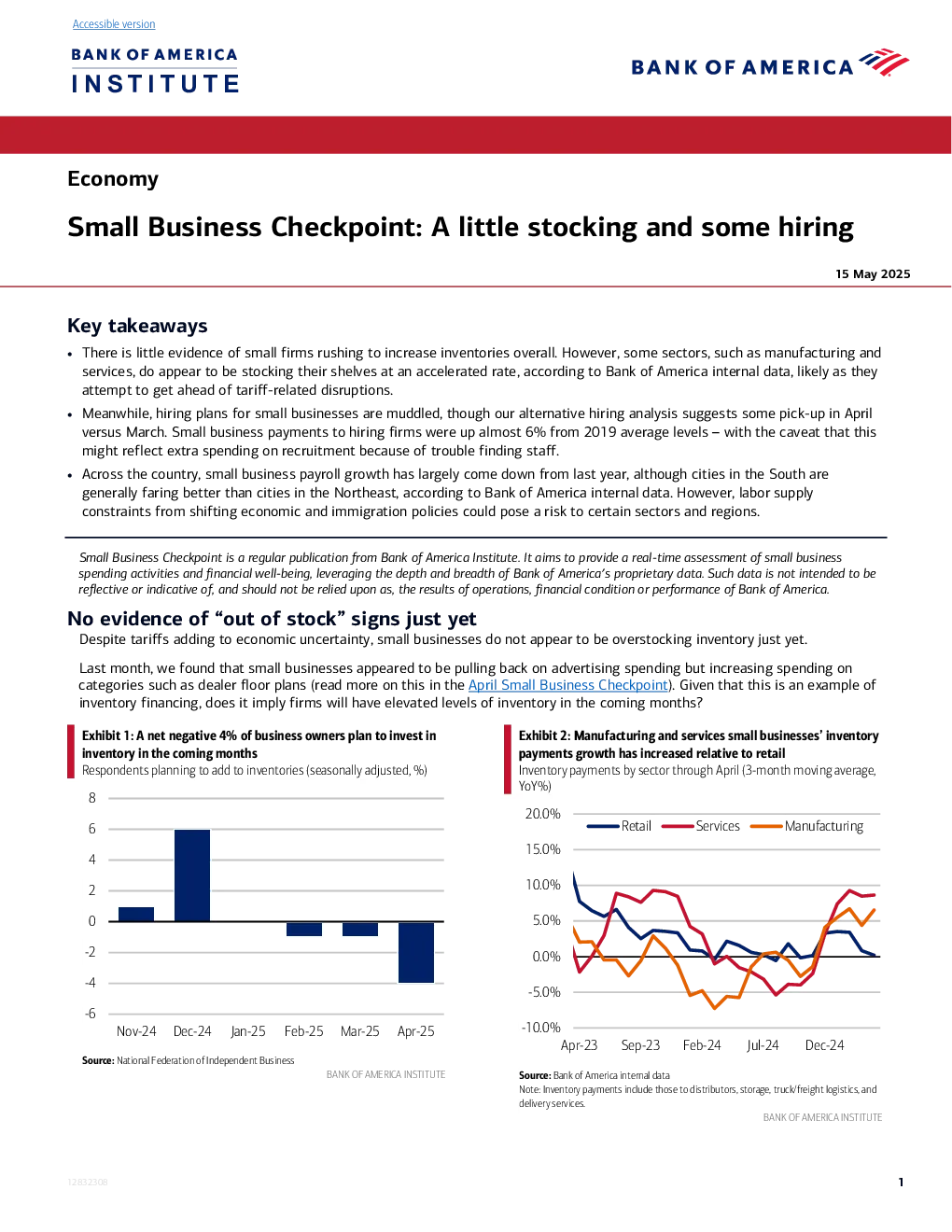
Small Business Checkpoint: A little stocking and some hiring 15 May 2025 Key takeaways •There is little evidence of small firms rushing to increase inventories overall. However, some sectors, such as manufacturing andservices, do appear to be stocking their shelves at an accelerated rate, according to Bank of America internal data, likely as theyattempt to get ahead of tariff-related disruptions. •Meanwhile, hiring plans for small businesses are muddled, though our alternative hiring analysis suggests some pick-up in Aprilversus March. Small business payments to hiring firms were up almost 6% from 2019 average levels–with the caveat that thismight reflect extra spending on recruitment because of trouble finding staff. •Across the country, small business payroll growth has largely come down from last year, although cities in the South aregenerally faring better than cities in the Northeast, according to Bank of America internal data. However, labor supplyconstraints from shifting economic and immigration policies could pose a risk to certain sectors and regions. Small Business Checkpoint is a regular publication from Bank of America Institute. It aims to provide a real-time assessment of small businessspending activities and financial well-being, leveraging the depth and breadth of Bank of America’s proprietary data. Such data is not intended to bereflective or indicative of, and should not be relied upon as, the results of operations, financial condition or performance of Bank of America. No evidence of “out of stock” signs just yetDespite tariffs adding to economic uncertainty, small businesses do not appear to be overstocking inventory just yet. Last month, we found that small businesses appeared to be pulling back on advertising spending but increasing spending oncategories such as dealer floor plans (read more on this in theApril Small Business Checkpoint). Given that this is an example ofinventory financing, does it imply firms will have elevated levels of inventory in the coming months? Exhibit1:Anet negative 4% of business owners plan to invest ininventory in the coming monthsRespondents planning to add to inventories (seasonally adjusted, %) Exhibit2: Manufacturing and services smallbusinesses’ inventorypayments growth has increased relative to retailInventory payments by sector through April (3-month moving average, YoY%) For retailers, we doubt it. In our view, any surge in imports over the last couple of months has likely been mostly offset with“buying ahead”by consumers. And, in fact, although there has been a surge in imports of consumer goods into the US in recentmonths, the ratio of retailers' inventories to their monthly sales was not especially high in recent data to begin with. Bank ofAmerica internal data on retailers' payments to transportation and shipping companies also does not suggest a big ramp-up ininventories in this sector (read more on this topic in May’sRetail inventories). Moreover, consumers have also been front loading purchases of durables to get ahead of potential tariff-related price increasesin March, with signs that this largely ran its course over April (read theMay 2025 Consumer Checkpointfor more), likely meaningthat both demand and supply for imported retail goods has been elevated recently. So, overall, in our view, retailers will notnecessarily have elevated inventory in coming months. Across other sectors, small firms are also not rushing to stock their inventories, according to the National Federation ofIndependent Business (NFIB;Exhibit 1). However, using Bank of America internal data on small business inventory paymentsgrowth (see Note inExhibit 2), we do see some signs of an increase in manufacturing and services–which might reflect firms inthese sectors making some attempts to secure supplies ahead of any tariff-related disruption. Small business hiring plans remain muddledWhat about small business hiring prospects over the coming months? Our updated alternative hiring analysis (which tracks small business payments to hiring firms; see Methodology) shows that overall job posting payments for April 2025 were up almost 6%above 2019 levels, an increase from last month’s -2% (Exhibit 3). But there’s a caveat: advertising a job does not necessarily lead to filling it. In fact, the rise in such payments may reflect theincreasing difficulty some companies are having filling job openings. Seasonally adjusted, 34% of business owners reportedhaving job openings they could not fill in April, according to the NFIB. The last time that job openings were below this level wasin January 2021. Markedly, there has been a muted trend of hiring over the last six months, and hiring during the first quarter of the year hasbeen mixed: February’s strength was largely due to the number of processing days and weather effects. In the past two months,small business hiring growth has turned negative (Exhibit 4). Exhibit3: In April, the volume of small business payments