您的浏览器禁用了JavaScript(一种计算机语言,用以实现您与网页的交互),请解除该禁用,或者联系我们。 [iCARDIO联盟]:iCARDIO联盟肥胖管理全球实施指南2025 - 发现报告

iCARDIO联盟肥胖管理全球实施指南2025

基础化工 2026-02-04 iCARDIO联盟 飞鹤萘酚
报告封面

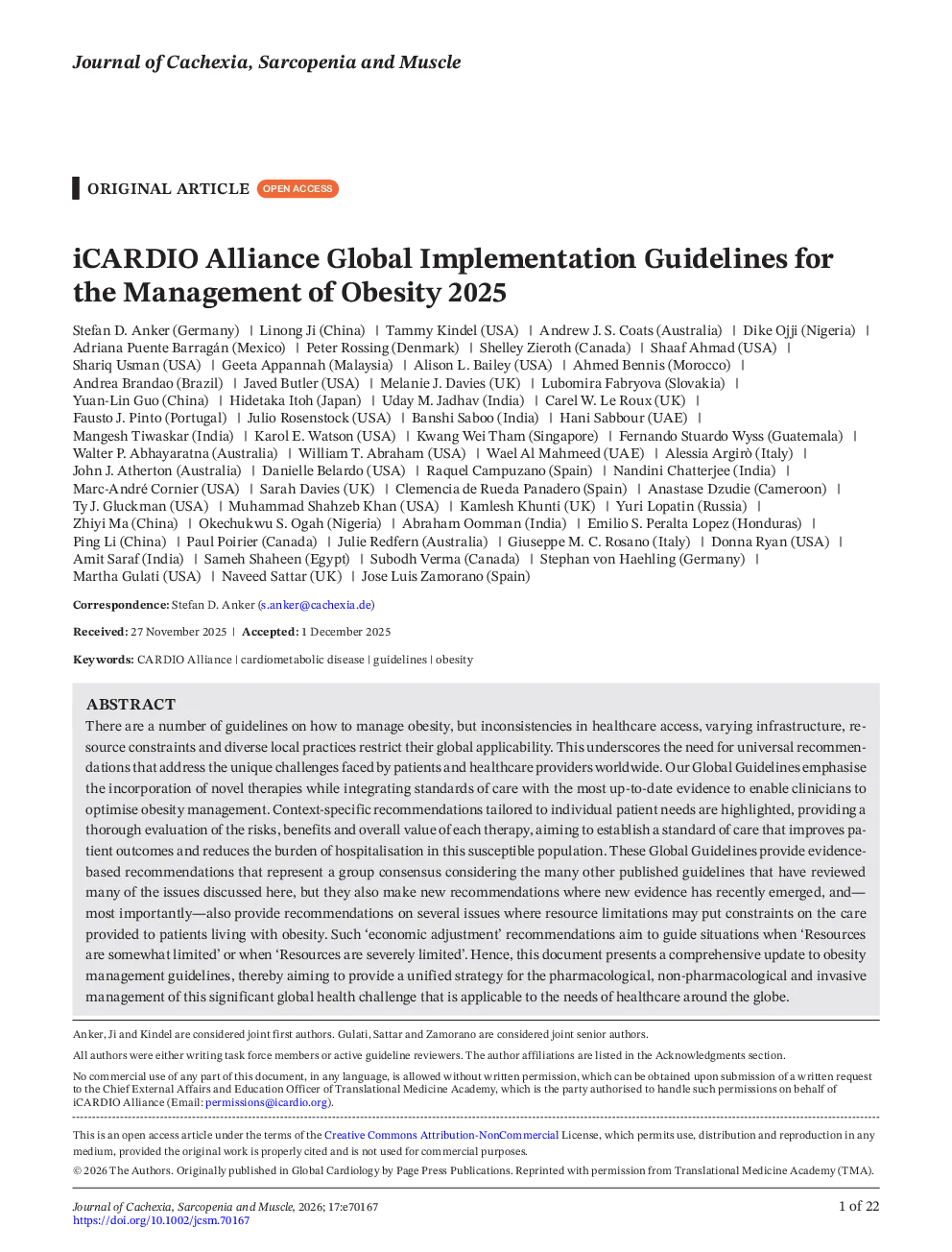
Stefan D. Anker (Germany)| Linong Ji (China)| Tammy Kindel (USA)| Andrew J. S. Coats (Australia)| Dike Ojji (Nigeria)|Adriana Puente Barragán (Mexico)| Peter Rossing (Denmark)| Shelley Zieroth (Canada)| Shaaf Ahmad (USA)|Shariq Usman (USA)| Geeta Appannah (Malaysia)| Alison L. Bailey (USA)| Ahmed Bennis (Morocco)|Andrea Brandao (Brazil)| Javed Butler (USA)| Melanie J. Davies (UK)| Lubomira Fabryova (Slovakia)|Yuan-Lin Guo (China)| Hidetaka Itoh (Japan)| Uday M. Jadhav (India)| Carel W. Le Roux (UK)|Fausto J. Pinto (Portugal)| Julio Rosenstock (USA)| Banshi Saboo (India)| Hani Sabbour (UAE)|Mangesh Tiwaskar (India)| Karol E. Watson (USA)| Kwang Wei Tham (Singapore)| Fernando Stuardo Wyss (Guatemala)|Walter P. Abhayaratna (Australia)| William T. Abraham (USA)| Wael Al Mahmeed (UAE)| Alessia Argirò (Italy)|John J. Atherton (Australia)| Danielle Belardo (USA)| Raquel Campuzano (Spain)| Nandini Chatterjee (India)|Marc-André Cornier (USA)| Sarah Davies (UK)| Clemencia de Rueda Panadero (Spain)| Anastase Dzudie (Cameroon)|Ty J. Gluckman (USA)| Muhammad Shahzeb Khan (USA)| Kamlesh Khunti (UK)| Yuri Lopatin (Russia)|Zhiyi Ma (China)| Okechukwu S. Ogah (Nigeria)| Abraham Oomman (India)| Emilio S. Peralta Lopez (Honduras)|Ping Li (China)| Paul Poirier (Canada)| Julie Redfern (Australia)| Giuseppe M. C. Rosano (Italy)| Donna Ryan (USA)|Amit Saraf (India)| Sameh Shaheen (Egypt)| Subodh Verma (Canada)| Stephan von Haehling (Germany)|Martha Gulati (USA)| Naveed Sattar (UK)| Jose Luis Zamorano (Spain) Correspondence:Stefan D. Anker (s.anker@cachexia.de) Received:27 November 2025|Accepted:1 December 2025 Keywords:CARDIO Alliance | cardiometabolic disease | guidelines | obesity ABSTRACT There are a number of guidelines on how to manage obesity, but inconsistencies in healthcare access, varying infrastructure, re-source constraints and diverse local practices restrict their global applicability. This underscores the need for universal recommen-dations that address the unique challenges faced by patients and healthcare providers worldwide. Our Global Guidelines emphasisethe incorporation of novel therapies while integrating standards of care with the most up-to-date evidence to enable clinicians tooptimise obesity management. Context-specific recommendations tailored to individual patient needs are highlighted, providing athorough evaluation of the risks, benefits and overall value of each therapy, aiming to establish a standard of care that improves pa-tient outcomes and reduces the burden of hospitalisation in this susceptible population. These Global Guidelines provide evidence-based recommendations that represent a group consensus considering the many other published guidelines that have reviewedmany of the issues discussed here, but they also make new recommendations where new evidence has recently emerged, and—most importantly—also provide recommendations on several issues where resource limitations may put constraints on the careprovided to patients living with obesity. Such ‘economic adjustment’ recommendations aim to guide situations when ‘Resourcesare somewhat limited’ or when ‘Resources are severely limited’. Hence, this document presents a comprehensive update to obesitymanagement guidelines, thereby aiming to provide a unified strategy for the pharmacological, non-pharmacological and invasivemanagement of this significant global health challenge that is applicable to the needs of healthcare around the globe. USD per capita in the Americas and from 6 USD in low-incomecountries to 1110 USD in high-income countries [9]. This under-scores the importance of adequate recognition of approaches forearly detection, lifestyle modification–based management, drugtherapies and surgical modalities quintessential to dealing withthe perils of the rapidly increasing prevalence of obesity. 1|Preamble TheInternational CARDIO Alliance to Improve DiseaseOutcomes (iCARDIO Alliance: https://icardioalliance.org) aimsto gather leading cardiovascular societies around the globe aspartner organisations to improve the quality of cardiovascularcare, from prevention and diagnosis to treatment and follow-up.The goal of these global implementation guidelines is to achieveglobal representation in writing panels and to produce conciseand practical guidelines applicable to all cardiovascular careworldwide. In addition to clinical practice guidelines (CPGs) de-veloped by other medical associations, the recommendations byiCARDIO Alliance take into account resource availability on atleast three economic levels (with no economic consideration; re-sources somewhat limited; resources severely limited). They arewritten by a team including world-renowned experts with a max-imum of 50% of the writing task force representing Europe andNorth America and 50% or more from the rest of the world. Thepeer review team is also made up of global experts further enrich-ing these documents and leading to a final phase of public reviewopen to all. Furthermore, we