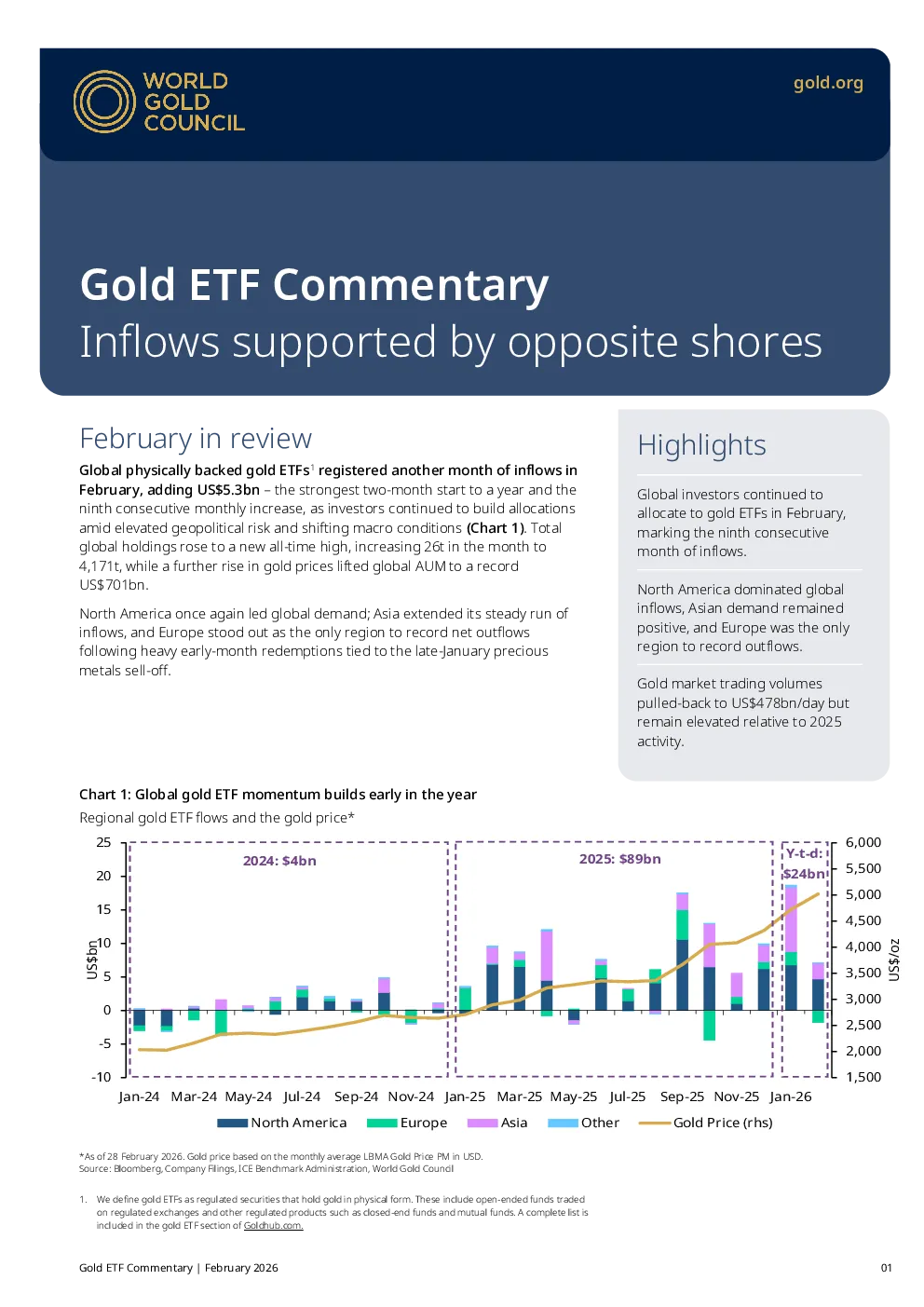
February in review Highlights Global physically backed gold ETFs1registered another month of inflows inFebruary, adding US$5.3bn– the strongest two-month start to a year and theninth consecutive monthly increase, as investors continued to build allocationsamid elevated geopolitical risk and shifting macro conditions(Chart1). Totalglobal holdings rose to a new all‑time high, increasing 26t in the month to4,171t, while a further rise in gold prices lifted global AUM to a recordUS$701bn. Global investors continued toallocate to gold ETFs in February,marking the ninth consecutivemonth of inflows. North America dominated globalinflows, Asian demand remainedpositive, and Europe was the onlyregion to record outflows. North America once again led global demand; Asia extended its steady run ofinflows, and Europe stood out as the only region to record net outflowsfollowing heavy early‑month redemptions tied to the late‑January preciousmetals sell‑off. Gold market trading volumespulled-back to US$478bn/day butremain elevated relative to 2025activity. Regional gold ETF flows and the gold price* Within Europe, the UK accounted for the bulk ofredemptions (-US$1.9bn), reflecting its outsized share of theregion’s gold ETF market; Germany followed at a distantsecond (-US$291mn). As the bulk of outflows on30 Januaryand 2 February was concentrated inUK‑listed funds– andnot tied to a wider regional or country-specific macro event –we do not interpret this divergence as the start of a longer-term structural trend. Regional overview North America added US$4.7bn in February, marking itsninth consecutive month of inflows.While this may notsurprise many investors, given the current environment,such a sustained run is notable and shouldn’t be overlooked. Outside of the initial conditions phase2there have only beentwo other periods in which the region recorded at least ninestraight months of inflows – during the Global Financial Crisis(GFC) andthe COVID‑19 pandemic. Although these episodeswere driven by different dynamics, both were characterisedby elevated systemic risk. As a result, diversification intosafe‑haven assets remains a consistent theme for investors. Asian funds expanded inflows to six months in a row,albeit at a slower pace, attracting US$2.3bn in February.Japan led inflows in the region.Political uncertainty earlier inthe month, escalating tensions with China, the weakeningyen, and gold’s strong performance in the currency (+6%) allsupportedJapanesegold ETF demand. China saw mildinflows, partially due to fewer trading days amid the ChineseNew Year holiday. Gold’s muted performance in RMB alsodiscouraged further buying. It is worth noting that the newgold ETF launched in Hong Kong SAR is attracting attentionas it offers both listed shares and tokenised units; thiscontributed to the area’s inflows.5 The recent rally in gold prices,following the late‑Januarypullback and early‑February softness, also helped attract newbuyers and contributed to inflows. It was the usual suspects that helped drive these inflows: •Heightened geopolitical risk, particularly involving Iran3•A more favourable opportunity cost for holding gold,driven by dollar weakness and lower rates•Ongoing trade and policy uncertainty following theSupreme Court’s ruling on tariffs4•Equity market concern, as software and SaaS-relatednames continued to weigh on the broader market. India recorded healthy inflows of US$565mn, although thisrepresented a moderation from the elevated prior two-month average of US$2bn. Redemptions from some of thelarger funds earlier in the month were likely driven by profittaking as the gold price pulled back, but these weregradually offset as the month progressed, underscoringsustained interest in gold ETFs. This growing interest wasfurther supported by the SEBI’s recent overhaul of themutual fund scheme‑categorisation framework, whichnowgives funds greater flexibility to increase exposure to goldand silver instruments within defined limits.6 Europe was the only region to record outflows ofUS$1.8bn in February, driven almost entirely by heavyredemptions during the first week as the late‑Januaryprecious metals sell-off spilled into early February. Althoughflows turned positive in subsequent weeks, including anotable rebound of roughly US$0.9bn in the second week,the early‑month liquidation remained too large to offset. Funds in other regions saw further net buying, adding amodest US$17mn. The third consecutive monthly inflow wasmainly from Australia, but this was partially offset by SouthAfrican outflows. 4.Supreme Court strikes down Trump’s tariffs| Politico | 20 February 20265.See:Hang Seng Gold ETF | Hang Seng Investment Management6.India revamps mutual fund rulebook, opens room for higher gold and silver exposure|Reuters | 26 February 2026 Tonnage‑based volume reflected the broader slowdown,averaging2,969t/day in February – down 26% m/m andbelow the 2025 average of 3,247t/day. Exchange tradingaccounted for mos