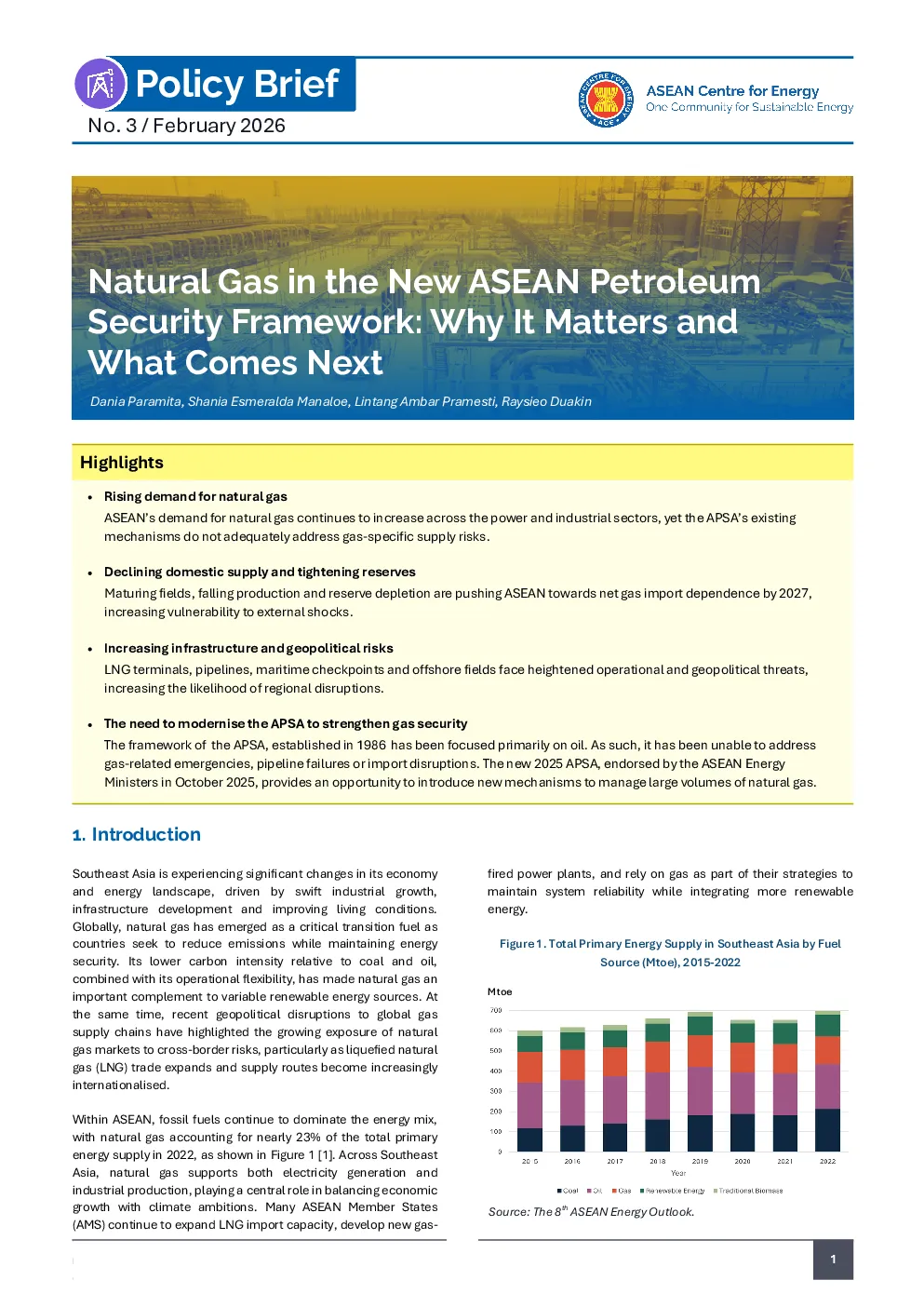
Dania Paramita, Shania Esmeralda Manaloe, Lintang Ambar Pramesti, Raysieo Duakin Highlights Rising demand for natural gas ASEAN’s demand for natural gas continues to increase across the power and industrial sectors, yet the APSA’s existingmechanisms do not adequately address gas-specific supply risks. Declining domestic supply and tightening reserves Maturing fields, falling production and reserve depletion are pushing ASEAN towards net gas import dependence by 2027,increasing vulnerability to external shocks. Increasing infrastructure and geopolitical risks LNG terminals, pipelines, maritime checkpoints and offshore fields face heightened operational and geopolitical threats,increasing the likelihood of regional disruptions. The need to modernise the APSA to strengthen gas security The framework ofthe APSA, established in 1986has been focused primarily on oil. As such, it has been unable to addressgas-related emergencies, pipeline failures or import disruptions. The new 2025 APSA, endorsed by the ASEAN Energy Introduction1. Southeast Asia is experiencing significant changes in its economyandenergy landscape,driven by swift industrial growth,infrastructuredevelopment and improving living conditions.Globally, natural gas has emerged as a critical transition fuel ascountries seek to reduce emissions while maintaining energysecurity. Its lower carbon intensity relative to coal and oil, fired power plants, and rely on gas as part of their strategies tomaintainsystem reliability while integrating more renewable Within ASEAN, fossil fuels continue to dominate the energy mix,with natural gas accounting for nearly 23% of the total primaryenergy supply in 2022, as shown in Figure 1[1]. Across SoutheastAsia,natural gas supports both electricity generation andindustrial production, playing a central role in balancing economicgrowth with climate ambitions. Many ASEAN Member States Policy Brief Reasons for ASEAN to IncorporateNatural Gas into the New APSA2. However, ASEAN’s natural gas security outlook is evolving.While natural gas use is expanding across the region, domesticsupply conditions and external dependencies are becomingmore complex, increasing exposure to market volatility, supply ASEAN’s increasingly complex gas landscape, marked by risingdemand, tightening domestic supply, and growing exposure toinfrastructure and geopolitical risks, has shifted natural gasfrom a solely national energy issue into a matter of regional ASEANadopted its ASEAN Petroleum Security Agreement(APSA) in 1986. At that time, oil security was the dominantconcern. Over the years, it was updated to reflect changing 2.1.Rising Dependence on Natural Gas Earlier versions of the APSA, particularly the 2013 Agreement,continuedthe oil-centred focus.Whilethe definition ofpetroleum included natural gas, the focus was mainly on liquidfuels such as crude oil and refined oil products. This definition While ASEAN’s total final energy consumption (TFEC) continuesto increase, the region faces an urgent challenge to balancerapid economic growth with sustainable energy practices.. As illustratedin Figure 1,according to the 8ASEANEnergyOutlook (AEO8), ASEAN’s energy demand under the BaselineScenario will be 2.6 times higher than the 2022 level by2050,and natural gas will continue to be one of the key fuels meetingthis demand [1]. Most of the natural gas consumed in the region The recently endorsed 2025 APSA recognises the transitiontowards a reliance on net gas imports by distinguishing naturalgas from petroleum and advocating the creation of a specialisednaturalgas Coordinated Emergency Response Mechanism No. 3 / February 2026 The demand for natural gas is rising not just due to economicexpansion, but also because it serves as a transitional or“bridge” fuel to support the transition from high-emission fossilfuels like coal to cleaner energy sources [4]. Natural gas emitslessgreenhouse gases than coal and oil do, generates fewer Data from the ASEAN Oil and Gas Updates 2024 also confirm aclear upward trajectory in regional natural gas consumption. In2022, ASEAN consumed 30.49 million tonnes of oil equivalent(Mtoe) of natural gas, and consumption increased by 4.56%from 2022 to 2023, with Indonesia and Malaysia recording thehighest growth rates [5]. Looking forward, ASEAN’s demand for Two AMS exhibit particularly high dependence on natural gas for Singaporerelies on natural gas for around 95%of itselectricitygeneration,making it one of the most gas-dependent power systems globally. With no domestic pro- Policy Brief resultin electricity shortages and other serious economicimpacts.This growing dependence reinforces the case forintegrating natural gas into APSA, ensuring that the AMS have a duction, Singapore’s electricity security is directly linked tothe availability and reliability of imported gas and LNG Thailandalso relies on natural gas for approximately 68% ofits power generation, even as domestic production declines.Incr