加拿大丰业银行美股招股说明书(2026-03-04版)
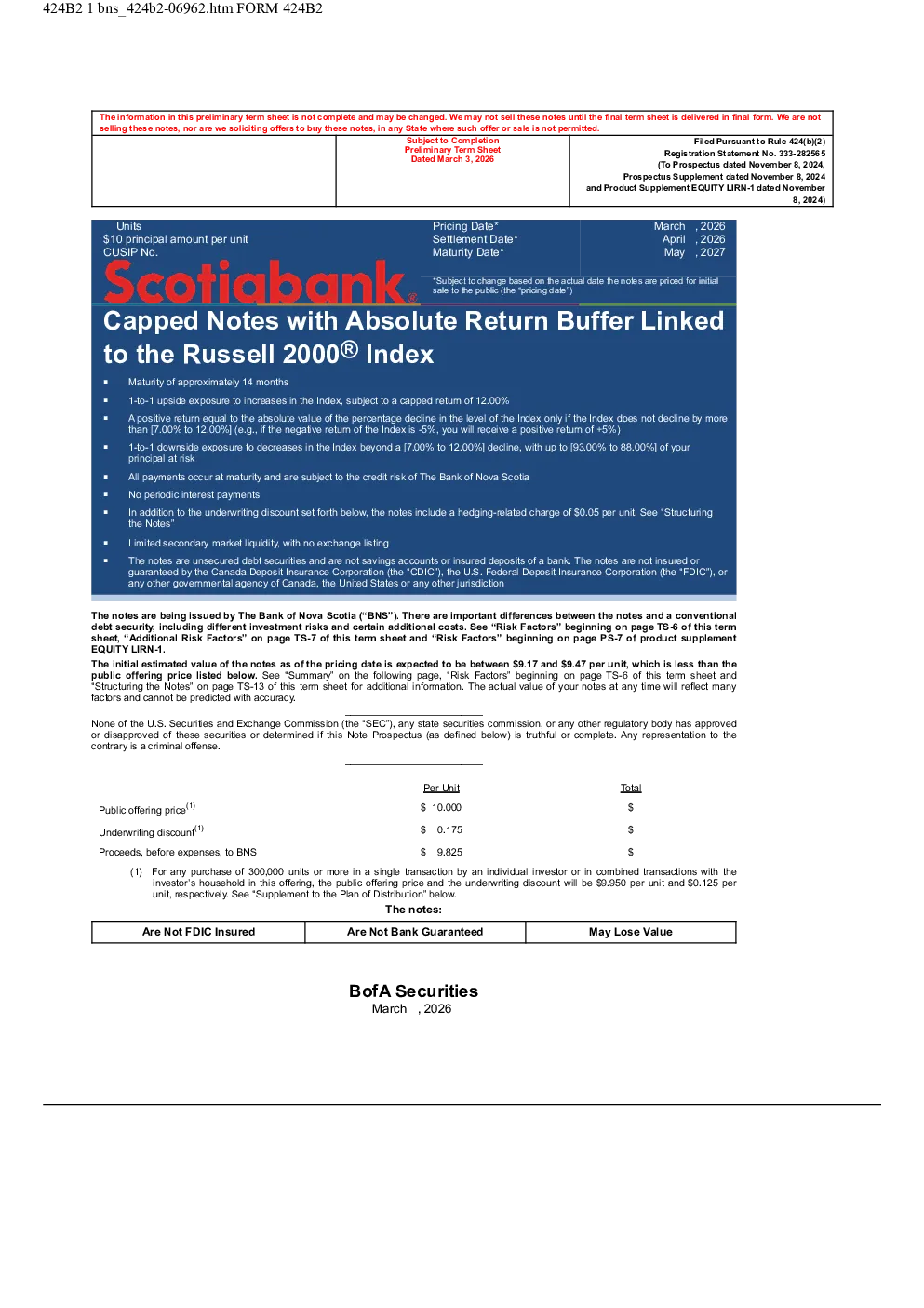
■1-to-1 upside exposure to increases in the Index, subject to a capped return of 12.00% ■A positive return equal to the absolute value of the percentage decline in the level of the Index only if the Index does not decline by morethan [7.00% to 12.00%] (e.g., if the negative return of the Index is -5%, you will receive a positive return of +5%) ■1-to-1 downside exposure to decreases in the Index beyond a [7.00% to 12.00%] decline, with up to [93.00% to 88.00%] of yourprincipal at risk ■All payments occur at maturity and are subject to the credit risk of The Bank of Nova Scotia ■No periodic interest payments ■In addition to the underwriting discount set forth below, the notes include a hedging-related charge of $0.05 per unit. See “Structuringthe Notes” ■Limited secondary market liquidity, with no exchange listing ■The notes are unsecured debt securities and are not savings accounts or insured deposits of a bank. The notes are not insured orguaranteed by the Canada Deposit Insurance Corporation (the “CDIC”), the U.S. Federal Deposit Insurance Corporation (the “FDIC”), orany other governmental agency of Canada, the United States or any other jurisdiction The notes are being issued by The Bank of Nova Scotia (“BNS”). There are important differences between the notes and a conventionaldebt security, including different investment risks and certain additional costs. See “Risk Factors” beginning on page TS-6 of this termsheet, “Additional Risk Factors” on page TS-7 of this term sheet and “Risk Factors” beginning on page PS-7 of product supplement The initial estimated value of the notes as of the pricing date is expected to be between $9.17 and $9.47 per unit, which is less than thepublic offering price listed below.See “Summary” on the following page, “Risk Factors” beginning on page TS-6 of this term sheet and“Structuring the Notes” on page TS-13 of this term sheet for additional information. The actual value of your notes at any time will reflect many None of the U.S. Securities and Exchange Commission (the “SEC”), any state securities commission, or any other regulatory body has approvedor disapproved of these securities or determined if this Note Prospectus (as defined below) is truthful or complete. Any representation to thecontrary is a criminal offense._________________________ Capped Notes with Absolute Return Buffer Summary The Capped Notes with Absolute Return Buffer Linked to the Russell 2000®Index due May, 2027 (the “notes”) are our senior unsecured debtsecurities. The notes are not guaranteed or insured by the CDIC or the FDIC, and are not, either directly or indirectly, an obligation of any thirdparty. The notes are not bail-inable debt securities (as defined in the prospectus).The notes will rank equally with all of our other unsecuredsenior debt. Any payments due on the notes, including any repayment of principal, will be subject to the credit risk of BNS.The notes provide you a 1-to-1 return, subject to a cap, if the Ending Value of the Market Measure, which is the Russell 2000®Index (the “Index”), is greaterthan the Starting Value. If the Ending Value is equal to or less than the Starting Value but greater than or equal to the Threshold Value, you willreceive a positive return equal to the absolute value of the percentage decline in the Index from the Starting Value to the Ending Value (e.g., if thenegative return of the Index is -5%, you will receive a positive return of +5%). If the Ending Value is less than the Threshold Value, you will lose a The economic terms of the notes (including the Capped Value and Threshold Value) are based on our internal funding rate, which is the rate wewould pay to borrow funds through the issuance of market-linked notes, and the economic terms of certain related hedging arrangements. Ourinternal funding rate is typically lower than the rate we would pay when we issue conventional fixed rate debt securities. This difference in fundingrate, as well as the underwriting discount and the hedging related charge described below, will reduce the economic terms of the notes to you and On the cover page of this term sheet, we have provided the initial estimated value range for the notes. This range of estimated values wasdetermined by reference to our internal pricing models, which take into consideration certain factors, such as our internal funding rate on thepricing date and our assumptions about market parameters. For more information about the initial estimated value and the structuring of the notes, Terms of the Notes Capped Notes with Absolute Return Buffer Linked to the Russell 2000®Index due May, 2027 The terms and risks of the notes are contained in this term sheet and in the following: ■Product supplement EQUITY LIRN-1 dated November 8, 2024:http://www.sec.gov/Archives/edgar/data/9631/000183988224038306/bns_424b2-21308.htm■Prospectus supplement dated November 8, 2024:http://www.sec.gov/Archives/edgar/data/9631/000183988224038303/bns_424b3-2