2013年欧洲旅游业——趋势与前景(2013年第三季度)
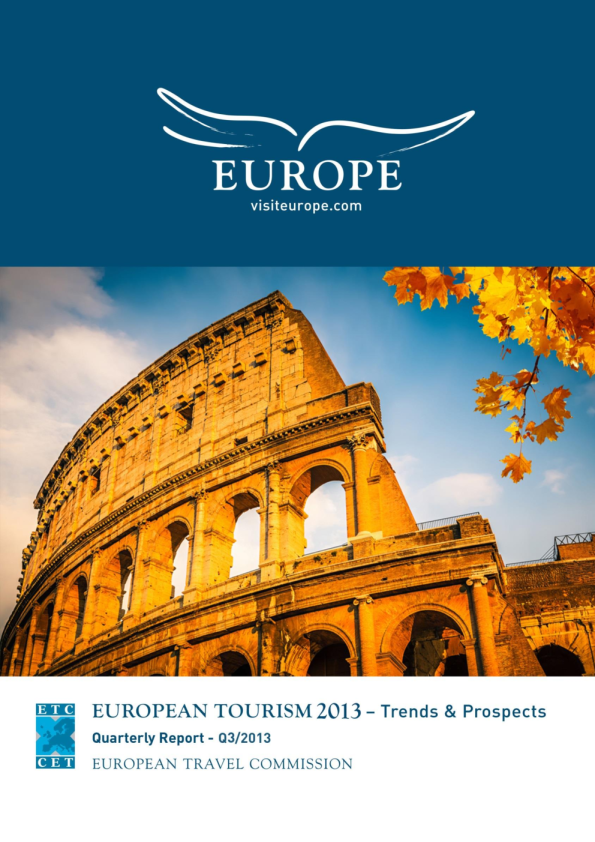
EUROPEAN TOURISM in 2013: Quarterly Report (Q3/2013) A quarterly insights report produced for the Market Intelligence Groupof theEuropean Travel Commission (ETC)byTourism Economics (an Oxford Economics Company) Copyright © 2013 European Travel Commission European Tourism in 2013: Trends & Prospects (Q3/2013) All rights reserved.The contents of this report may be quoted, provided the sourceis given accurately and clearly.Distribution or reproduction in full is permitted forown or internal use only.While we encourage distribution via publicly accessible websites,this should be done via a link to ETC's corporate website,www.etc-corporate.org, referring visitors to the Market Intelligence Section. The designations employed and the presentation of material in this publication do Data sources: This report includes data from the TourMIS database /http://www.tourmis.info, STR Global, IATA, AEA and UNWTO. Economic analysis and forecasts are provided by Tourism Economics and Published and printed by the European Travel CommissionRue du Marché aux Herbes, 61, 1000 Brussels, BelgiumWebsite:www.etc-corporate.org Email:info@visiteurope.com ISSN No: 2034-9297 Cover: Colosseum in Rome, ItalyPhoto © Shutterstock / S. Borisov Foreword Strong international demand supports Europeantourism Preliminary results for the first three quarters of 2013 point to astrong performance of tourism in Europe. UNWTO1estimates pointto a 5%year-to-date growth,which is well aboveEurope’s long-term trend and close togrowth in world’s fastest Most of the 32 destinations reporting foreign visits throughMay-Augustpost positive growth.A strong performance isreported by Europe’s largest destinations, such asthe UK(+6%), Spain (+5%), Germany (+4%), Austria and Italy (both+3%). Almost all the medium-sized destinations report above Consumers remain cost-conscious and consolidate the trendtowardsshorter stays,as suggested by a more moderategrowth in overnights compared to arrivals. A notable exceptionis Bulgaria (+6% in arrivals and +8% in overnights), which International travel from the UK and France eventuallyrebound,on top of a strong performance of the Germanmarket. Travel demand from Russia persists at high growthlevels, turning this market into a consistent source of visitors Travel from the US remains solid, although growth somewhatslowed throughout the year, reflecting business and consumerconfidence stall over fiscal uncertainty. The Chinese travelmarketremains the fastest-growing market for most ETCdestinations, supported by the rise of personal incomes and Destinationsin Europe successfully capture growth potential,but remain exposed to Targeted strategies are the solid foundation of Europe’s growth. Ireland (+7%)reaps the benefit of“TheGathering Ireland”, a global campaign targeting the 70 million people Irish diaspora, while Germany(+4%) consolidates growth through a theme year focussed on young travellers. Other ETC memberscapitalise on the international exposure received through large-scale events, such as Italy on the The coordination between tourism and aviation turned out to be crucial for the success of destinationssuch as Malta (+9%), Croatia (+6%) and Portugal (+8%), who benefit of route expansion. Opposite sideof the same coin, Estonia subdued growth (+3%) is mainly linked to route cuts with airports in Germanyand the UK, with trickle down effects on travel from markets connected via these hubs. Similarly, Finnair’s Tax burden could halt European tourism take-off There have been encouraging signs that an economic recovery is underway in Europe, although annualgrowth is estimated at 0% in the EU and -0,4% in the euro area. Prospects for next year point to a gradually increasing pace of growth, pointing to 1,4 % in the EU and 1,1 % the euro area in 20142,underpinned in many cases by the significant structural reforms and fiscal consolidation. Tourism remains one of the best performing sectors in many European economies, and a significantsource of income and labour. Tourism may be seen as an increasingly appealing source of governmentrevenues through additional taxation. Instead, tourism resilience should be an incentive for governmentsto build a legislative framework that encourages growth in this sector, as this would spread over thebroader economy. “Croatia is a success story in this respect”, says Eduardo Santander, ExecutiveDirector at ETC.”The Croatian government approved a 50%cut in VAT on tourism services at the 2013 Tourism Performance Summary Initial data available for the peak summer months suggest some clear improvement intravel demand for European destinations. Increased tourism demand coincided with a Of the 25 European destinations reporting inbound travel trends through at least May, afull 23 report that arrivals have been higher than in 2012 (using data reported throughTourMIS). Growth markets account for over 80% of tourist arrivals in these reportingdestinations.However,there re