2013年欧洲旅游业——趋势与前景(2013年第一季度)
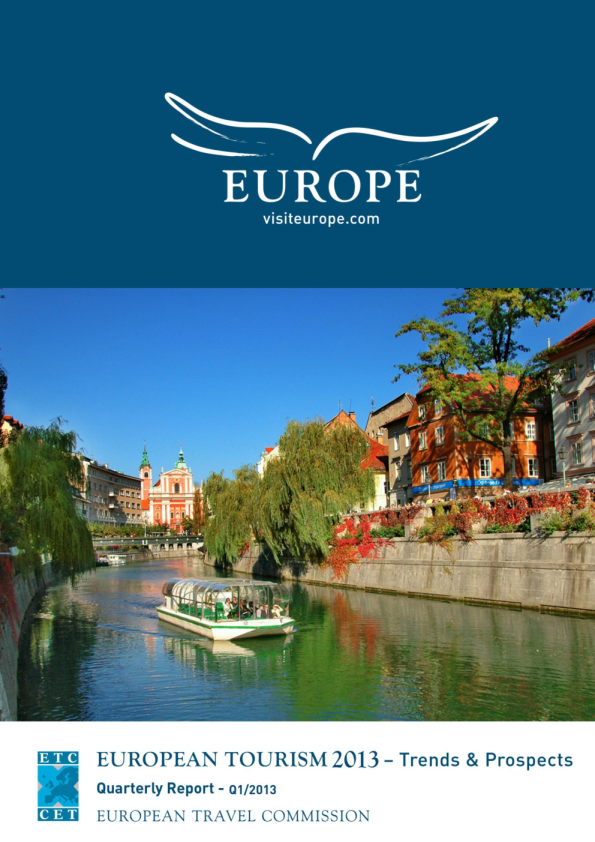
EUROPEAN TOURISM in 2013: Quarterly Report (Q1/2013) A quarterly insights report produced for the Market Intelligence Groupof theEuropean Travel Commission (ETC) Copyright © 2013 European Travel Commission European Tourism in 2013: Trends & Prospects (Q1/2013) All rights reserved.The contents of this report may be quoted, provided the sourceis given accurately and clearly.Distribution or reproduction in full is permitted forown or internal use only.While we encourage distribution via publicly accessible The designations employed and the presentation of material in this publication do Data sources:This report includes data fromtheTourMISdatabase/http://www.tourmis.info, STR Global, IATA, AEA and UNWTO. Economic analysis and forecasts are provided by Tourism Economics and ISSN No: 2034-9297 This report was compiled and edited by:Tourism Economics (an Oxford Economics Company) Cover: The River Ljubljanica, Ljubljana, Slovenia. ©SPIRIT Slovenia.Photographer: Dunja Wedam Foreword Appetite for tourism is expected to remain through 2013 The UN World Tourism Organization expects worldtourism to grow on average between 3% and 4% thisyear. Growth is forecast in all world regions, withEurope (+2% to +3%) and the Americas (+3% to International arrivals and nights to Europe for the firstmonthsof 2013 point to a slower,but continuedgrowth for most of the reporting destinations. Keyindicatorsfrom the aviation and accommodation Source : TourMIS*date varies (Jan-Mar) by destination Forthe remaining months of 2013,Europeandestinations’ performance will largely depend on theeconomicperformance of intra-European markets.Cross-borderdemand rose in importance through Source : TourMIS*date varies (Jan-Mar) by destination The multi-speed economic recovery in Europe mayexacerbate changes in travel patterns. Travel fromsomelarge Southern and Western Europeanmarkets(e.g.Italy,Spain and the Netherlands)slowed down during the first months of 2013. Asfurtherlow cost options are sought,demand for Source: AEA The most attractive prospects for Europe come from long-haul While they represent just some 20% of total inbound travel, long-haul marketswill initially drive growth in 2013. Key indicators suggest further growth in travelfrom US, where consumer spending has remained remarkably strong despitethe threat of imminent spending cuts. A recovering housing market, improving Among the rapidly emerging markets, Chinese tourism is expected to continuesoaring in most European destinations, though moving from a low base. Indian European tourism growth shines light amid economic gloom The EU economy will gradually overcome headwinds, but the outlook for 2013remains negative. Policy actions have managed to reduce risks and improvemarket confidence. Yet the latest economic forecast of the European Union Tourism can hence play a key role as a tool for economic development and jobcreation, within Europe and worldwide. Growing faster than the global economy(+2.4%), WTTC expects the total contribution of Travel and Tourism to the worldeconomy to expand by 3.2% in 2013 and to support nearly 266 million jobs this Growth-supporting actions should be taken to maximize tourism contribution toweak economies, especially in Europe’s peripheral areas. In the immediatefuture,marketing and promoting Europe overseas will facilitate the rising ETC Market Intelligence Group 2013 Tourism Performance Summary Source : TourMIS*date varies (Jan-Mar) by destination International travel has continued to grow in early 2013 to the majority of theEuropean destinations that have reported data. This is clearly an encouragingindication of performance for the coming year. But the growth rates trend is a Travel to Iceland grew strongly during 2012 and early 2013 and the destination isstill apparently benefitting from the competitiveness boost delivered by currencydepreciation in 2008/09. This was followed by the volcanic eruption in 2010 and With only limited data available for up to three months of the year it is not likelythat these trends will be representative of growth rates for 2013 as a whole at thecountry level. For example, travel to Iceland in the period January to Marchtypically represents less than 15% of the volume for the year, while the peak Combined with the industry data it is clear that demand for European tourism hascontinued to grow through the first quarter of 2013, albeit at a slower rate than in2012. This may be consistent with lower demand for some destinations but The strongest growth in demand remains from emerging markets, although theserepresent a small proportion of arrivals. Slower intra-European demand is a more Growth in overnights remains lower than for arrivals for many destinations as costsavings,including shorter stays,remain important factors in travel choices.Industry data now suggest that domestic demand may now be growing at the 2012 Tourism Performance Summary Final2012 data are now available f