预制房屋雷达2025
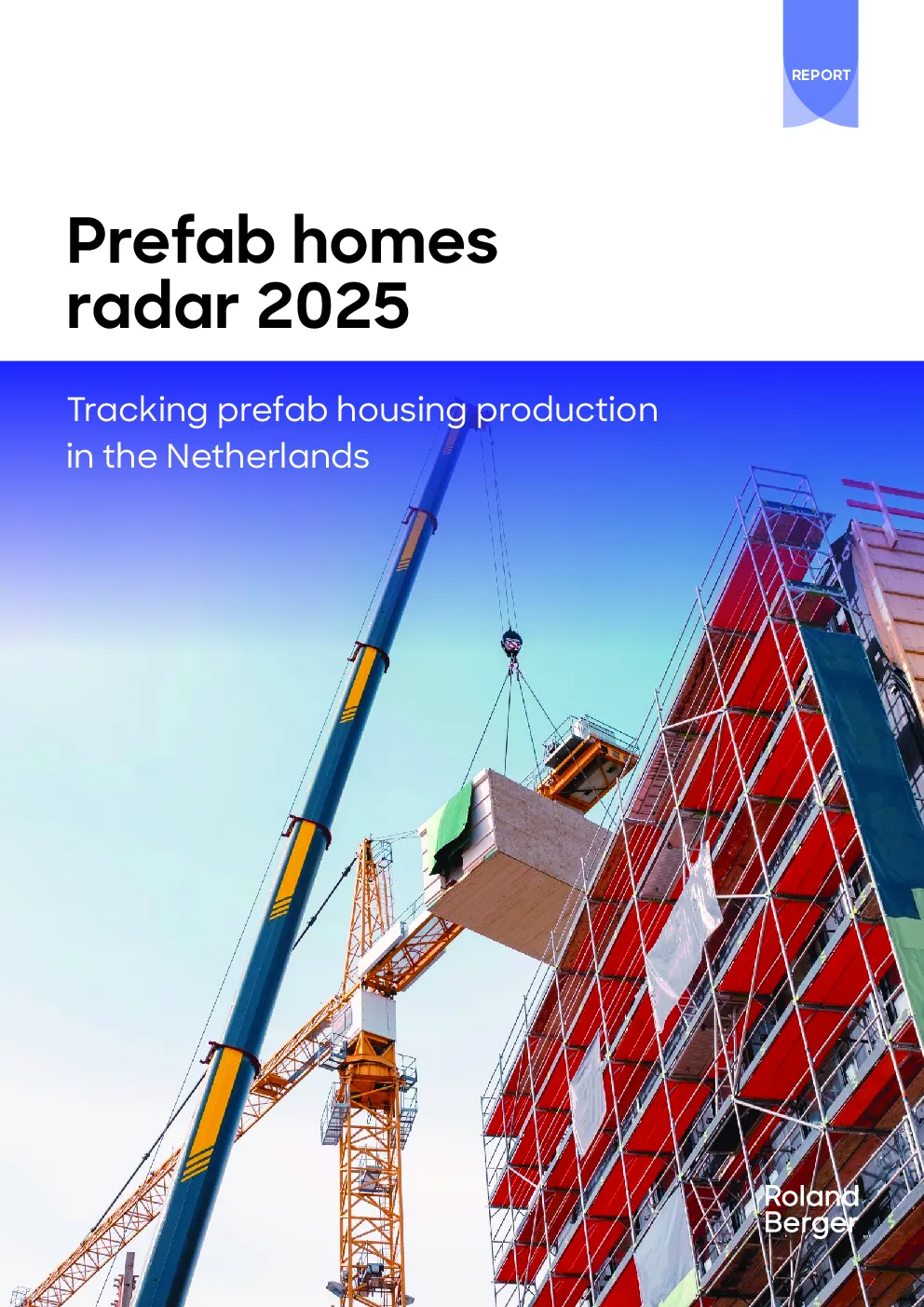
Tracking prefab housing production Managementsummary P prefab in 2025. Its efficiency and effectiveness over traditional buildingmethods make it a crucial component of addressing ongoing labor Roland Berger’s Prefab Homes Radar, developed in collaboration with theMinistry of the Interior, monitors the sector and its evolution. In this second •Renewed growth in prefab’s share of residential construction in 2025following a plateau in 2024 - Both the penetration of prefab within the total market and the absolute number of prefab homes increased over the past year, while total residential construction remained flat •In contrast to certain perceptions, apartments constitute the majority of prefab homes These points highlight the ongoing development and maturation of theprefab industry and its players. Building on the growth trajectory of the pastfive years, the prefab share can be expected to reach 30–40% by 2030. 1Biobased refers to houses where material use exceeds 30 % biobased materials byweight (including foundation, groundfloor, and installations). Biobased materials Contents Fastfacts ~400 kHousing shortagein the Netherlandsin 2025 14.7 k(+8% vs. 2024)Prefab housing units in 21.2%(+1.5 ppt vs. 2024)Prefab share in allresidential new buildin 2025 16.1 k(+10% vs. 2025)Forecasted prefabhousing units inresidential newbuild in 2026 Definitions used in the radar For the purposes of our Radar, prefab housing is defined ashouses that are: •Made windproof and waterproof within 10 days on-site•Completed within 50 days from the start of construction Compared with previous edition on this topic, certain players andbuilding concepts have been excluded following a reassessmentof their compliance with the above definition. As a result, Introduction Amid the persistent challenges in the construction market and overall housing market in the Since 2015, the housing shortage has grown by approximately 7 % per year. Although theCOVID-19 pandemic years briefly slowed this trend, growth has since accelerated to roughly A broad set of measures is being deployed to address this challenge, ranging from regulatoryreforms to sector- and municipality-level incentives. Within this toolkit, prefab construction The Prefab Homes Radar is based on an extensive survey and in-depth interviews withselected prefab housing producers. These quantitative and qualitative inputs are Latest market developments Prefab housing output increased strongly from 2019 to 2023. Although overall residentialconstruction volumes declined in 2024, prefab’s share still increased slightly. In 2025, prefab Prefab’s share of Dutch residential new build has shifted materially over a short period. Fromaround 10.0 % five years ago, it reached 21.2 % in 2025. Moreover, after a slight decrease in In 2025, total residential construction flattened after two years of decline. In contrast,prefab production grew by 8 %, lifting prefab’s share of new build by a further 1.5 percentage BPrefab housing production share in total residential new build, Earlier involvement in the design phaseis essential for prefab; key decisions areoften made too early for prefab to remain 2.1/Player landscape In 2025, the top 20 prefab housing producers accounted for 83 % of total prefab construction.As the market matures, the number of active producers has remained relatively stable. The Source: Prefab housing production survey 2025 Roland Berger 2026 market outlook Prefab players expect prefab housing production to continueto grow in 2026 Sentiment among prefab players remains positive. For 2026, producers anticipate increasingoutput by +34 %, building more than 19,000 housing units. This confidence is broadly shared,as roughly 90 % of respondents indicate that they expect higher production levels in 2026compared to 2025. At the same time, historical performance suggests prefab players Even after this correction, there remains significant headroom. The corrected projectioncorresponds to roughly 45 % capacity utilization - similar to 2024 - against an estimated Notable points in 2025 A majority of prefab players indicate that prefab housing is cheaper than traditionalconstruction, with the majority of respondents stating it is 10–20 % cheaper. Furthermore, 4.1/Key stats Most prefab houses built in 2025 were low-rise (<5 floors) apartments and c.42 % wereprimarily made of wood. A majority of homes were sold to housing associations, with 4.2/Observations Notable observations that arose from our survey and interviews are: •The share of apartments - including c.55 % low-rise (<5 floors), c.10 % mid-rise (5-9floors), and c.1 % high-rise (≥10 floors) - increased to 66 % in 2025, up from 61 % in 2024H•Share of wood for a building’s structural frame increased from 37 % in 2024 to 42 % in2025H•The share of project developer, internal developer and others has increased from 33 %in 2024 to 46 % in 2025, pointing to broader adoption of prefab solutions beyond t