您的浏览器禁用了JavaScript(一种计算机语言,用以实现您与网页的交互),请解除该禁用,或者联系我们。 [印度国家转型委员会]:通讯 - NITIसंधान 2025年10月 - 发现报告

通讯 - NITIसंधान 2025年10月

报告封面

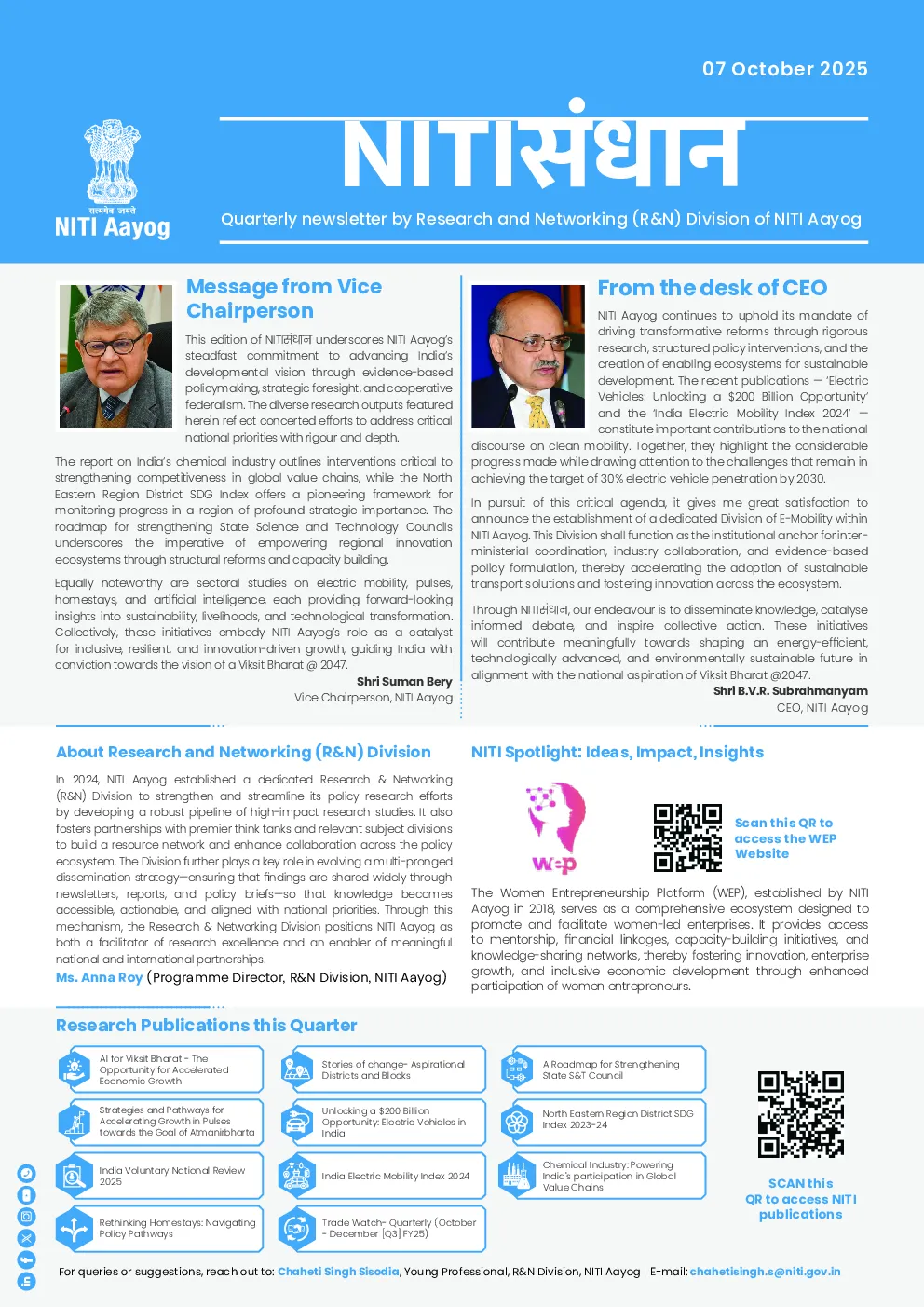
Quarterly newsletter by Research and Networking (R&N) Division of NITI Aayog Message from ViceChairperson From the desk of CEO NITI Aayog continues to uphold its mandate ofdriving transformative reforms through rigorousresearch, structured policy interventions, and thecreation of enabling ecosystems for sustainabledevelopment. The recent publications — ‘Electric This edition of NITIसंधान underscores NITI Aayog’ssteadfastcommitment to advancing India’sdevelopmental vision through evidence-basedpolicymaking, strategic foresight, and cooperative discourse on clean mobility. Together, they highlight the considerableprogress made while drawing attention to the challenges that remain in The report on India’s chemical industry outlines interventions critical tostrengthening competitiveness in global value chains, while the NorthEastern Region District SDG Index offers a pioneering framework formonitoring progress in a region of profound strategic importance. The In pursuit of this critical agenda, it gives me great satisfaction toannounce the establishment of a dedicated Division of E-Mobility withinNITI Aayog. This Division shall function as the institutional anchor for inter- Equallynoteworthy are sectoral studies on electric mobility,pulses,homestays,and artificial intelligence,each providing forward-lookinginsights into sustainability, livelihoods, and technological transformation.Collectively, these initiatives embody NITI Aayog’s role as a catalyst Through NITIसंधान, our endeavour is to disseminate knowledge, catalyseinformeddebate,and inspire collective action.These initiativeswillcontribute meaningfully towards shaping an energy-efficient, Shri Suman BeryVice Chairperson, NITI Aayog Shri B.V.R. SubrahmanyamCEO, NITI Aayog About Research and Networking (R&N) Division In2024,NITI Aayog established a dedicated Research&Networking(R&N) Division to strengthen and streamline its policy research effortsby developing a robust pipeline of high-impact research studies. It alsofosters partnerships with premier think tanks and relevant subject divisionsto build a resource network and enhance collaboration across the policyecosystem. The Division further plays a key role in evolving a multi-pronged Scan this QR toaccess the WEP The Women Entrepreneurship Platform (WEP), established by NITIAayog in 2018, serves as a comprehensive ecosystem designed topromote and facilitate women-led enterprises. It provides accessto mentorship, financial linkages, capacity-building initiatives, and Voice of ourResearchers India has committed to an accelerated transition toward electric mobility with theobjectives of reducing dependence on imported fuel and lowering greenhouse gasemissions, while simultaneously improving air quality, enhancing renewable energyintegration, and positioning itself as a global Electric Vehicles (EV) leader. The country has Unlocking a $200 BillionOpportunity: Electric Vehicles set an ambitious target of achieving a 30% EV share in total vehicle sales by 2030.Significant progress has been made in recent years, but the transition remains slowercompared to global leaders such as China, the EU, and the US. EV sales in India increased Author:SHRI SUDHENDU J. SINHA,Programme Director,e-Mobility Division Co-Authors: Shri Amarjeet Singh,Consultant, e-Mobility Division India’s EV penetration rose from one-fifth of the global average in 2020 to over two-fifths in 2024, yet at ~7.7% of sales, the country remainsfar behind its 30% goal. Growth has largely been concentrated in e-2W and e-3W, with some progress in e-buses. However, passengere-car adoption has been sluggish, and the electrification of trucks is still at a nascent stage. Achieving the target will require India to Tochart the way forward,7 stakeholderconsultations were convened at NITI Aayog inFebruary 2025. These discussions outlined 9 keyapproaches to accelerate the EV transition. First,India must move from incentives to mandates/disincentives. Second, policies should prioritizethevehicle segment where electrificationyields the greatest benefits. Third, efforts shouldfocus on saturating select geographies rather EV Penetration Rate – Global & India ensuring public value derives from utilisation rather than underused infrastructure. Sixth, shifting capital costs to operating costs.Seventh, Research & Development (R&D) must be scaled on new battery chemistries to reduce costs, improve performance, and lowerdependence on imported minerals. Eighth, charging infrastructure should be strategically deployed after viability assessments, avoiding To kickstart the effort, four immediate priorities are identified. First, develop a clear national EV policy with specific targets and timelines.Second, design a program of progressively stringent regulations mandating EV adoption within defined timeframes.Third, launch a new initiative to saturate 5 cities with 100% e-buses, e-paratransit, and e-freight vehicles in urban This report thus serves