您的浏览器禁用了JavaScript(一种计算机语言,用以实现您与网页的交互),请解除该禁用,或者联系我们。 [RAS]:英国为何不制造更多机器人?解析英国机器人制造的障碍及克服之道 - 发现报告

英国为何不制造更多机器人?解析英国机器人制造的障碍及克服之道

机械设备 2025-11-01 - RAS 丁叮叮叮
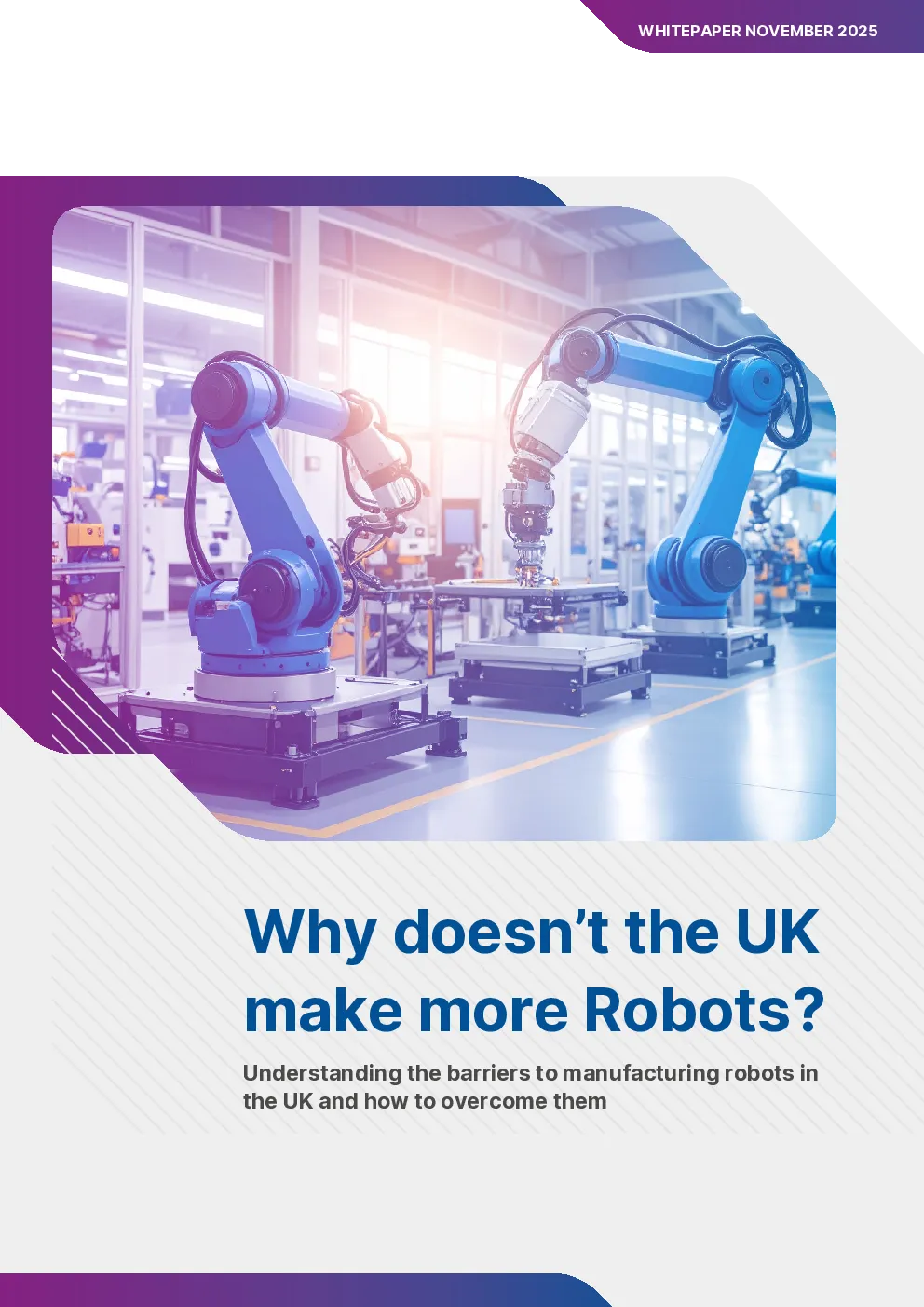
报告封面

Understanding the barriers to manufacturing robots in Foreword As a former Business Minister and lifelong champion of British manufacturing, I believerobotics and automation are vital to unlocking the UK’s full potential for growth and stop short of turning that brillianceinto world-class production” Britain has world-class researchers and innovators, but we too often stop short of turning that brilliance intoworld-class production. We excel in developing the ideas and intelligence behind robotics, but far less of the The evidence is clear, too few of our factories are making full use of robotics today. Yet Make UK’s ownresearch shows that when businesses do invest in automation, they see real gains – higher productivity,better quality, safer workplaces, and stronger growth. If we want to unlock a £150 billion boost to UK GDP by2035, we must make it easier for SMEs to adopt advanced technologies such as robotics and automation – The opportunity before us is significant. By acting now, we can boost productivity, strengthen our economy,and create high-value jobs in every region. This report sets out how we can make that happen – and why Executive Summary Meet the Authors The UK Robotics and Autonomous Systems (RAS) sector holds substantial economicpromise, with the potential to significantly enhance national productivity and economicresilience. Despite notable strengths, particularly in software and artificial intelligence,the UK’s ability to manufacture RAS domestically remains limited, leading to reliance on Professor Robert Richardson, RealRobotics, University of Leeds. Expert inreal-world robotic systems operating in Jonathan Walker, Innovation Lead:Robotics and Sensors, Innovate UK.Expert in the use of robotics for Dr Sarah Field, Real Robotics,University of Leeds. Community We undertook a comprehensive industry survey of ~10% of the UK industry actively making RAS domestically.We found that while structural and mechanical components are generally sourced domestically (reflecting stronglocal fabrication capabilities) the UK lacks significant manufacturing infrastructure for more sophisticated parts,predominantly procured from Asia, particularly China, due to perceived lower production costs and superior technical Secondly, the creation of adedicatedRAS ComponentAdoption Hubwouldfacilitate hands-on testing, Firstly, establishing aNational RAS Registryto enhance UK industryconnectivity, collaboration,and visibility. Such a platformwill enable companies to Thirdly, investing intargetedskills developmentinitiativesis critical. Structuredapprenticeships, modularcertification programs, andprofessional secondment Professor Samia Nefti-Meziani OBE,University of Birmingham. Globallyrecognised authority in AI and robotics, Dr Sina Sareh, Reader in Robotics andDesign Intelligence, Royal Collegeof Art. Expert in robotics in high-risk Ben Scott-Robinson, SerialEntrepreneur. C-Suite Consultantand Advisor to UK and Scottish Acknowledgements The authors gratefully acknowledge the support of the community in responding to our survey and attendingour summit. We are also grateful for the support of DIST and UKRI from projects ‘UK RAS STEPS’, ‘RESCu-M2’recycling hub and ‘The Circular Robot 5.0’. We also thank Prof. Habib Khosoroshahi, Prof. Robert Kay, Dr Andrew These recommendations need to be implemented on foundational circular economy principles. This includesdesigning robots for easier disassembly and recyclability, promoting material transparency, establishing regional Finally, we thank Benedex Ltd., Guidance Automation, Hydra Drones Ltd., Labman Automation and The RoyalCollege of Art for their generosity in sharing images of UK manufactured robotics. Together, these initiatives form a comprehensive and cohesive strategy to transform the UK’s fragmentedRAS sector into a robust, innovative, and globally competitive manufacturing ecosystem, capable of achieving Contents 1Introduction 2The UK RAS Manufacturers Landscape2.1Introduction2.2Ecosystem Structure and Participants2.3International Benchmarking3Domestic Manufacturing Patterns3.1Classification of RAS Subcomponents3.2The Origins of Hardware Components3.3The Origins of Software Components4Factors Influencing the Origins of Hardware Components5Challenges to Scale-up Manufacturing6The Perceived Level of Manufacturing Resilience7The Circular Economy7.1Sustainable End-of-Life Practices7.2Critical Challenges in End-of-Life Robotics7.3UK Initiatives Leading the Way(EPSRC) Manufacturing Research Hub in Robotics, Automation & Smart 1 Introduction Growth in the UK Robotics and Autonomous Systems (RAS) market ispredicted to have a major impact on the UK economy and in turn on everyaspect of our lives; the future of RAS will be defined by extraordinarydiversity in form, function, and application. From agile drone swarms Current momentum in AI policy is welcome,but it does not automatically translate to athriving RAS sector without complementaryinve