您的浏览器禁用了JavaScript(一种计算机语言,用以实现您与网页的交互),请解除该禁用,或者联系我们。 [世界卫生组织]:联合国预防和控制非传染性疾病机构间工作队的独立评价:执行摘要 - 发现报告

联合国预防和控制非传染性疾病机构间工作队的独立评价:执行摘要

医药生物 2026-02-05 世界卫生组织 徐红金
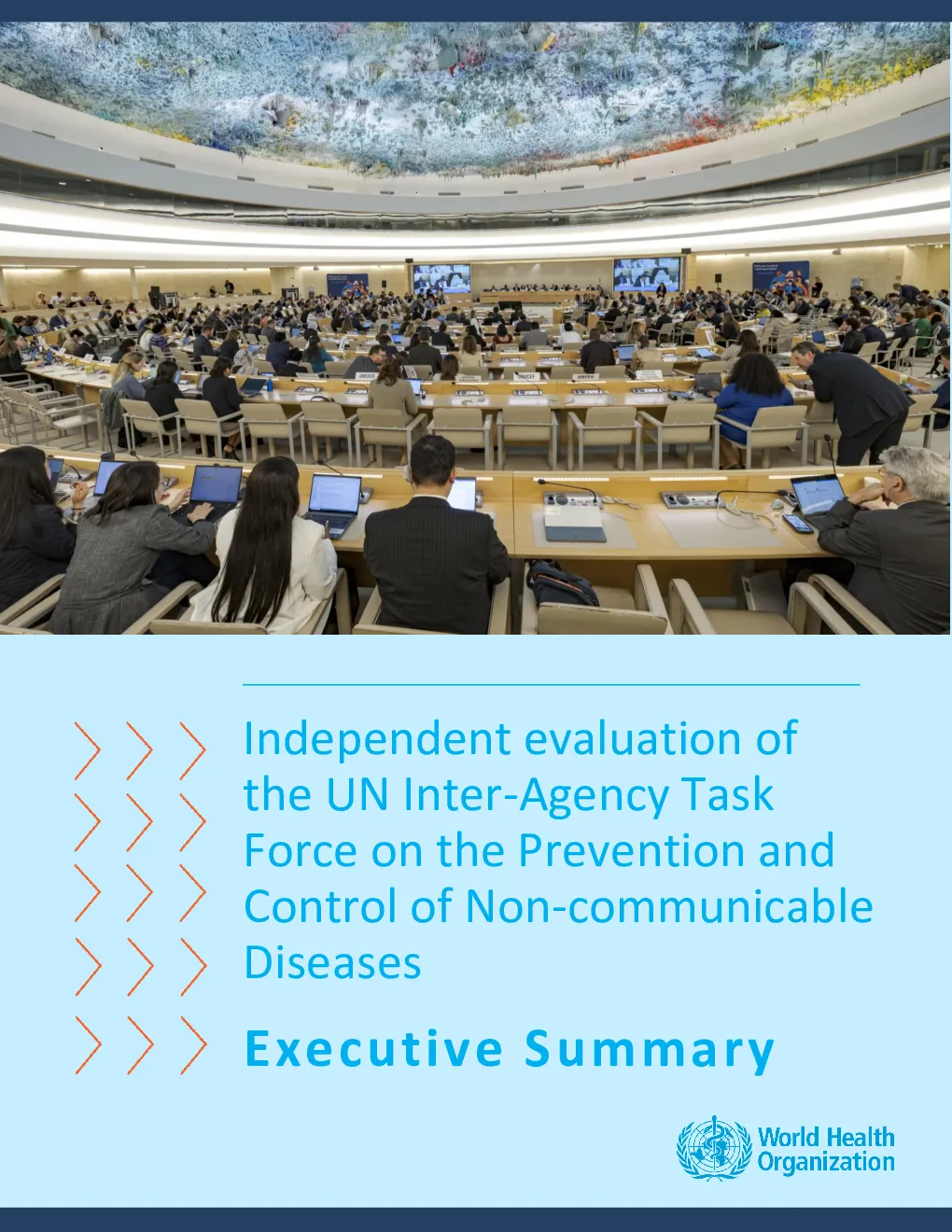
报告封面

© World HealthOrganization 2025. All rights reserved. The content of this document is not final and the text may be subject to editorial revisions beforepublication. The content of this draft, however, will not undergo substantive changes. The document maynot be reviewed, abstracted, quoted, reproduced, transmitted, distributed, translated or adapted, in part WHO/DGO/EVL/2025.55 Caption:Seventy-fifth World Health Assembly, Geneva, Switzerland, 22-28 May 2022 Executivesummary 1.Overview of the evaluation object Thedecentralizedindependent evaluation of the United Nations Inter-Agency Task Force on the Prevention andControl of Non-communicable Diseases (NCDs)wascommissioned by the Task Force Secretariat and its members.This is the first independent evaluation of the work of the Task Force since its creation in 2013. The Task Forceconsists of 46 UN agencies, funds, programmes, intergovernmental organizations, and development banks with asecretariat at the World Health Organization (WHO).Its purpose is to support the realization of the commitments 2.Evaluation objectives and intended audience The purpose of the evaluation is to provide an independent assessment of the Task Force strategy, interventions,operations and performance as well as to provide lessons learned on its engagement and coordination with partners.The evaluation is both formative and summative, with the summative aspect assessing the Task Force’s contribution The evaluation focuses on the implementation of the recent two strategies (2019–2021and 2022–2025),andalsoincludes progress made since the creation of the Task Force. The evaluation considers the work of the Task Force atglobal level with a particular focus on actions mentioned in the Task Force’s strategies and work plans,andactivitiesimplemented in 61 countries.Specifically, the evaluation objectives are to assess the work of the Task Force towardsthe achievement of its strategic priorities; document the facilitating factors and challenges that hindered progress 3.Methodology The evaluationopted for a non-experimental evaluation designandused a theory-based approach, testing the causalpathways andassumptions laid out in the evaluation reconstructedtheory of change (ToC).Amixed methodsapproachwas employedto gather data and information from quantitative and qualitative sources both through areview of secondary sources and primary data collection. It sought views from a variety of informants at global,regional and country levels.Using OECD criteria, the evaluation assessed the relevance, coherence, effectiveness, Key stakeholderscontributed tothe evaluation design through a theory of change workshop during inception,discussing conclusions and then co-creating recommendations through a two-day workshop held at WHO, Genevaon the 14 and 15 October 2024. Summary findings were presented to the twenty-third meeting of the Task Force 4.Keyfindings Relevance There is a high demand for the Task Force’s coordination role among Member States and UN agencies based on itsunique mandate from ECOSOC and the World Health Assembly. The Task Force objectives and design are well alignedto the strategic priorities of several historically engaged agencies. There are, however, variations in the relevance ofthe Task Force’s work to its members’ priorities. The Task Force’s mandate has gradually expanded over time toinclude mental health and financing of national NCD and mental health responses, in recognition of the progressmade as well as the changing global health landscape and priorities.This increased mandate, and in particular the Coherence At global level, the Task Force has contributed to building synergies among UN agencies on NCDs through initiatingjoint programmes including on governance, cervical cancer, tobacco control, harmful use of alcohol and digital healthas well as through theHealth4Life Fund. However, it is unclear that the Task Force has had sufficient leverage toinfluence the UN to deliver its ambitious mandate as joint accountabilities are not in place. The efforts of the TaskForce have raised the profile of NCDs in someof its member agencies. Overall, there is poor visibility on agencies’level of financial resources on NCDs, and the time allocation for the positions of Task Force focal points varies. With other WHO teams working on NCDs, highlighting the need to enhance the alignment of strategies and workplans. Inaddition,synergies and interlinkages with WHO interventions have been hampered by the fragmentation of the NCDand mental health agendas in WHO, which has resulted in unclear lines of reporting and lack of alignment. Thecurrent institutional set up within WHO doesnot sufficiently empower the Task Force to implement its UN-wide Effectiveness and efficiency The Secretariat has been highly effective in coordinating Task Force activities. Examples include the biannual TaskForce meetings, the organization of side events on NCDs at global events, the development of jo