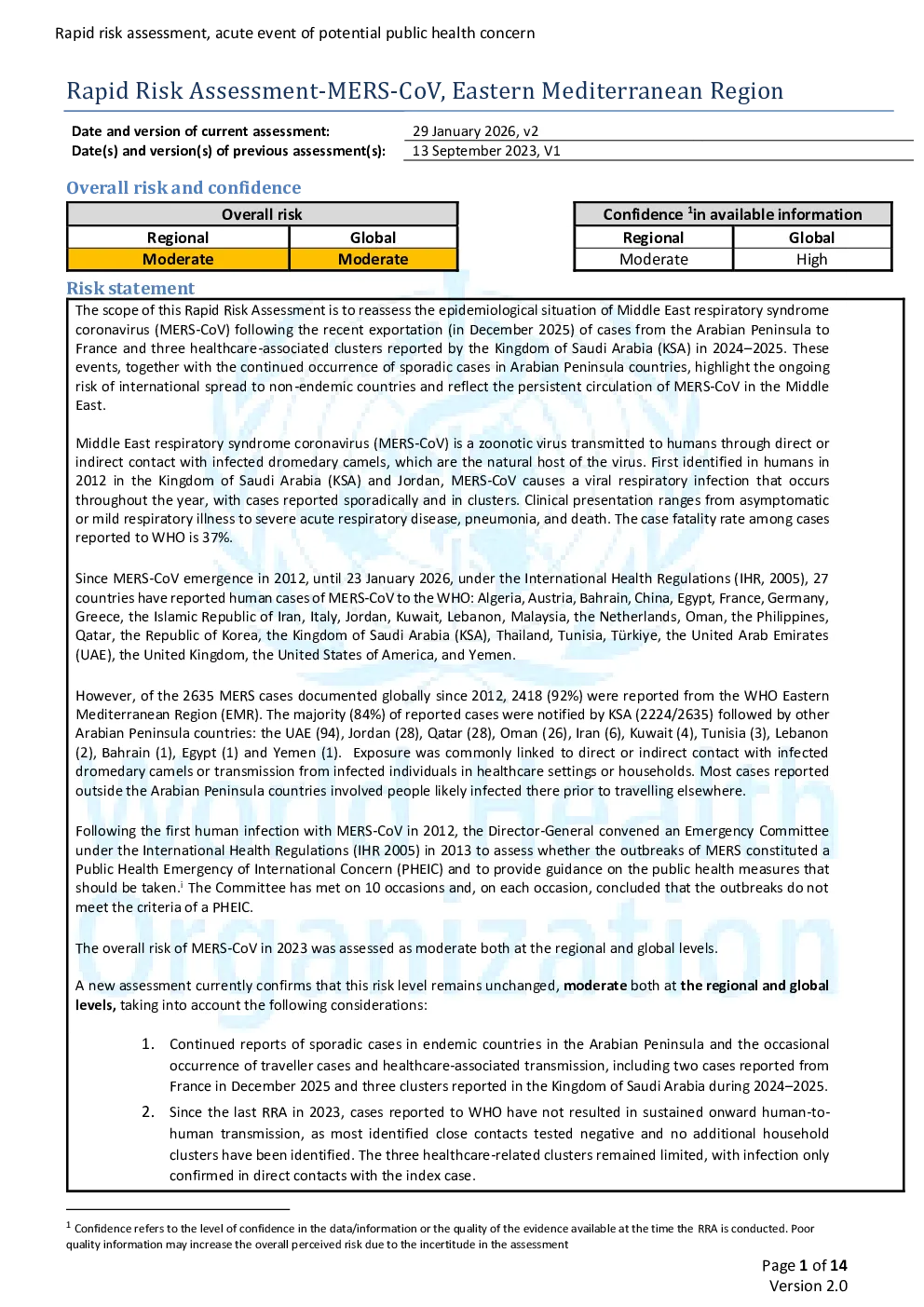
Dateandversionof current assessment:Date(s)and version(s)of previous assessment(s): Risk statement The scope of this Rapid Risk Assessment is to reassess theepidemiological situation of Middle East respiratory syndromecoronavirus (MERS-CoV) following the recent exportation(inDecember 2025)of cases from the Arabian Peninsula toFrance and three healthcare-associated clusters reported by the Kingdom of Saudi Arabia (KSA) in 2024–2025. Theseevents, together with the continued occurrence of sporadic casesinArabian Peninsulacountries, highlight the ongoing Middle East respiratory syndrome coronavirus (MERS-CoV) is a zoonotic virus transmitted to humans through direct orindirect contact with infected dromedary camels, whichare the natural hostofthe virus.First identified in humansin2012in the Kingdom of Saudi Arabia (KSA)and Jordan,MERS-CoV causesa viralrespiratory infectionthat occursthroughout the year, with cases reportedsporadicallyand inclusters.Clinicalpresentationranges from asymptomatic SinceMERS-CoVemergencein2012, until23January 2026, under the International Health Regulations (IHR, 2005), 27countries have reported human cases of MERS-CoV to the WHO: Algeria, Austria, Bahrain, China, Egypt, France, Germany,Greece, the Islamic Republic of Iran, Italy, Jordan, Kuwait, Lebanon, Malaysia, the Netherlands, Oman, the Philippines,Qatar, the Republic of Korea, the Kingdom of Saudi Arabia (KSA), Thailand, Tunisia, Türkiye, the United Arab Emirates However,of the 2635 MERS casesdocumentedgloballysince 2012, 2418(92%) werereportedfromthe WHO EasternMediterranean Region (EMR). The majority (84%) of reported cases were notified by KSA (2224/2635)followed byotherArabian Peninsula countries: the UAE (94), Jordan (28), Qatar (28),Oman (26), Iran (6), Kuwait (4), Tunisia (3), Lebanon(2), Bahrain (1), Egypt (1) and Yemen (1).Exposurewas commonly linkedto direct or indirect contact with infecteddromedary camels ortransmissionfrominfectedindividualsinhealthcaresettingsor households.Mostcases reported Following the first humaninfection with MERS-CoV in 2012, the Director‐Generalconvened an Emergency Committeeunder the International Health Regulations (IHR2005) in 2013 toassesswhether the outbreaks of MERSconstituteda Public Health Emergency of International Concern (PHEIC) andto provide guidanceon the public health measures thatshould be taken.iThe Committee has met on 10 occasions and, on each occasion, concluded that the outbreaks do not The overall riskof MERS-CoVin 2023was assessed asmoderateboth at theregionalandgloballevels. A new assessment currently confirmsthat this risk level remains unchanged,moderateboth atthe regional and globallevels,taking into account the following considerations: 1.Continuedreportsof sporadic cases in endemic countriesin the Arabian Peninsulaand theoccasionaloccurrenceoftraveller cases andhealthcare-associated transmission, includingtwo cases reported from 2.Since the last RRA in 2023,cases reported to WHO have not resulted in sustained onward human-to-human transmission,asmostidentifiedclose contacts tested negative and no additional householdclusters have been identified.The threehealthcare-related clusters remained limited,withinfection only 3.The observed decline in reported MERS cases since 2020, in particular duringthe COVID-19 pandemicemergency phase, is thought to be a result of pandemic-related InfectionPrevention &Controlmeasuresthat also limited human-to-human transmission of MERS-CoV, as well asbehaviouralchanges during thepandemic. Any role of potential cross-reactive immunity from SARS-CoV-2 infection and/ or vaccinationremains in need of further investigation. Other hypotheses—such as reduced surveillance, viralattenuation, or decreased circulation in camel populations—are not supported by currentevidence.4.Significant disparitiespersistgloballyincountries'capacitiesto detect andrespondeffectively to thedisease, particularly in regions where the virus has not been previously documented.Withinthe EMR,sixfragile, conflict-affected, and vulnerable countriesareconsideredat greater risk.5.Global inequalitiesremainin theadequacy ofpreparedness, infection prevention and control capacities,and response measures,particularly in thecontextof a cross-border outbreakor a traveller case.6.MERS-CoVcontinuestocirculatein dromedary camel populations without causing overt clinical signs,constituting a constant sourceofhumanexposureand a risk of zoonoticspillover, which mayresult inoccasional onward human-to-human transmission.The recent detection of Clade B viruses in camels ofAfrican origin further highlights the risk of MERS-CoV spread from the Arabian Peninsulavia camelmovements and poses an additional risk to other regions, particularly given the documented increasedreplication competence and more efficient viral entry of Clade B compared withClade C.7.Preliminary data from in vitro growth kinetics and partial sequencing indicate no major attenuation in 8.The potentialpublic h