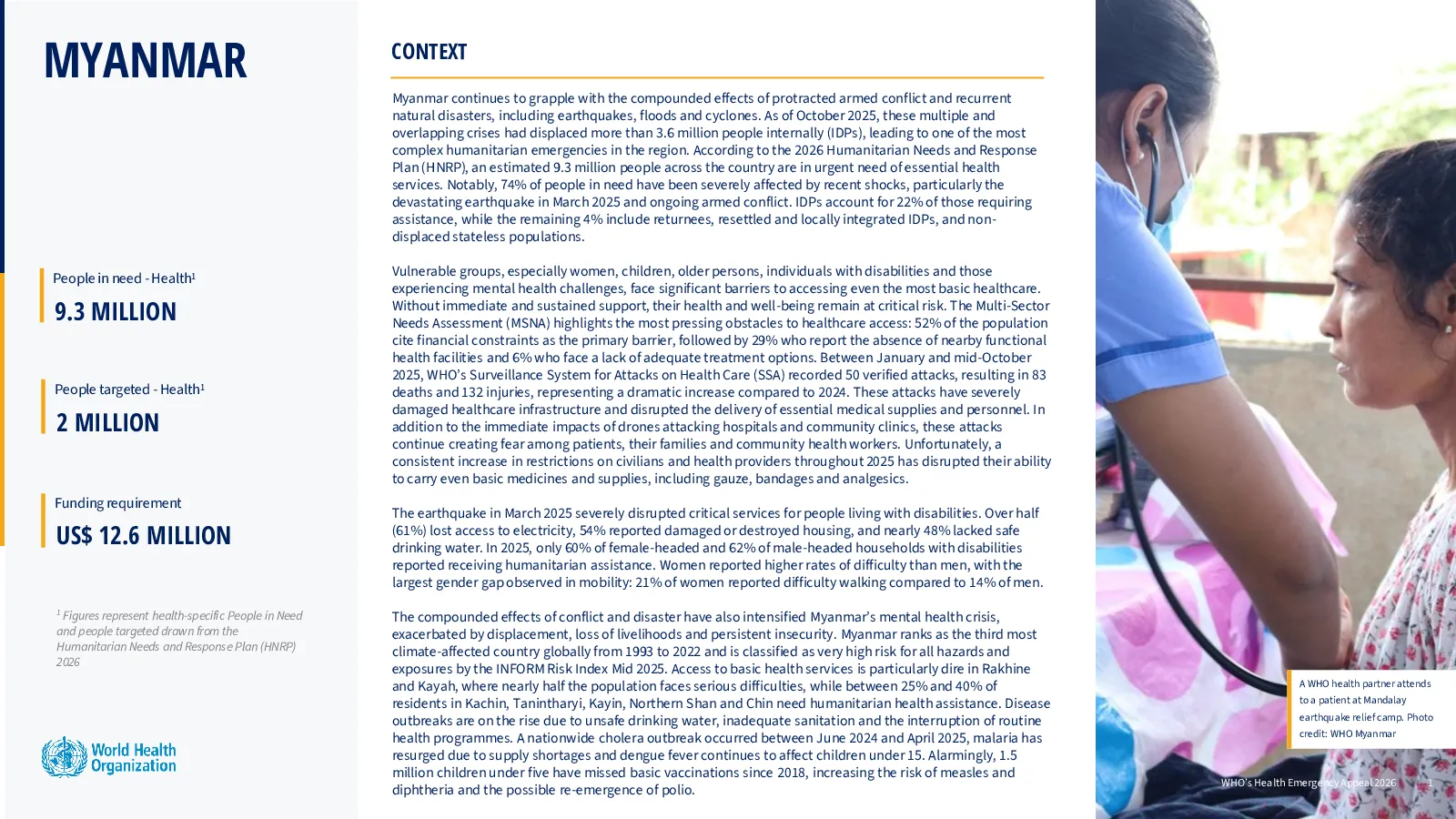
CONTEXT Myanmar continues to grapple with the compounded effects of protracted armed conflict and recurrentnatural disasters, including earthquakes, floods and cyclones. As of October 2025, these multiple andoverlapping crises had displaced more than 3.6 million people internally (IDPs), leading to one of the mostcomplex humanitarian emergencies in the region. According to the 2026 Humanitarian Needs and ResponsePlan (HNRP), an estimated 9.3 million people across the country are in urgent need of essential healthservices. Notably, 74% of people in need have been severely affected by recent shocks, particularly thedevastating earthquake in March 2025 and ongoing armed conflict. IDPs account for 22% of those requiringassistance, while the remaining 4% include returnees, resettled and locally integrated IDPs, and non-displaced stateless populations. Vulnerable groups, especially women, children, older persons, individuals with disabilities and thoseexperiencing mental health challenges, face significant barriers to accessing even the most basic healthcare.Without immediate and sustained support, their health and well-being remain at critical risk. The Multi-SectorNeeds Assessment (MSNA) highlights the most pressing obstacles to healthcare access: 52% of the populationcite financial constraints as the primary barrier, followed by 29% who report the absence of nearby functionalhealth facilities and 6% who face a lack of adequate treatment options. Between January and mid-October2025, WHO’s Surveillance System for Attacks on Health Care (SSA) recorded 50 verified attacks, resulting in 83deaths and 132 injuries, representing a dramatic increase compared to 2024. These attacks have severelydamaged healthcare infrastructure and disrupted the delivery of essential medical supplies and personnel. Inaddition to the immediate impacts of drones attacking hospitals and community clinics, these attackscontinue creating fear among patients, their families and community health workers. Unfortunately, aconsistent increase in restrictions on civilians and health providers throughout 2025 has disrupted their abilityto carry even basic medicines and supplies, including gauze, bandages and analgesics. People in need-Health19.3 MILLION People targeted-Health12 MILLION Funding requirementUS$ 12.6 MILLION The earthquake in March 2025 severely disrupted critical services for people living with disabilities. Over half(61%) lost access to electricity, 54% reported damaged or destroyed housing, and nearly 48% lacked safedrinking water. In 2025, only 60% of female-headed and 62% of male-headed households with disabilitiesreported receiving humanitarian assistance. Women reported higher rates of difficulty than men, with thelargest gender gap observed in mobility: 21% of women reported difficulty walking compared to 14% of men. The compounded effects of conflict and disaster have also intensified Myanmar’s mental health crisis,exacerbated by displacement, loss of livelihoods and persistent insecurity. Myanmar ranks as the third mostclimate-affected country globally from 1993 to 2022 and is classified as very high risk for all hazards andexposures by the INFORM Risk Index Mid 2025. Access to basic health services is particularly dire in Rakhineand Kayah, where nearly half the population faces serious difficulties, while between 25% and 40% ofresidents in Kachin, Tanintharyi, Kayin, Northern Shan and Chin need humanitarian health assistance. Diseaseoutbreaks are on the rise due to unsafe drinking water, inadequate sanitation and the interruption of routinehealth programmes. A nationwide cholera outbreak occurred between June 2024 and April 2025, malaria hasresurged due to supply shortages and dengue fever continues to affect children under 15. Alarmingly, 1.5million children under five have missed basic vaccinations since 2018, increasing the risk of measles anddiphtheria and the possible re-emergence of polio. 1Figures represent health-specific People in Needand people targeted drawn from theHumanitarian Needs and Response Plan (HNRP)2026 A WHO health partner attendsto a patient at Mandalayearthquake relief camp. Photocredit: WHO Myanmar WHO’S STRATEGIC OBJECTIVES As the Cluster Lead Agency, WHO’s strategic objectives are fully aligned with the 2026HNRP to ensure a coherent, harmonized and principled approach: 1.Enhance access to life-saving health services:Ensure the delivery of quality andinclusive healthcare for displaced, returned, stateless and other shock-affectedpopulations. 2.Reduce excess morbidity and mortality:Strengthen systems for timely detection,prevention and response to epidemic-prone and endemic diseases. 3.Promote coordination and accountability to affected populations:Coordinatehealth partners to provide effective and equitable humanitarian health assistance,with a focus on transparency and community engagement. We care for people with chronic illnesses, pregnant women and thosestill recovering from injur