缅甸:世卫组织健康紧急呼吁2025
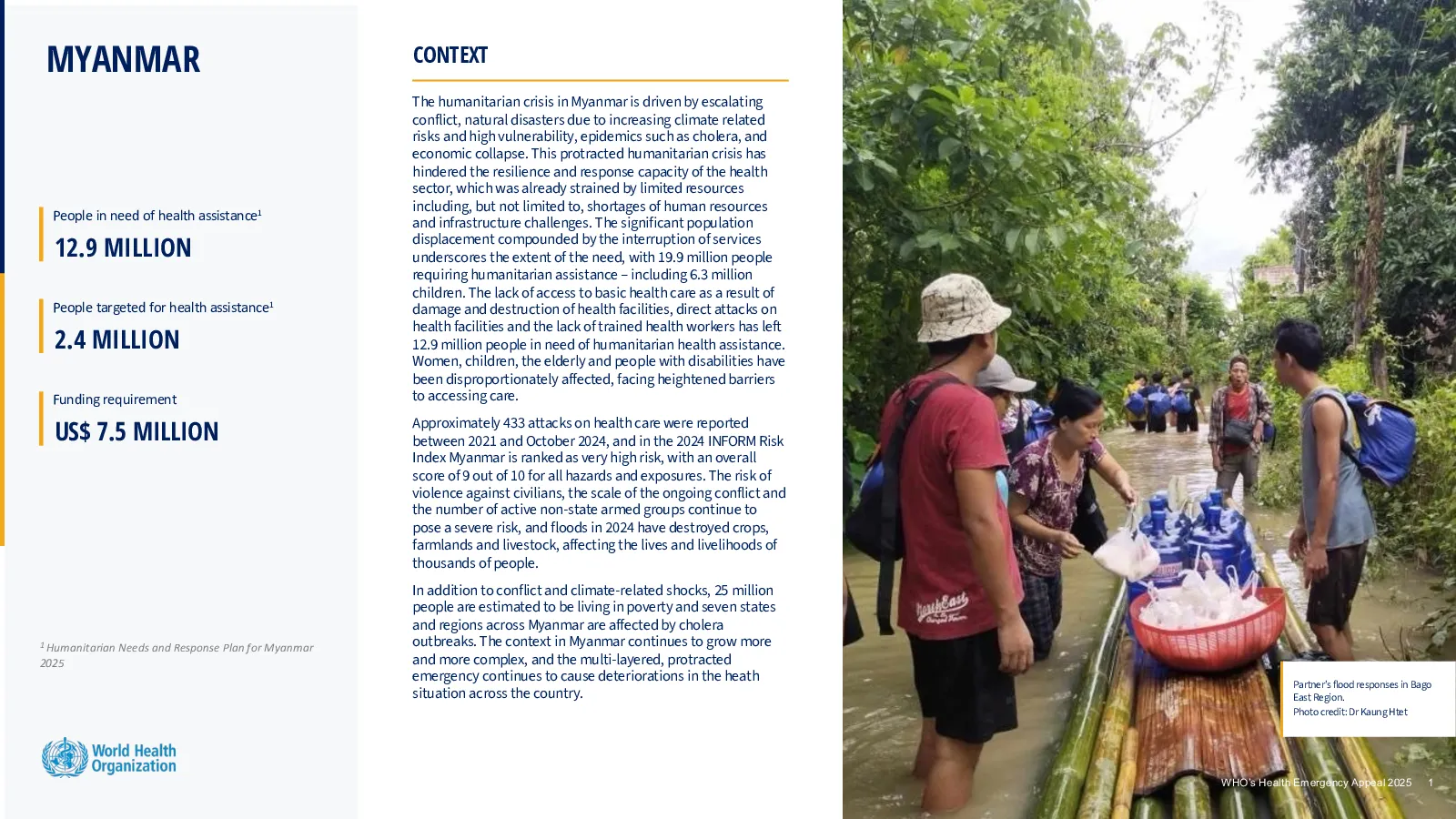
CONTEXT The humanitarian crisis in Myanmar is driven by escalatingconflict, natural disasters due to increasing climate relatedrisks and high vulnerability, epidemics such as cholera, andeconomic collapse. This protracted humanitarian crisis hashindered the resilience and response capacity of the healthsector, which was already strained by limited resourcesincluding, but not limited to, shortages of human resourcesand infrastructure challenges. The significant populationdisplacement compounded by the interruption of servicesunderscores the extent of the need, with 19.9 million peoplerequiring humanitarian assistance–including 6.3 millionchildren. The lack of access to basic health care as a result ofdamage and destruction of health facilities, direct attacks onhealth facilities and the lack of trained health workers has left12.9 million people in need of humanitarian health assistance.Women, children, the elderly and people with disabilities havebeen disproportionately affected, facing heightened barriersto accessing care. People in need of health assistance112.9 MILLION People targetedfor health assistance12.4 MILLION Funding requirementUS$ 7.5 MILLION Approximately 433 attacks on health care were reportedbetween 2021 and October 2024, and in the 2024 INFORM RiskIndex Myanmar is ranked as very high risk, with an overallscore of 9 out of 10 for all hazards and exposures. The risk ofviolence against civilians, the scale of the ongoing conflict andthe number of active non-state armed groups continue topose a severe risk, and floods in 2024 have destroyed crops,farmlands and livestock, affecting the lives and livelihoods ofthousandsof people. In addition to conflict and climate-related shocks, 25 millionpeople are estimated to be living in poverty and seven statesand regions across Myanmar are affected by choleraoutbreaks. The context in Myanmar continues to grow moreand more complex, and the multi-layered, protractedemergency continues tocause deteriorations in the heathsituation across the country. 1Humanitarian Needs and Response Plan for Myanmar2025 Partner’s flood responses in BagoEast Region.Photo credit: Dr Kaung Htet WHO’S STRATEGIC OBJECTIVES 1.Strengthen early detection and response capacities foroutbreaks, including border-based collaboration fordisease surveillance and reducing response time by 50%. 2.Enhance dissemination of informationrelated to publichealth emergencies among concerned stakeholders,increasing data-sharing by 30%.3.Advocate for the protection of health care workers andfacilities, reducing attacks by 75%.4.Improve access to health carein conflict areas andprisons, reaching an additional targeted 500 000 people.5.Support pandemic influenza preparedness activities,targeting 100% sample testing. Snake bites are common in our village, and reachingthe township hospital can take over four hours,especially with the ongoing conflict. Recently, a manand a five-year-old girl died because we didn’t haveanti-snake venom. Now, we can provide immediate,life-saving treatment before referral. This criticalsupport can save lives that would otherwise be lost. Primary health care facility worker inThinTawVillage,KanbuluTownship,SagaingRegion WHO 2025 RESPONSE STRATEGY In 2024, WHO Myanmar worked in collaboration with technical teams andimplementing partners, including local partners, to reach approximately 47 000people in the most vulnerable areas of the country through strategic outreach.WHO also prioritized implementing event-based surveillance as part of the EarlyWarning Alert and Response System to ensure early detection and timelyresponse to acute public health emergencies, particularly in conflict-affectedregions. This system facilitated swift responses to disease outbreaks, includingcholera. Collaboration with partners enabled effective cholera casemanagement, oral cholera vaccination and water, sanitation and hygiene(WASH) interventions. By strengthening surveillance and response systems,WHO ensured timely data sharing and coordinated action with relevantstakeholders. Additionally, WHO enhanced the capacity to detect, assess andrespond to public health risks including mpox. Through regular coordinationwith national focal points, WHO supported early notification and reporting ofhealth threats. To mitigate pandemic and epidemic risks, WHO advanced thePandemic Influenza Preparedness Program by supporting influenza-like illnessand severe acute respiratory infection surveillance, improving laboratorydiagnostic capacity for zoonotic and seasonal influenza and enhancing riskcommunication for managing acute health threats. These efforts protectedvulnerable populations by preventing the emergence and re-emergence of high-threat pathogens. Local communities remain central to WHO’s approach, recognizing them asfrontline responders to health emergencies. In 2025, WHO will deepenengagement with local partners to leverage their contextual knowledge,networks and community trust. Strengthenin