AI智能总结
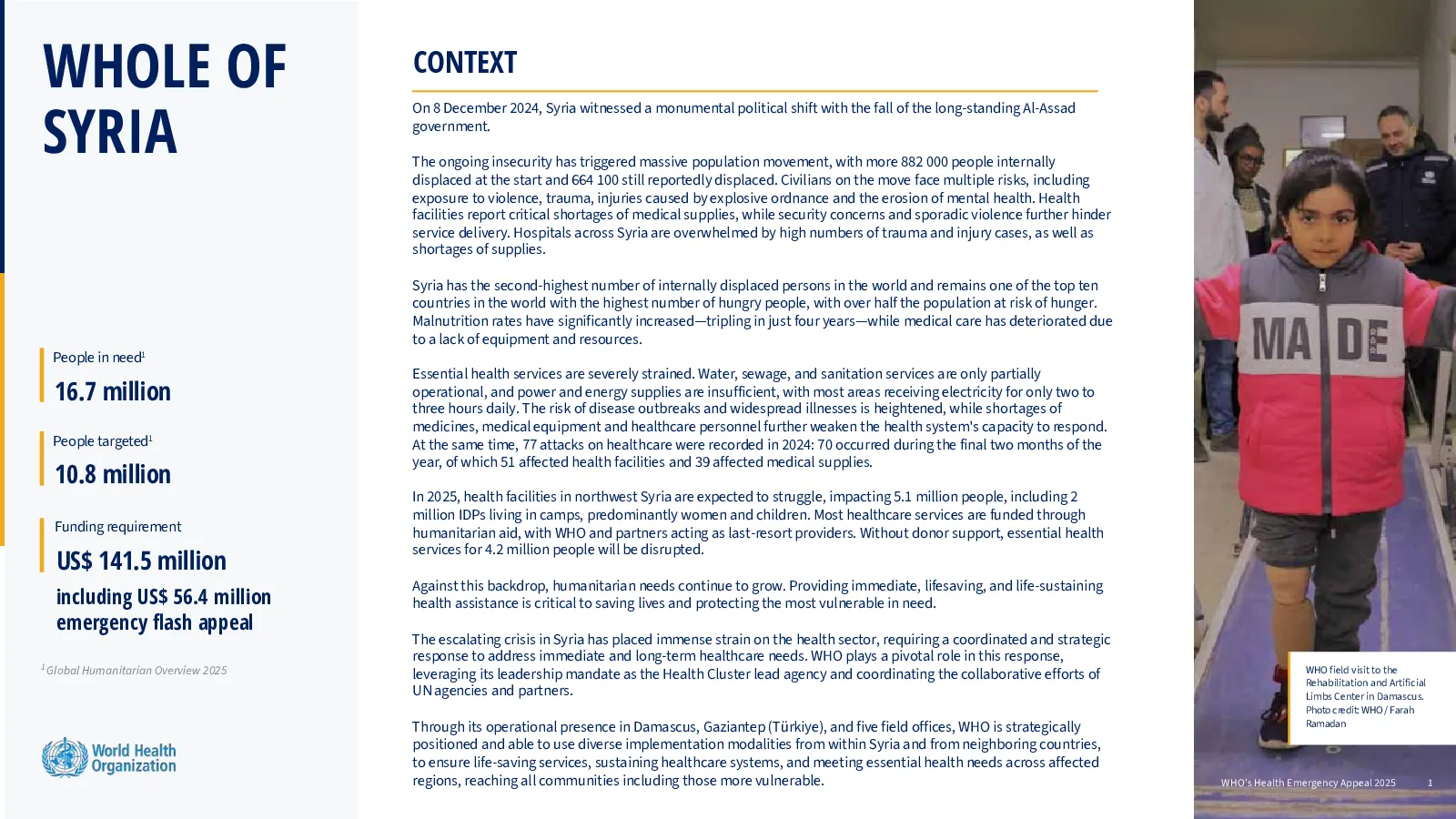
CONTEXT On 8 December 2024, Syria witnessed a monumental political shift with the fall of the long-standing Al-Assadgovernment. The ongoing insecurity has triggered massive population movement, with more 882 000 people internallydisplaced at the start and 664 100 still reportedly displaced. Civilians on the move face multiple risks, includingexposure to violence, trauma, injuries caused by explosive ordnance and the erosion of mental health. Healthfacilities report critical shortages of medical supplies, while security concerns and sporadic violence further hinderservice delivery. Hospitals across Syria are overwhelmed by high numbers of trauma and injury cases, as well asshortages of supplies. Syria has the second-highest number of internally displaced persons in the world and remains one of the top tencountries in the world with the highest number of hungry people, with over half the population at risk of hunger.Malnutrition rates have significantly increased—tripling in just four years—while medical care has deteriorated dueto a lack of equipment and resources. People in need1 Essential health services are severely strained. Water, sewage, and sanitation services are only partiallyoperational, and power and energy supplies are insufficient, with most areas receiving electricity for only two tothree hours daily. The risk of disease outbreaks and widespread illnesses is heightened, while shortages ofmedicines, medical equipment and healthcare personnel further weaken the health system's capacity to respond.At the same time, 77 attacks on healthcare were recorded in 2024: 70 occurred during the final two months of theyear, of which 51 affected health facilities and 39 affected medical supplies. 16.7 million People targeted110.8 million In 2025, health facilities in northwest Syria are expected to struggle, impacting 5.1 million people, including 2million IDPs living in camps, predominantly women and children. Most healthcare services are funded throughhumanitarian aid, with WHO and partners acting as last-resort providers. Without donor support, essential healthservices for 4.2 million people will be disrupted. Funding requirement Against this backdrop, humanitarian needs continue to grow. Providing immediate, lifesaving, and life-sustaininghealth assistance is critical to saving lives and protecting the most vulnerable in need. including US$ 56.4 millionemergency flash appeal The escalating crisis in Syria has placed immense strain on the health sector, requiring a coordinated and strategicresponse to address immediate and long-term healthcare needs. WHO plays a pivotal role in this response,leveraging its leadership mandate as the Health Cluster lead agency and coordinating the collaborative efforts ofUN agencies and partners. WHO field visit to theRehabilitation and ArtificialLimbs Center in Damascus.Photo credit: WHO / FarahRamadan 1Global Humanitarian Overview 2025 Through its operational presence in Damascus, Gaziantep (Türkiye), and five field offices, WHO is strategicallypositioned and able to use diverse implementation modalities from within Syria and from neighboring countries,to ensure life-saving services, sustaining healthcare systems, and meeting essential health needs across affectedregions, reaching all communities including those more vulnerable. WHO’S 2025 STRATEGIC OBJECTIVES In 2025, programmatic support continues to be dominated by humanitarian assistance, prioritizing vulnerablepopulations and areas of high severity to ensure critical services are not disrupted. The main objectives are as follows: •Sustain and enhance access to essential quality health services.Improve access to essential medicines,vaccines, diagnostics and other medical devices and equipment. •Ensure emergency preparedness and response.Enable life-saving health care supporting primary,secondary, and specialized health facilities, including access to healthcare for displaced persons andcommunities in hard-to-reach areas. Particular emphasis will be placed on life-saving trauma and emergencycare, including blood banks and emergency referrals. •Ensure that health emergencies are rapidly detected through effective prevention, surveillance, andresponseto outbreaks and preventable diseases in light of increased risks in the country. WHO will reinforceearly warning systems and capacitate the health system to respond to future emergencies. •Support multi-sectoral response to early recovery.Aim to assure health determinants, reduce risk factors,and promote health system resilience. •Strengthen health leadership and coordination.Ensure a timely, effective and unified health sectorresponse that addresses the urgent needs of affected populations. I have worked as a provider of mental health and psychosocial support for the past 13 years.During this time, I have experienced a number of challenges throughout my responsibilities.It is through my work that I have learned that everyone needs someone who will li