AI智能总结
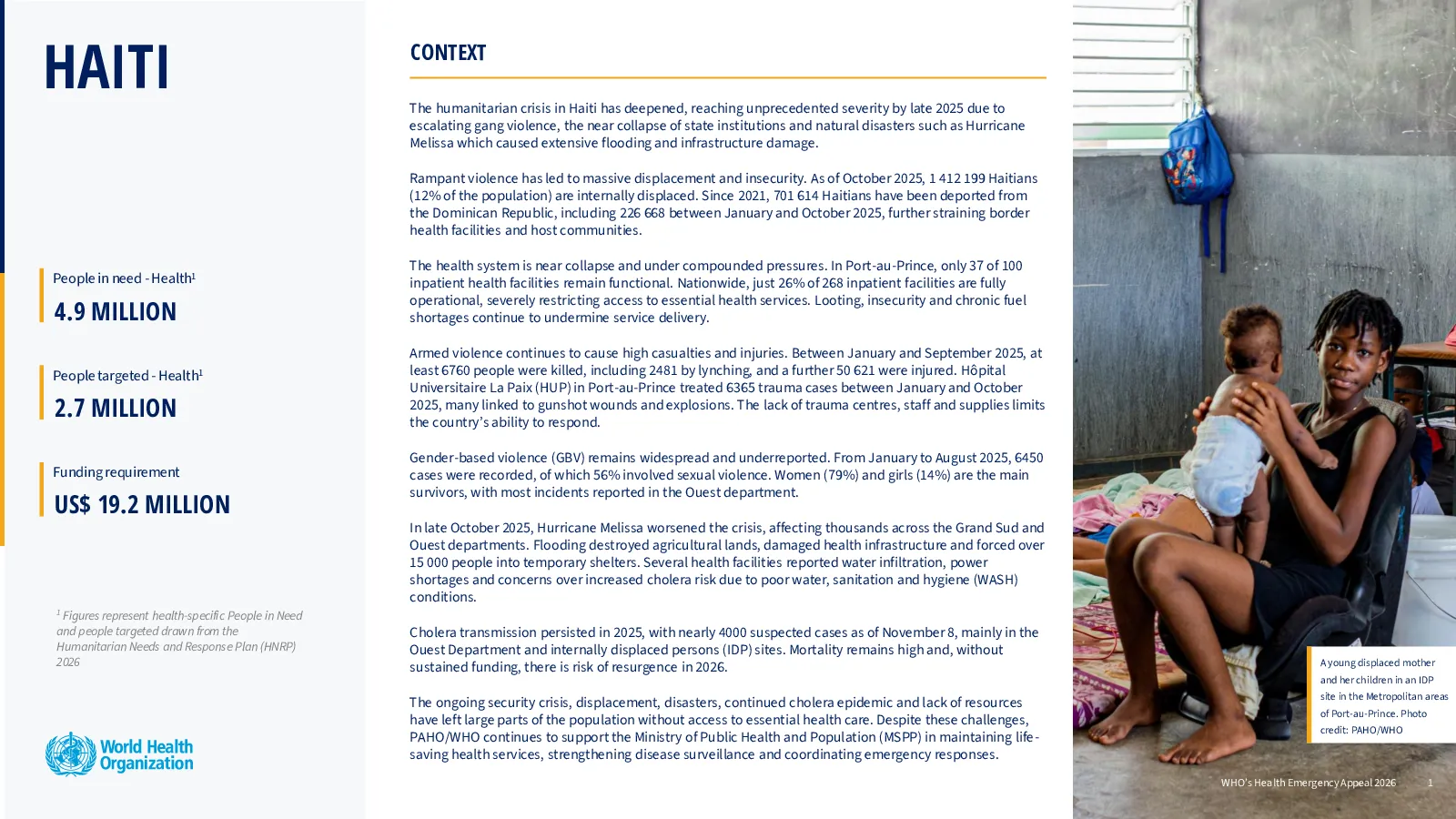
CONTEXT The humanitarian crisis in Haiti has deepened, reaching unprecedented severity by late 2025 due toescalating gang violence, the near collapse of state institutions and natural disasters such as HurricaneMelissa which caused extensive flooding and infrastructure damage. Rampant violence has led to massive displacement and insecurity. As of October 2025, 1 412 199 Haitians(12% of the population) are internally displaced. Since 2021, 701 614 Haitians have been deported fromthe Dominican Republic, including 226 668 between January and October 2025, further straining borderhealth facilities and host communities. The health system is near collapse and under compounded pressures. In Port-au-Prince, only 37 of 100inpatient health facilities remain functional. Nationwide, just 26% of 268 inpatient facilities are fullyoperational, severely restricting access to essential health services. Looting, insecurity and chronic fuelshortages continue to undermine service delivery. People in need-Health14.9 MILLION Armed violence continues to cause high casualties and injuries. Between January and September 2025, atleast 6760 people were killed, including 2481 by lynching, and a further 50 621 were injured.HôpitalUniversitaire La Paix (HUP) in Port-au-Prince treated 6365 trauma cases between January and October2025, many linked to gunshot wounds and explosions. The lack of traumacentres, staff and supplies limitsthe country’s ability to respond. People targeted-Health12.7 MILLION Gender-based violence (GBV) remains widespread and underreported. From January to August 2025, 6450cases were recorded, of which 56% involved sexual violence. Women (79%) and girls (14%) are the mainsurvivors, with most incidents reported in the Ouest department. Funding requirementUS$ 19.2 MILLION In late October 2025, Hurricane Melissa worsened the crisis, affecting thousands across the Grand Sud andOuest departments. Flooding destroyed agricultural lands, damaged health infrastructure and forced over15 000 people into temporary shelters. Several health facilities reported water infiltration, powershortages and concerns over increased cholera risk due to poor water, sanitation and hygiene (WASH)conditions. 1Figures represent health-specific People in Needand people targeted drawn from theHumanitarian Needs and Response Plan (HNRP)2026 Cholera transmission persisted in 2025, with nearly 4000 suspected cases as of November 8, mainly in theOuest Department and internally displaced persons (IDP) sites. Mortality remains high and, withoutsustained funding, there is risk of resurgence in 2026. A young displaced motherand her children in an IDPsite in the Metropolitan areasof Port-au-Prince. Photocredit: PAHO/WHO The ongoing security crisis, displacement, disasters, continued cholera epidemic and lack of resourceshave left large parts of the population without access to essential health care. Despite these challenges,PAHO/WHO continues to support the Ministry of Public Health and Population (MSPP) in maintaining life-saving health services, strengthening disease surveillance and coordinating emergency responses. WHO’S STRATEGIC OBJECTIVES 1. Ensure availability of and access to emergency, primary and life-saving health services:Prioritize the delivery of emergency and primaryhealth services for the most vulnerable population groups, including pregnant women, children, IDPs, returnees and those injureddue to violence. 2. Maintain and strengthen disease surveillance and outbreak response mechanisms:Enhance the capacity for timely detection and rapidresponse to disease outbreaks of epidemic potential such as cholera, malaria, diphtheria, measles or COVID-19. 3. Secure critical supply chain operations:Ensure a reliable supply of essential medicines and medical equipment amid security challenges. WHO’S CHANGING ROLE AND APPROACH:DELIVERING UNDER THE HUMANITARIAN RESET In 2026, PAHO/WHO will adapt its operational model in Haiti to meet the demands of a prolonged humanitarian crisis, emphasizingsustainability,localization and efficiency. As other actors progressively scale down or withdraw from health operations due to insecurity and fundingconstraints, PAHO/WHO will assume expanded responsibilities in life-saving health service delivery, emergency coordination and outbreakresponse. This includes maintaining national cholera surveillance, ensuring supply chain continuity for essential medicines andreagents andstrengthening referral hospitals to provide emergency and obstetric care in underserved areas. At the same time, PAHO/WHO will continue to support the operational functions-such as direct community sensitization and field-levelsurveillance-of departmental health authorities and trusted local partners like Zanmi Lasante, thereby reinforcing national ownership andsustainability. Global trends, marked by reduced humanitarian funding, escalating violence and the localization agenda, require PAHO/WHO to operate morestrategically, inte