您的浏览器禁用了JavaScript(一种计算机语言,用以实现您与网页的交互),请解除该禁用,或者联系我们。 [世界卫生组织]:阿富汗:世界卫生组织2026年卫生紧急呼吁 - 发现报告

阿富汗:世界卫生组织2026年卫生紧急呼吁

信息技术 2026-01-28 世界卫生组织 朝新G
报告封面

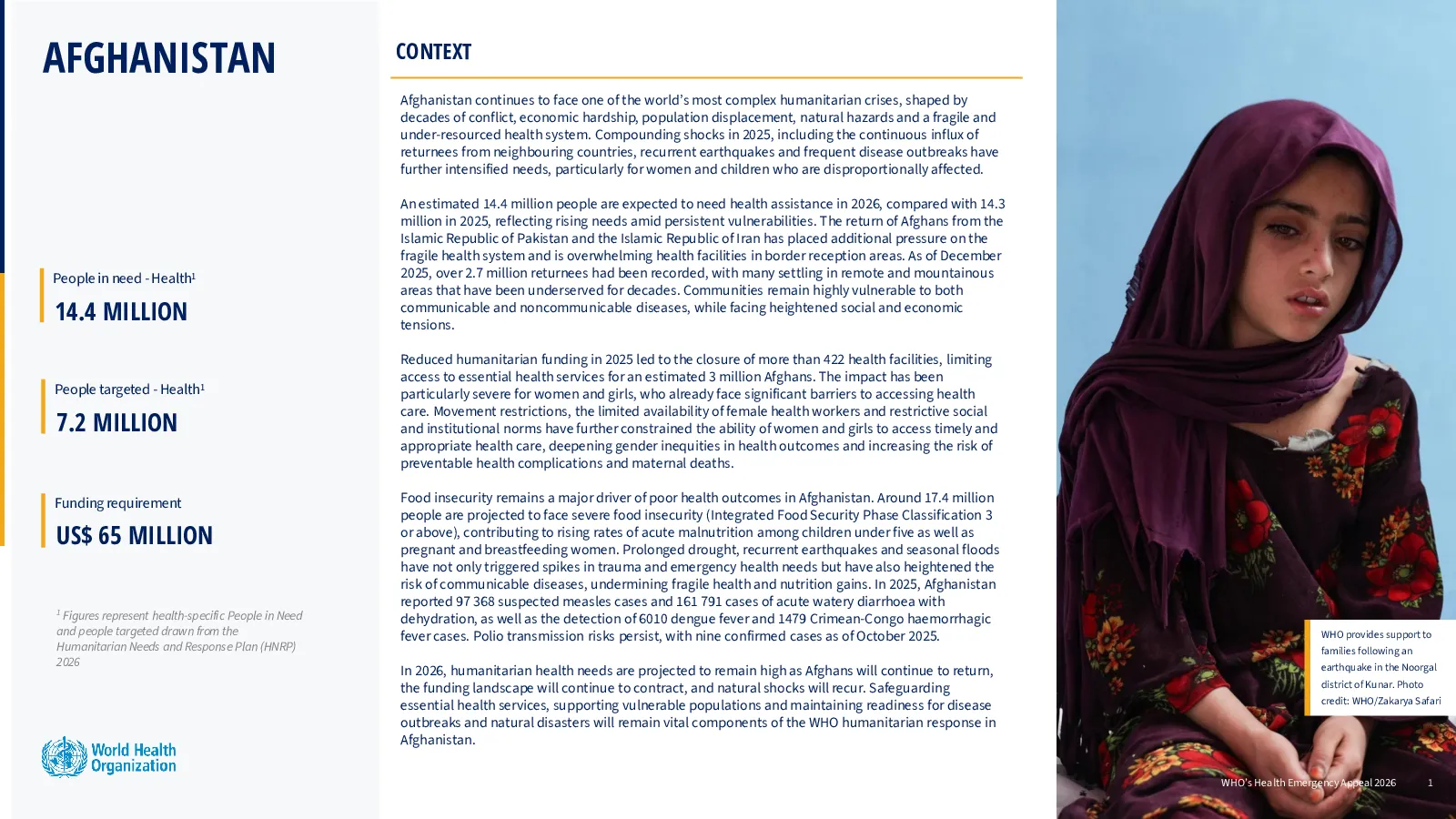
CONTEXT Afghanistan continues to face one of the world’s most complex humanitarian crises, shaped bydecades of conflict, economic hardship, population displacement, natural hazards and a fragile andunder-resourced health system. Compounding shocks in 2025, including the continuous influx ofreturnees from neighbouring countries, recurrent earthquakes and frequent disease outbreaks havefurther intensified needs, particularly for women and children who are disproportionally affected. An estimated 14.4 million people are expected to need health assistance in 2026, compared with 14.3million in 2025, reflecting rising needs amid persistent vulnerabilities. The return of Afghans from theIslamic Republic of Pakistan and the Islamic Republic of Iran has placed additional pressure on thefragile health system and is overwhelming health facilities in border reception areas. As of December2025, over 2.7 million returnees had been recorded, with many settling in remote and mountainousareas that have been underserved for decades. Communities remain highly vulnerable to bothcommunicable and noncommunicable diseases, while facing heightened social and economictensions. People in need-Health114.4 MILLION Reduced humanitarian funding in 2025 led to the closure of more than 422 health facilities, limitingaccess to essential health services for an estimated 3 million Afghans. The impact has beenparticularly severe for women and girls, who already face significant barriers to accessing healthcare. Movement restrictions, the limited availability of female health workers and restrictive socialand institutional norms have further constrained the ability of women and girls to access timely andappropriate health care, deepening gender inequities in health outcomes and increasing the risk ofpreventable health complications and maternal deaths. People targeted-Health17.2 MILLION Food insecurity remains a major driver of poor health outcomes in Afghanistan. Around 17.4 millionpeople are projected to face severe food insecurity (Integrated Food Security Phase Classification 3or above), contributing to rising rates of acute malnutrition among children under five as well aspregnant and breastfeeding women. Prolonged drought, recurrent earthquakes and seasonal floodshave not only triggered spikes in trauma and emergency health needs but have also heightened therisk of communicable diseases, undermining fragile health and nutrition gains. In 2025, Afghanistanreported 97 368 suspected measles cases and 161 791 cases of acute watery diarrhoea withdehydration, as well as the detection of 6010 dengue fever and 1479 Crimean-Congo haemorrhagicfever cases. Polio transmission risks persist, with nine confirmed cases as of October 2025. Funding requirementUS$ 65 MILLION 1Figures represent health-specific People in Needand people targeted drawn from theHumanitarian Needs and Response Plan (HNRP)2026 WHO provides support tofamilies following anearthquake in theNoorgaldistrict of Kunar. Photocredit: WHO/Zakarya Safari In 2026, humanitarian health needs are projected to remain high as Afghans will continue to return,the funding landscape will continue to contract, and natural shocks will recur. Safeguardingessential health services, supporting vulnerable populations and maintaining readiness for diseaseoutbreaks and natural disasters will remain vital components of the WHO humanitarian response inAfghanistan. WHO’S STRATEGIC OBJECTIVES 1.Ensure equitable access to essential and life-saving health services,with a focus on women, children and underserved communities, throughintegrated primary and emergency health care services and strengthenedreferral systems. 2.Strengthen surveillance, preparedness and rapid response capacitiesto prevent, detect and respond to infectious disease outbreaks andhealth emergencies. 3.Enhance coordination, accountability and system resiliencebysupporting national capacities, sustaining critical health services andreinforcing the humanitarian-development-peace nexus. Through this partnership with WHO, we aim to strengthenAfghanistan's capacity to prevent, detect and respond to outbreaksand health emergencies. With an ongoing surge of migratorymovements and the undeniable reality that viruses respect no borders,a stronger and more effective health security system in Afghanistan is acrucial investment in mitigating the risk of cross-border spread andsafeguarding the health of populations. Mrs. Veronika Boskovic Pohar, Chargéd’Affairesof theEuropean Union Delegation to Afghanistan WHO’S CHANGING ROLE AND APPROACH: DELIVERING UNDER THEHUMANITARIAN RESET WHO’s role in Afghanistan continues to evolve in line with the Humanitarian Reset, focusingresources on essential and life-saving services while strengthening national systems toenhance resilience and sustainability. WHO remains committed to safeguarding access tocritical health interventions, particularly for women, children and communities in remote andunderserve