您的浏览器禁用了JavaScript(一种计算机语言,用以实现您与网页的交互),请解除该禁用,或者联系我们。[PitchBook]:12月总结:尽管经历动荡一年,欧洲贷款在2025年底站稳脚跟 - 发现报告

12月总结:尽管经历动荡一年,欧洲贷款在2025年底站稳脚跟

2026-01-08-PitchBook王***
AI智能总结
查看更多
12月总结:尽管经历动荡一年,欧洲贷款在2025年底站稳脚跟

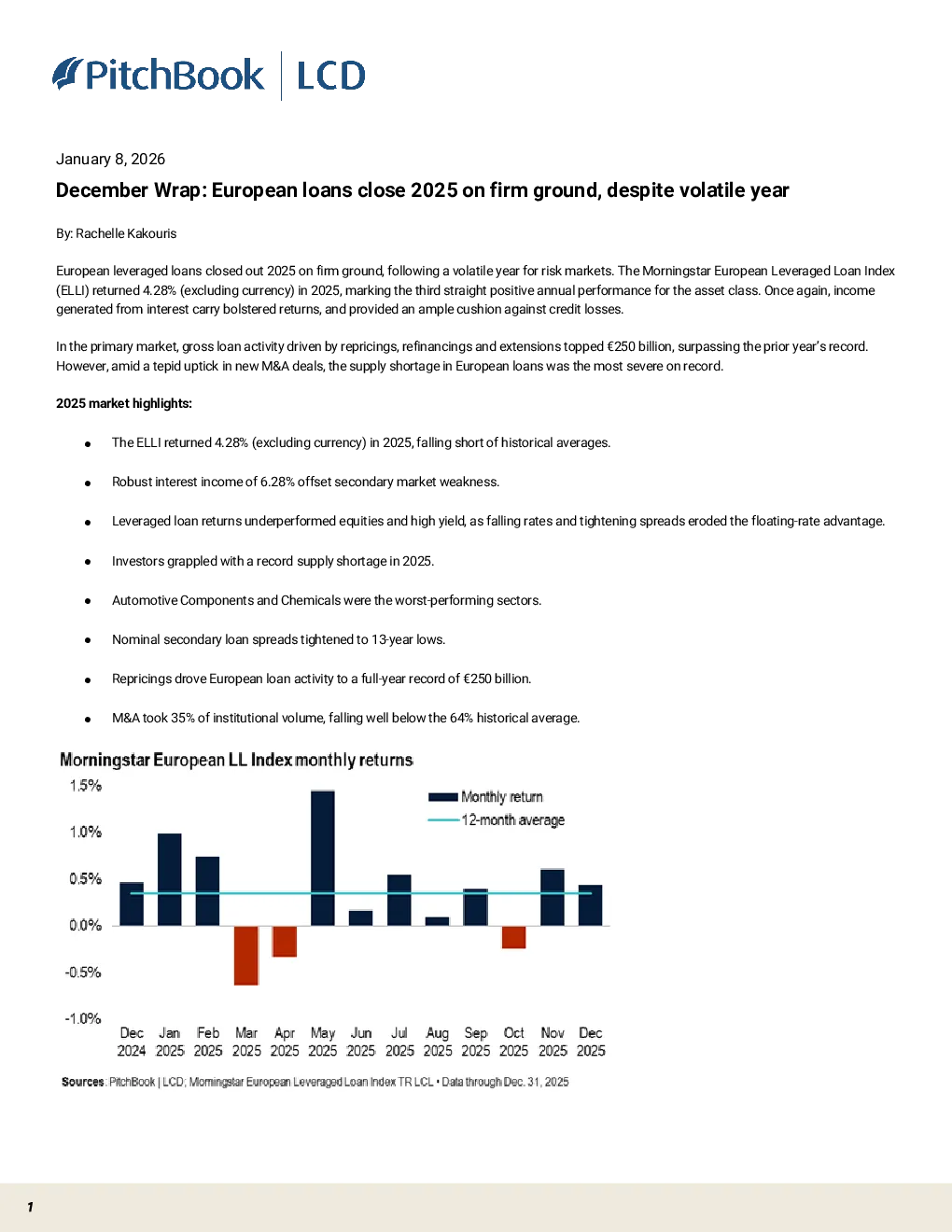
January 8, 2026 December Wrap: European loans close 2025 on firm ground, despite volatile year By: Rachelle Kakouris European leveraged loans closed out 2025 on firm ground, following a volatile year for risk markets. The Morningstar European Leveraged Loan Index(ELLI) returned 4.28% (excluding currency) in 2025, marking the third straight positive annual performance for the asset class. Once again, income In the primary market, gross loan activity driven by repricings, refinancings and extensions topped €250 billion, surpassing the prior year’s record.However, amid a tepid uptick in new M&A deals, the supply shortage in European loans was the most severe on record. 2025 market highlights: •The ELLI returned 4.28% (excluding currency) in 2025, falling short of historical averages. •Robust interest income of 6.28% offset secondary market weakness. •Leveraged loan returns underperformed equities and high yield, as falling rates and tightening spreads eroded the floating-rate advantage. •Investors grappled with a record supply shortage in 2025. •Automotive Components and Chemicals were the worst-performing sectors. •Nominal secondary loan spreads tightened to 13-year lows. •Repricings drove European loan activity to a full-year record of €250 billion. •M&A took 35% of institutional volume, falling well below the 64% historical average. Zooming in on December performance, the ELLI gained 0.44% (excluding currency) on the month. While this reading sits comfortably above the0.35% 12-month average, the full-year 2025 return of 4.28% was below the 5.34% average annual return over the last five years. Margin reductionsfrom record repricings and falling base rates eroded interest income in 2025, while weak secondary performance — particularly in the lower echelons The annual loan performance also fell short of Street expectations, with the majority of bulge bracket banks having pointed to 2025 loan returns in a Carry conviction Nevertheless, the appeal of floating-rate loans in the current rate environment remained in play as income generated from interest carry in 2025 — at6.28% — boosted loan performance against a market-value loss of 1.99%. December cemented this dynamic, with the ELLI posting an interest return That said, the benefit of a relatively high interest component — reflecting both base rates and loan coupons — is starting to normalise. By comparison,loan investors in 2025 and 2024 earned a respective 8.21% and 8.37% from coupon-clipping alone. With the advantage of floating-rate debt waning, European loan returns underperformed versus equities in 2025, and for the first time since 2019, Trading rollercoaster Turning to the trading picture, it was a rollercoaster year for risk markets shaped by US President Donald Trump's global trade tariffs, as well asgeopolitical tensions, AI bubble concerns and — for loans in particular — idiosyncratic credit events. As such, leveraged loan prices — as measured bythe average bid in the ELLI — failed to retrace the sharp losses sustained after plummeting from a three-year high of 98.70 on Feb. 26, and then December’s six-basis-point fall left the ELLI's average bid at 96.66 by year-end for a total price drop of 135 bps from its 2024 closing level, markingthe largest annual price decline on this measure since 2022. All told, loans retraced a little over 100 bps of losses from the year-low of 95.54 reached Rearview mirror Market volatility sparked by US tariff policy caused ELLI returns to whipsaw at the beginning of April. Indeed, the index lost 1.08% on April 7 — theninth-worst reading since LCD began calculating daily returns (note, the top-eight worst daily returns all occurred in March 2020 as the Covid-19 Fast-forwarding to the final quarter of the year, the dramatic collapse ofFirst Brandsput a spotlight on idiosyncratic risk, and proved a further drag onsentiment and loan returns. Amid growing bifurcation — as well as a general pushback on tight spreads — the ELLI posted a 0.25% loss in October, in With the collapse of First Brands, the Automobile Components sector was hardest hit in 2025 after the automotive parts manufacturer filed forChapter 11 on Sept. 29. The company’s precipitous fall from grace (its first lien debt was rated high single-B for the majority of the month it filed) The Chemicals sector — which has a relatively large footprint in Europe with a market weight of 5.45% in the index — lost 4.26% in 2025 amid a broad- The average spread-to-maturity finished the year at E+450 bps — roughly even with E+452 bps at the end of November, and E+451 bps at the end of2024. This metric — which incorporates both a loan’s nominal spread and secondary-market bid price — dipped to a cycle-low of E+418 bps on Amid rampant margin repricings and tighter new-issue spreads, the nominal spread of the ELLI (which reflects the contractual spread over a baserate and does not account for the impact of a floor) tightened to E+367 bps, its lowes