您的浏览器禁用了JavaScript(一种计算机语言,用以实现您与网页的交互),请解除该禁用,或者联系我们。[韩国央行]:人工智能的快速采用及其生产力效应:以韩国为例 - 发现报告

人工智能的快速采用及其生产力效应:以韩国为例

信息技术2025-08-18-韩国央行陈***
AI智能总结
查看更多
人工智能的快速采用及其生产力效应:以韩国为例

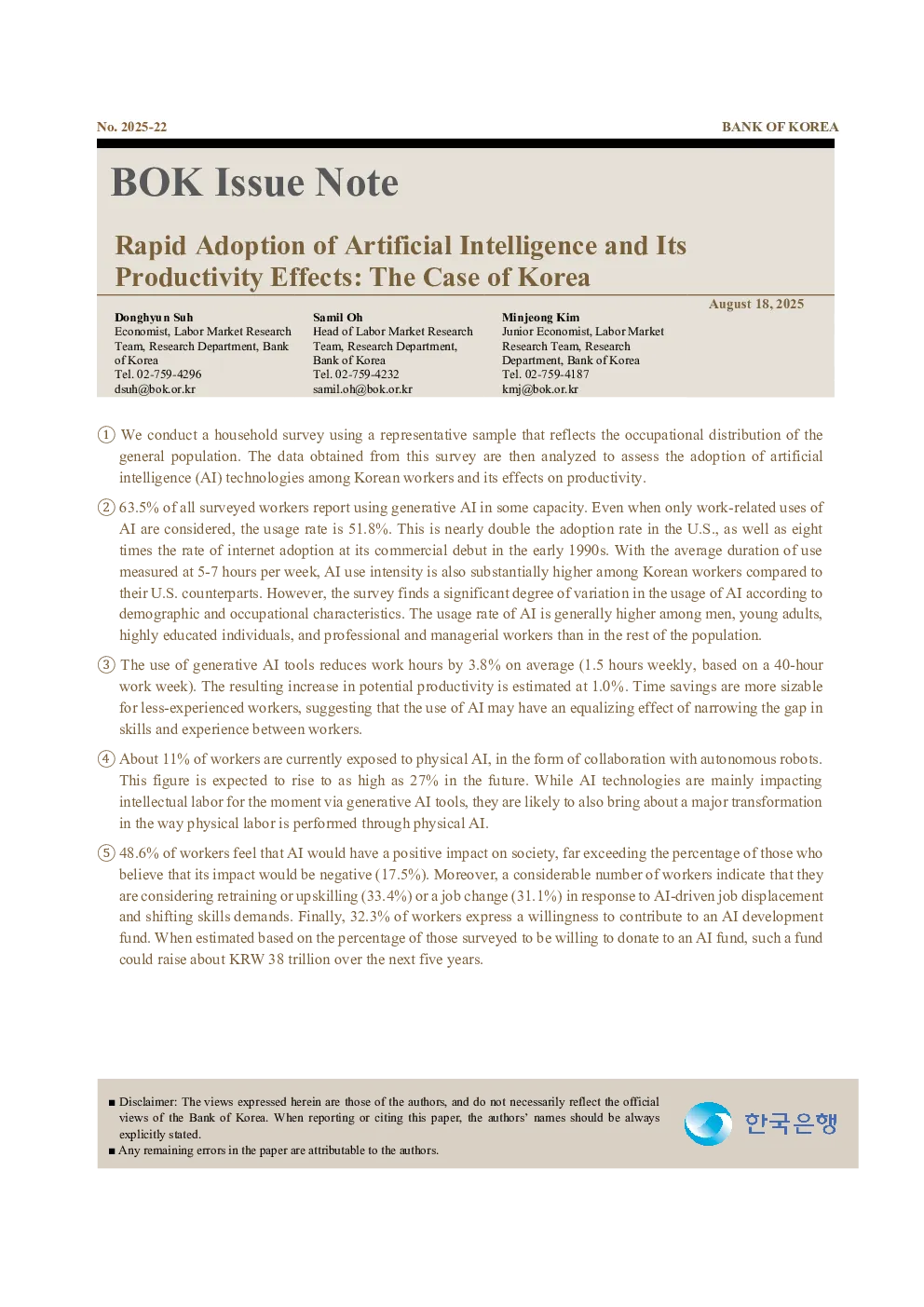
Rapid Adoption of Artificial Intelligence and ItsProductivity Effects:TheCase of Korea August 18, 2025 MinjeongKimJunior Economist, Labor MarketResearch Team, ResearchDepartment, Bank of KoreaTel.02-759-4187kmj@bok.or.kr SamilOhHead ofLabor MarketResearchTeam, Research Department,Bank of KoreaTel. 02-759-4232samil.oh@bok.or.kr DonghyunSuhEconomist,Labor MarketResearch Team, Research Department,Bankof KoreaTel. 02-759-4296dsuh@bok.or.kr ①We conducta household surveyusinga representative sample that reflects the occupational distribution of thegeneral population. The data obtained from this surveyare then analyzed to assess the adoption of artificialintelligence (AI) technologies among Korean workers and its effects on productivity. ②63.5% of all surveyed workers reportusing generative AI in some capacity. Even when only work-related uses ofAIare considered, the usagerateis51.8%. This is nearly double the adoption rate in the U.S., as well as eighttimes the rate of internet adoption at its commercial debut in the early 1990s. With the average duration of usemeasured at 5-7 hours per week, AI use intensityis also substantially higher among Korean workers compared totheir U.S. counterparts. However, the survey findsa significant degree of variation in the usage of AI according todemographic and occupational characteristics. The usage rate of AIis generally higheramong men, young adults,highlyeducated individuals, and professional and managerial workers than in the rest of the population. ③The use of generative AI toolsreduceswork hoursby 3.8% on average (1.5 hours weekly,based on a 40-hourwork week). The resulting increase in potential productivity is estimated at 1.0%.Time savingsaremore sizableforless-experienced workers, suggesting that the use of AI may have an equalizing effect of narrowing the gap inskills and experience betweenworkers. ④About 11% of workersare currently exposed to physical AI, in the form of collaboration with autonomous robots.This figure is expected to rise to as high as 27% in the future. While AI technologies are mainly impactingintellectual labor for the moment via generative AI tools, they are likely to also bring about a major transformationin the way physical labor is performed through physical AI. ⑤48.6% of workers feelthat AI would have a positive impactonsociety, far exceeding the percentage of those whobelievethat its impact would be negative (17.5%). Moreover, a considerable number of workers indicatethat theyare considering retraining or upskilling (33.4%) or a job change (31.1%)inresponse to AI-driven job displacementand shifting skills demands. Finally, 32.3% of workers expressa willingness to contribute to an AI developmentfund. When estimated based on the percentage of those surveyed to be willing to donate to an AI fund, such a fundcould raise about KRW 38 trillion over the next five years. ■ Disclaimer: The views expressed herein are those of the authors, and do not necessarily reflect the officialviews of the Bank of Korea. When reporting or citing thispaper, the authors’ names should be alwaysexplicitly stated.■Anyremaining errors in the paper are attributable to the authors. Artificial intelligence (AI) technology has emerged as the most transformative force of our time. Since the unveilingof ChatGPT, a large language model (LLM)-based generative AI, in November 2022, the number of its weekly activeusers has rapidly increased to reach an estimated 700 million in July 2025. ChatGPT was soon followed by othervarious generative AI systems, such as Gemini, CLOVA Note, Perplexity, and Claude, whose user bases are alsoquickly growing. Recent studies have demonstrated the positive effects of generative AI on productivity (Oh et al. 2025; Brynjolfssonet al. 2025; Cui et al. 2024), with some of them predicting a substantial economic impact from its adoption (Chui et al.2023; Filippucci et al. 2024). However, other studies estimated that the economic impact of generative AI could berather limited (Acemoglu 2024). Expert predictions are, therefore, mixed at best, regarding both AI’s impact oneconomic growth and its impact on the labor market. Uncertainty surrounding the future outlook of AI is in part dueto the lack of comprehensive data on its usage among workers. In this study, in order to provide crucial data for AI policy formulation, we assessed the usage of AI tools amongKorean workers and analyzed its impact on productivity based on the results of a household survey. The survey wasdesigned as a nationally representative survey that reflects the occupational distribution of the overall population andwas conducted online. The sample consisted of close to 5,500 individuals.The survey asked respondents about whetherthey used AI, how their productivity changed as a result, how their task performance was impacted by physical AI,how they perceived AI technology, and whether they supported government policies including the establishment of anAI fund. Some of the