2030年全球营养目标:低出生体重简报
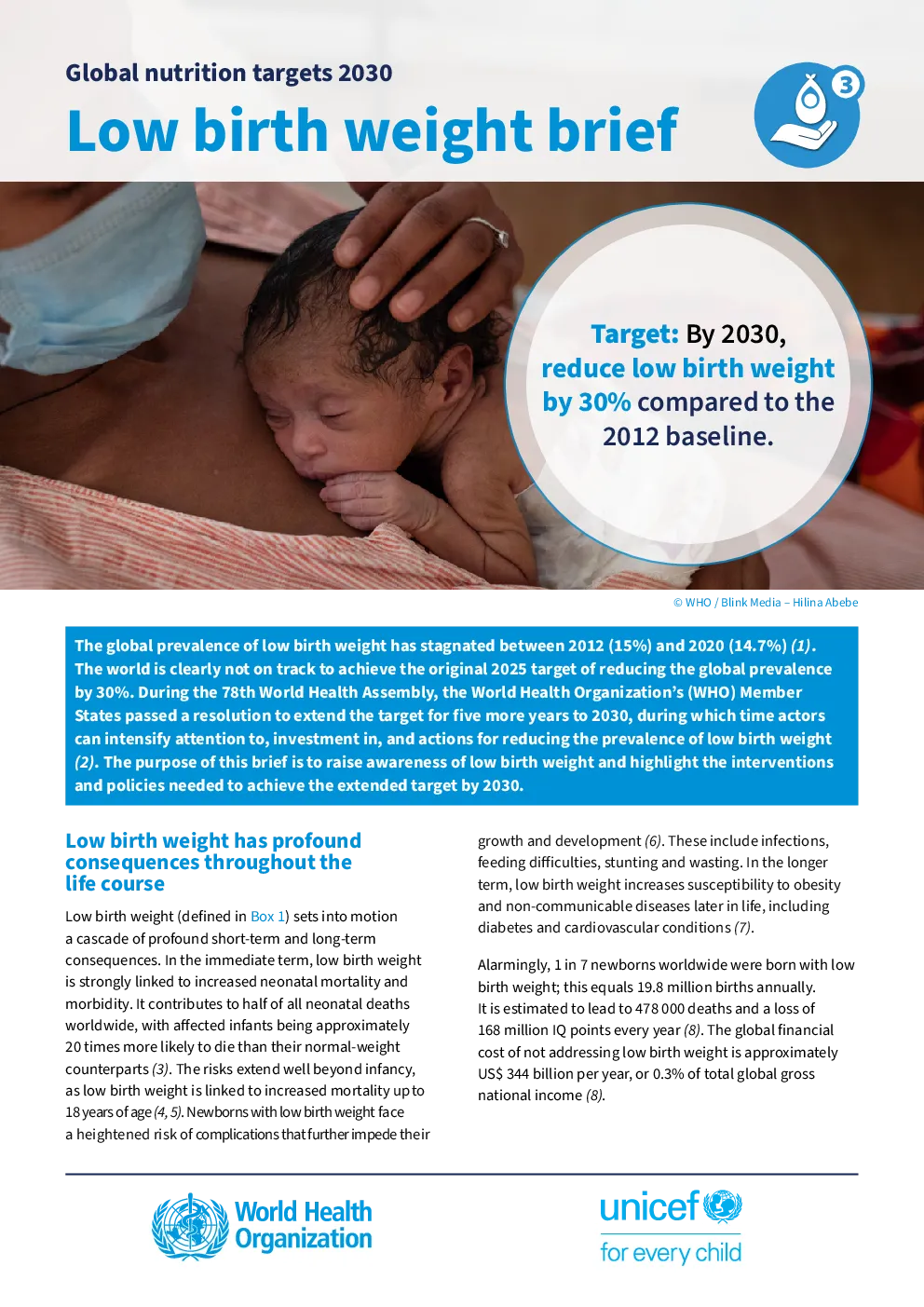
Target:By 2030,reduce low birth weightby 30%compared to the The global prevalence of low birth weight has stagnated between 2012 (15%) and 2020 (14.7%)(1).The world is clearly not on track to achieve the original 2025 target of reducing the global prevalenceby 30%. During the 78th World Health Assembly, the World Health Organization’s (WHO) MemberStates passed a resolution to extend the target for five more years to 2030, during which time actors Low birth weight has profoundconsequences throughout thelife course growth and development(6). These include infections,feeding difficulties, stunting and wasting. In the longerterm, low birth weight increases susceptibility to obesity Low birth weight (defined inBox 1) sets into motiona cascade of profound short-term and long-termconsequences. In the immediate term, low birth weightis strongly linked to increased neonatal mortality andmorbidity. It contributes to half of all neonatal deathsworldwide, with affected infants being approximately Alarmingly, 1 in 7 newborns worldwide were born with lowbirth weight; this equals 19.8 million births annually.It is estimated to lead to 478 000 deaths and a loss of168 million IQ points every year(8). The global financialcost of not addressing low birth weight is approximately The causes of low birth weightare complex While low birth weight is not explicitly mentioned in theSustainable Development Goals (SDGs), its reductionwould contribute to the achievement of the SDG targetson health, nutrition, education, and economic growth.Improved birth weight would drive down neonataland infant mortality rates and have positive long-termhealth consequences for infants and their families, thusadvancing progress towards SDG 3 (Good health and Low birth weight is a complex and multifaceted issue,influenced by factors ranging from maternal nutrition tohealth, psychosocial, environmental, and socioeconomicelements.Key risk factors include early induction of labouror caesarean birth (for medical or non-medical reasons), Poor maternal nutritional status is one of the mostcommon causes of poor gestational growth(11-13).Adequate nutrition over the life course, particularly priorto and during pregnancy, is crucial for a healthy pregnancyand the delivery of a newborn with normal weight(12, 13).Additionally, inadequatenutrition impairs immunological Addressing this issue is imperative. This brief underscoresthe urgent need for comprehensive multisectoralmeasures, including improved maternal nutrition,antenatal care of adequate quality, and a supportive Gender inequality undermines the health and nutritionalstatus of mothers and children in many parts of theworld. For example, adolescent girls and women oftenface challenges in accessing adequate nutrition and care.These can be made worse by discriminatory social and Box 1. World Health Organization definition of low birth weight Low birth weight is weight at birth of less than 2500 grams (5.5 lbs), regardless of gestational age. Low birth weightincludes both appropriately grown preterm infants (less than 37 completed weeks of gestation) and term and preterm We are not on track to meet the targetby 2025 countries (Fig. 1). The slow progress is partially due to itsmultifaceted nature, with contributing factors varying bycountry. Historically, interventions have focused on singlesolutions, neglecting the critical role of multisectoralapproaches to improve maternal nutrition. Even proveninterventions are often under-resourced and poorly Close to three quarters of all countries worldwide (146out of 195) are off track to achieve the 2025 global targetof a 30% reduction for low birth weight, and globally theprevalence has stagnated at 14.7% (in 2020) compared to Progress on reducing the prevalence of low birth weighthas been slow or lacking across all regions. While thereis considerable variation, the great majority of infants As of 2022, Finland reported a relatively low prevalence of low birth weightof 4%(18). This rate has remained consistently low over the last decade.A combination of comprehensive health care services and targetedinterventions are important contributing factors to this situation.Free antenatal services, funded by taxes and led by specializednurses and doctors(19)are associated with the low rates(20).Pregnant women typically have 11-15 antenatal care visits, duringwhich their health and wellbeing are continuously monitored.Additional support is offered if challenges arise, such as withmental health and economic stability. Maternity clinics providefollow-up on the health of the pregnant woman and the growthand development of the fetus. They support the welfare of theentire family, emphasizing the role of both parents. In cases ofabnormal growth or development, pregnant women are referred tospecialist care. The Finnish Food Authority emphasizes the importanceof maternal nutrition, including the consumption of a balanced diet, safefish consumption, and ensuring adequa