AI智能总结
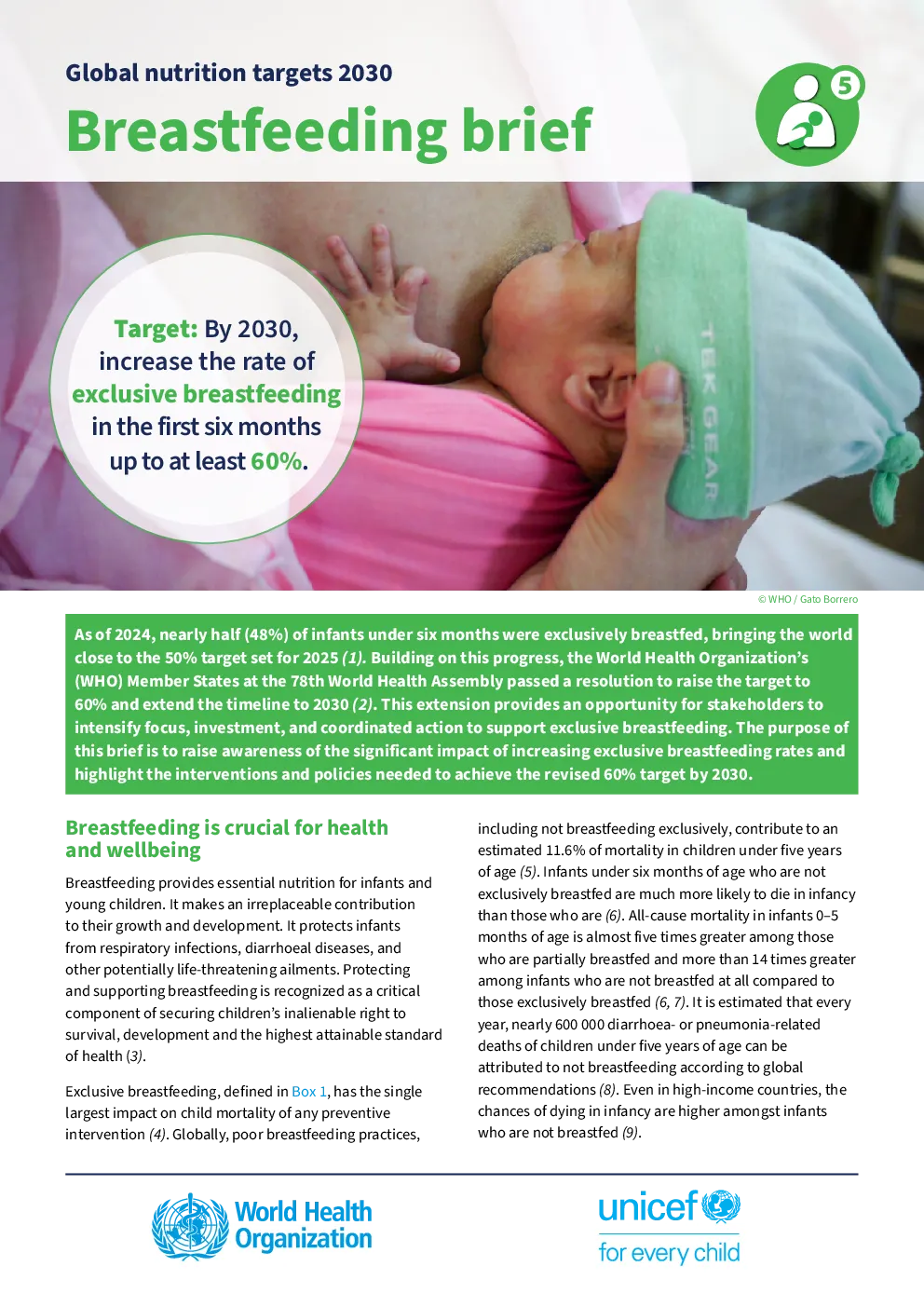
Target:By 2030,increase the rate ofexclusive breastfeedingin the first six months As of 2024, nearly half (48%) of infants under six months were exclusively breastfed, bringing the worldclose to the 50% target set for 2025(1).Building on this progress, the World Health Organization’s(WHO) Member States at the 78th World Health Assembly passed a resolution to raise the target to60% and extend the timeline to 2030(2). This extension provides an opportunity for stakeholders tointensify focus, investment, and coordinated action to support exclusive breastfeeding. The purpose of Breastfeeding is crucial for healthand wellbeing including not breastfeeding exclusively, contribute to anestimated 11.6% of mortality in children under five yearsof age(5). Infants under six months of age who are notexclusively breastfed are much more likely to die in infancythan those who are(6). All-cause mortality in infants 0–5months of age is almost five times greater among thosewho are partially breastfed and more than 14 times greater Breastfeeding provides essential nutrition for infants andyoung children. It makes an irreplaceable contributionto their growth and development. It protects infantsfrom respiratory infections, diarrhoeal diseases, andother potentially life-threatening ailments. Protecting Exclusive breastfeeding, defined inBox 1, has the singlelargest impact on child mortality of any preventiveintervention(4). Globally, poor breastfeeding practices, Breastfeeding has significant protective effects along thelife course. Children and adults who were not exclusivelybreastfed for the first six months of life are more likely toexperience noncommunicable diseases(7), including type growth, employment and decent work for all; SDG 10)Reduce inequality within and among countries; andSDG 12) Ensure sustainable consumption and production There are many barriers to exclusivebreastfeeding Breastfeeding practices have considerable economicand environmental implications. It is estimated that theincreased morbidity and mortality among women andchildren associated with low breastfeeding prevalencecost health care systems US$ 1.1 billion a year globally,in treatment costs.The largest source of economicloss attributable to poor breastfeeding practices is theassociated cognitive deficits, which reduce individual While breastfeeding was standard practice for most ofhuman history, changes in lifestyle over the last centuryor more have created new challenges and barriers tosuccessful breastfeeding. For example, women in the The widespread promotion of breast-milk substituteshas led to cultural shifts in much of the world, and theuse of these products has become normalized. Familiesare bombarded with misleading claims that commercialinfant formula is a healthy and convenient alternative to In addition, health workers are often not adequatelytrained to assess, manage and support breastfeeding.Hospital practices such as separating mothers and babiesafter birth, and delaying the first breastfeeding, caninterrupt the behaviours that are critical for establishingbreastfeeding. Providing every mother with skilled The carbon footprint for breastfeeding is significantlysmaller than that of using breast-milk substitutes. Theproduction and transportation of breast-milk substitutes Improving breastfeeding makes a considerablecontribution to meeting other Sustainable DevelopmentGoals (SDGs)(18). These include: SDG 1) End poverty inall its forms everywhere; SDG 2) End hunger, achievefood security and promote sustainable agriculture;SDG 3) Ensure healthy lives and promote well-being for all Box 1.World Health Organization definition of exclusive breastfeeding in infants less thansix months of age Exclusive breastfeeding means only breastfeeding with no other food or fluids, not even water. Exclusive breastfeedingmay include breastfeeding by a wet nurse, feeding of expressed breastmilk, and feeding of donor human milk(20).Prescribed medicines, oral rehydration solution, vitamins and minerals are not considered as fluids or foods. However, The indicator of exclusive breastfeeding rates is the proportion of infants 0–5 months of age who were exclusivelybreastfed during the previous day (24hrs)(21). Exclusive breastfeeding rates haveincreased in many countries Based on current trends, it is projected that we will havereached the 2025 global nutrition target of 50%. However,this still leaves half of infants 0–5 months of age at anincreased risk of infectious and often deadly diseases, suchas diarrhoea and pneumonia, simply because they arenot exclusively breastfed. There is also a need to focus oncountries falling behind the global increasing trend. The Between 2017 and 2024, 75 of the 106 countries thatupdated their data on the Global Breastfeeding Scorecarddocumented an increase in exclusive breastfeeding(1).In 23 of these countries, the increase was greater than ten latest Scorecard show 29 countries experiencing a decline Globally,