您的浏览器禁用了JavaScript(一种计算机语言,用以实现您与网页的交互),请解除该禁用,或者联系我们。[世界银行]:2025年西岸和加沙贫困评估:贫困、冲突和巴勒斯坦生计的侵蚀(英)2025 - 发现报告

2025年西岸和加沙贫困评估:贫困、冲突和巴勒斯坦生计的侵蚀(英)2025

公用事业2025-11-03世界银行测***
AI智能总结
查看更多
2025年西岸和加沙贫困评估:贫困、冲突和巴勒斯坦生计的侵蚀(英)2025

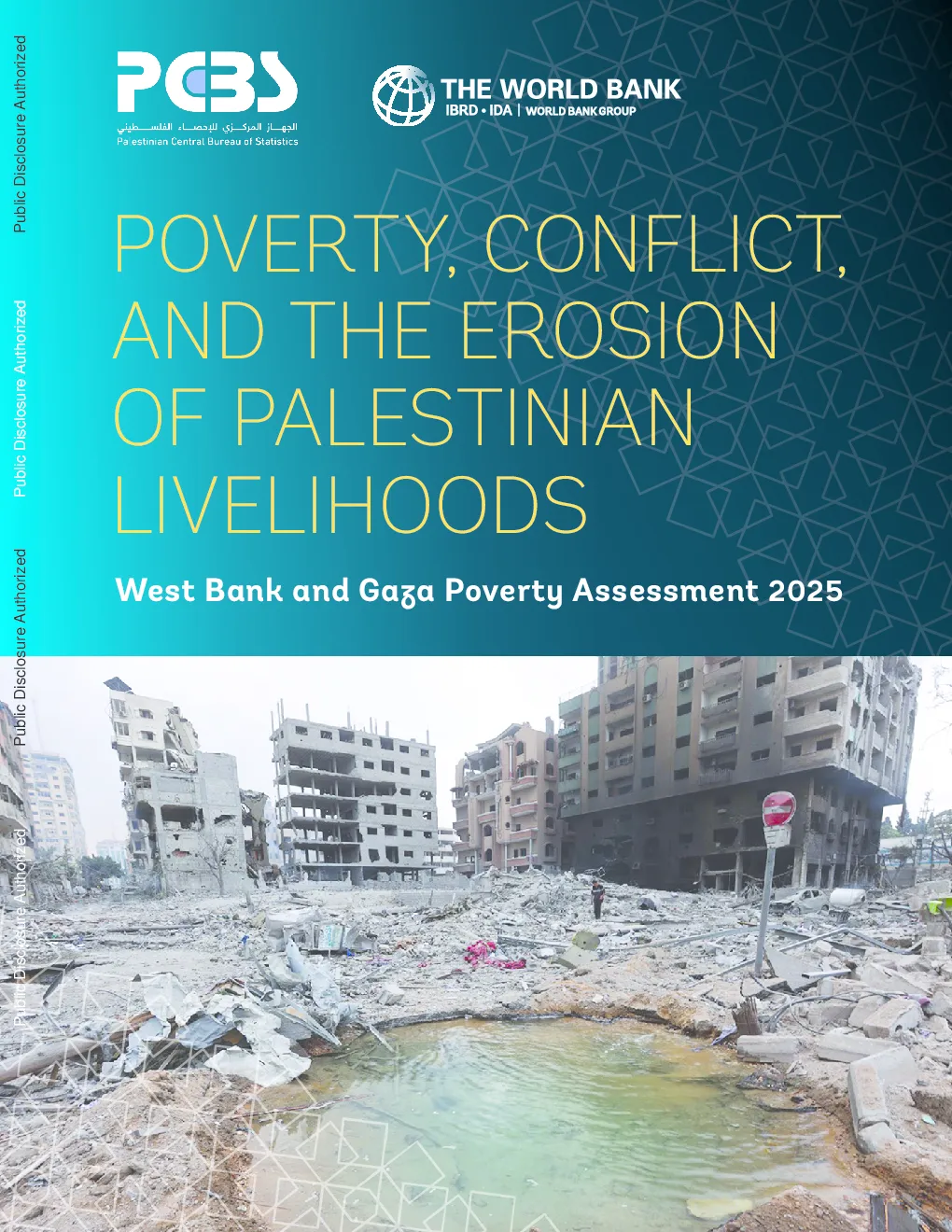
POVERTY, CONFLICT,AND THE EROSIONOF PALESTINIANLIVELIHOODSPublic Disclosure AuthorizedPublic Disclosure Authorized West Bank and Gaza Poverty Assessment2025 © 2025 International Bank for Reconstruction and Development/ The World Bank 1818 H Street NW, Washington,DC 20433 Telephone: 202-473-1000; Internet: www.worldbank.org SOME RIGHTS RESERVED This work is a product of the staff of The World Bank with external contributions. The findings, interpretations, andconclusions expressed in this work do not necessarily reflect the views of The World Bank, its Board of ExecutiveDirectors, or the governments they represent. The World Bank does not guarantee the accuracy of the data included inthis work. The boundaries, colors, denominations, and other information shown on any map in this work do not imply anyjudgment on the part of The World Bank concerning the legal status of any territory or the endorsement or acceptanceof such boundaries. Nothing herein shall constitute or be considered to be a limitation upon or waiver of the privilegesand immunities of The World Bank, all of which are specifically reserved. RIGHTS AND PERMISSIONS This work is available under the Creative Commons Attribution 4.0 IGO license (CC BY 4.0 IGO)http://creativecommons.org/licenses/by/4.0/igo. Under the Creative Commons Attribution license, you are free to copy, distribute, transmit, andadapt this work, including for commercial purposes, under the following conditions: ATTRIBUTION—Please cite the work as follows: World Bank. 2025. West Bank and Gaza Poverty Assessment: Poverty,Conflict and the Erosion of Palestinian Livelihoods. Washington DC. © World Bank. TRANSLATIONS—If you create a translation of this work, please add the following disclaimer along with the attribution:This translation was not created by The World Bank and should not be considered an official World Bank translation. TheWorld Bank shall not be liable for any content or error in this translation. ADAPTATIONS—If you create an adaptation of this work, please add the following disclaimer along with the attribution:This is an adaptation of an original work by The World Bank. Views and opinions expressed in the adaptation are the soleresponsibility of the author or authors of the adaptation and are not endorsed by the World Bank. THIRD-PARTY CONTENT—The World Bank does not necessarily own each component of the content contained withinthe work. The World Bank therefore does not warrant that the use of any third-party owned individual componentor part contained in the work will not infringe on the rights of those third parties. The risk of claims resulting fromsuch infringement rests solely with you. If you wish to re-use a component of the work, it is your responsibility todetermine whether permission is needed for that re-use and to obtain permission from the copyright owner. Examplesof components can include, but are not limited to, tables, figures, or images. All queries on rights and licenses should be addressed to World Bank Publications, The World Bank Group, 1818 HStreet NW, Washington, DC 20433, USA; e-mail: pubrights@worldbank.org. Cover Photo: World Bank Contents Abbreviations and acronyms_________________________________________________________________2 Executive Summary_________________________________________________________________________4 The ongoing conflict comes at a time when Palestinians in both Gaza and the West Bankwere already vulnerable_____________________________________________________________________4 Fragmented control in the West Bank contributed to geographic pockets of higher poverty___________6 Fiscal policy helped the very poorest but increased national poverty_______________________________8 Chapter 1:The ongoing conflict comes at a time when Palestinians in bothGaza and the West Bank were already vulnerable._____________________________________________11 Long-term structural constraints and an unprecedented economic collapse________________________13Poverty and inequality in the Palestinian territories through 2023: A snapshot before changesin Gaza since the start of the conflict_________________________________________________________15A deep dive into poverty in the West Bank:Fragile gains erased_______________________________________________________________________24Unprecedented living conditions in Gaza_____________________________________________________37Conclusion______________________________________________________________________________41 Chapter 2:Fragmented control in the West Bank contributed to geographic pocketsof higher poverty.___________________________________________________________________________43 The fragmented geography of the West Bank_________________________________________________45Pockets of poverty________________________________________________________________________46Barriers to mobility exacerbate fragmentation_________________________________________________48Access to jobs can v