AI智能总结
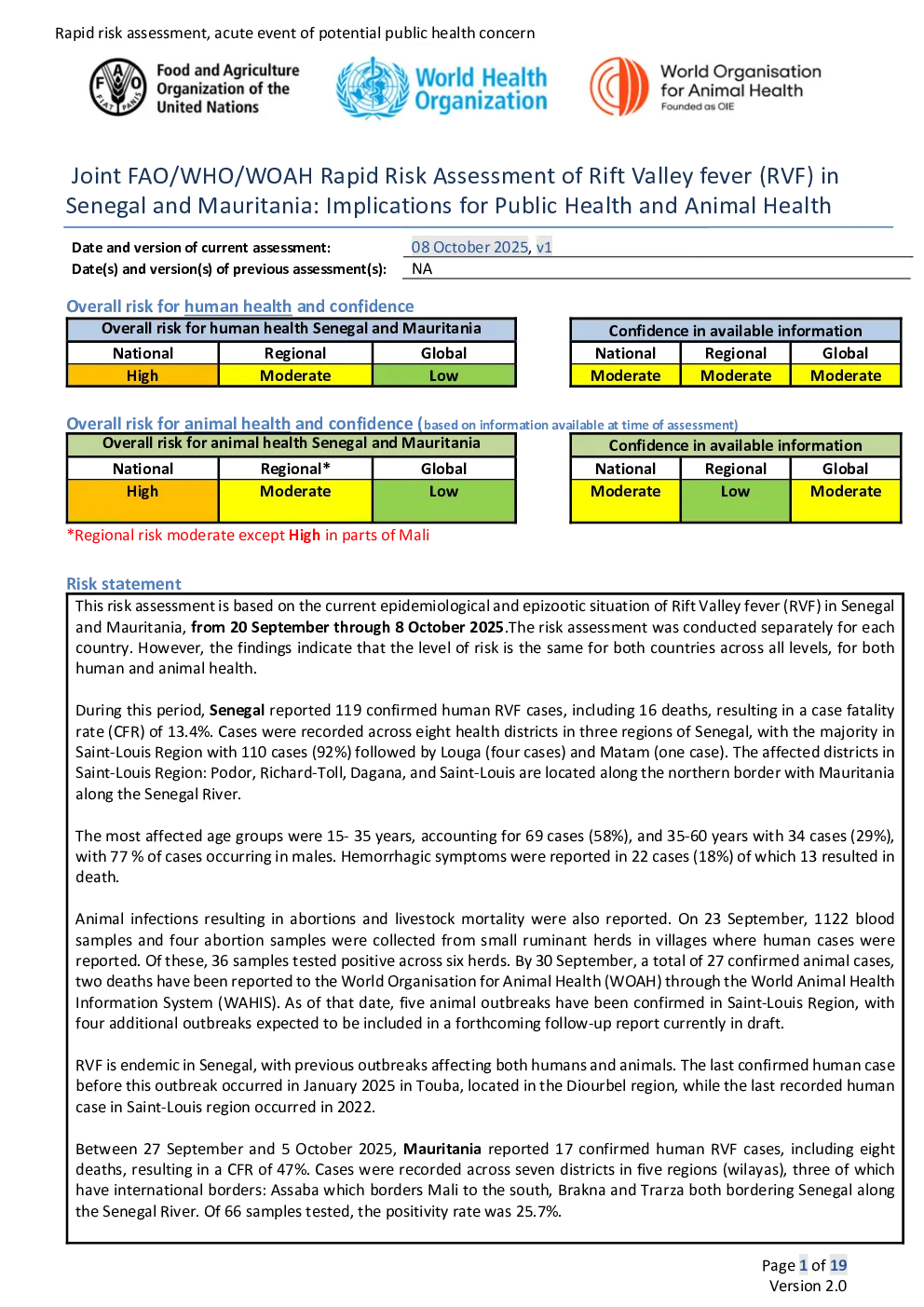
Joint FAO/WHO/WOAH Rapid Risk Assessment of Rift Valley fever (RVF) inSenegal and Mauritania: Implications for Public Health and Animal Health 08 October 2025,v1NA Date and version of current assessment:Date(s) and version(s) of previous assessment(s): Overall risk for human health and confidenceOverall risk for human health Senegal and Mauritania Overall risk for animal health and confidence (based on information available at time of assessment)Overall risk for animal health Senegal and Mauritania Risk statement This risk assessment is based on the current epidemiological and epizootic situation of Rift Valley fever (RVF) in Senegaland Mauritania,from 20 September through 8 October 2025.The risk assessment was conducted separately for eachcountry. However, the findings indicate that the level of risk is the same for both countries across all levels, for bothhuman and animal health. During this period,Senegalreported 119 confirmed human RVF cases, including 16 deaths, resulting in a case fatalityrate (CFR) of 13.4%. Cases were recorded across eight health districts in three regions of Senegal, with the majority inSaint-Louis Region with 110 cases (92%) followed by Louga (four cases) and Matam (one case). The affected districts inSaint-Louis Region: Podor, Richard-Toll, Dagana, and Saint-Louis are located along the northern border with Mauritaniaalong the Senegal River. The most affected age groups were 15- 35 years, accounting for 69 cases (58%), and 35-60 years with 34 cases (29%),with 77 % of cases occurring in males. Hemorrhagic symptoms were reported in 22 cases (18%) of which 13 resulted indeath. Animal infections resulting in abortions and livestock mortality were also reported. On 23 September, 1122 bloodsamples and four abortion samples were collected from small ruminant herds in villages where human cases werereported. Of these, 36 samples tested positive across six herds. By 30 September, a total of 27 confirmed animal cases,two deaths have been reported to the World Organisation for Animal Health (WOAH) through the World Animal HealthInformation System (WAHIS). As of that date, five animal outbreaks have been confirmed in Saint-Louis Region, withfour additional outbreaks expected to be included in a forthcoming follow-up report currently in draft. RVF is endemic in Senegal, with previous outbreaks affecting both humans and animals. The last confirmed human casebefore this outbreak occurred in January 2025 in Touba, located in the Diourbel region, while the last recorded humancase in Saint-Louis region occurred in 2022. Between 27 September and 5 October 2025,Mauritaniareported 17 confirmed human RVF cases, including eightdeaths, resulting in a CFR of 47%. Cases were recorded across seven districts in five regions (wilayas), three of whichhave international borders: Assaba which borders Mali to the south, Brakna and Trarza both bordering Senegal alongthe Senegal River. Of 66 samples tested, the positivity rate was 25.7%. Page1of19Version 2.0 Rapid risk assessment, acute event of potential public health concern Multiple active outbreaks in animals have also been reported. According to the Ministry of Animal Resources ofMauritania, as of 6 October, 17 outbreaks across eight regions, with 86 out of 307 samples testing positive. The firstanimal cases, involving goats and camels, were reported in August 2025. A total of 39 clinical animal cases (including16 deaths in two dromedaries and 14 goats) were reported in Aioun, Hodh-Gharbi region and Timbedra, Hodh-Charghiregion, both are located in southeastern Mauritania near the Mali border, and in Maghta Lahjar, Brakna region, incentral Mauritania. In Brakna region alone, 233 animal cases and 55 deaths have been reported to WOAH by 3 October2025. Affected animals include sheep, goats, camels and cattle. RVF is endemic inMauritania. The last major outbreak occurred in 2022, with 47 confirmed human cases, including 23deaths (CFR 49%), mostly among animal breeders in nine of 15 regions. The virus also affected animals such as cattle,camels, and small ruminants, with sample positivity rates of around 24% tested during that outbreak period. The current outbreak in Senegal and Mauritania is unusual in both its magnitude and severity. It involves multipledistricts in border regions, particularly along the Senegal River, increasing the risk of cross-border transmission betweenSenegal and Mauritania. In Mauritania, the outbreak also extends to eastern regions bordering Mali, raising concernsabout potential regional spread beyond the Senegal River basin. A notably high proportion of severe and haemorrhagic cases has been reported. In Senegal, 18% of confirmed humancases presented with haemorrhagic symptoms, with 13 cases resulting in death. The situation is particularly concerningin Mauritania, where the CFR has reached 47%, reflecting both the severity of illness and potential gaps in earlydetection and clinical management. Further information is n