您的浏览器禁用了JavaScript(一种计算机语言,用以实现您与网页的交互),请解除该禁用,或者联系我们。[世界卫生组织]:粮农组织-世界卫生组织-世界动物卫生组织联合会对塞内加尔和毛里塔尼亚裂谷热(RVF)的快速风险评估:对公共卫生和动物健康的影响 - 发现报告

粮农组织-世界卫生组织-世界动物卫生组织联合会对塞内加尔和毛里塔尼亚裂谷热(RVF)的快速风险评估:对公共卫生和动物健康的影响

AI智能总结
查看更多
粮农组织-世界卫生组织-世界动物卫生组织联合会对塞内加尔和毛里塔尼亚裂谷热(RVF)的快速风险评估:对公共卫生和动物健康的影响

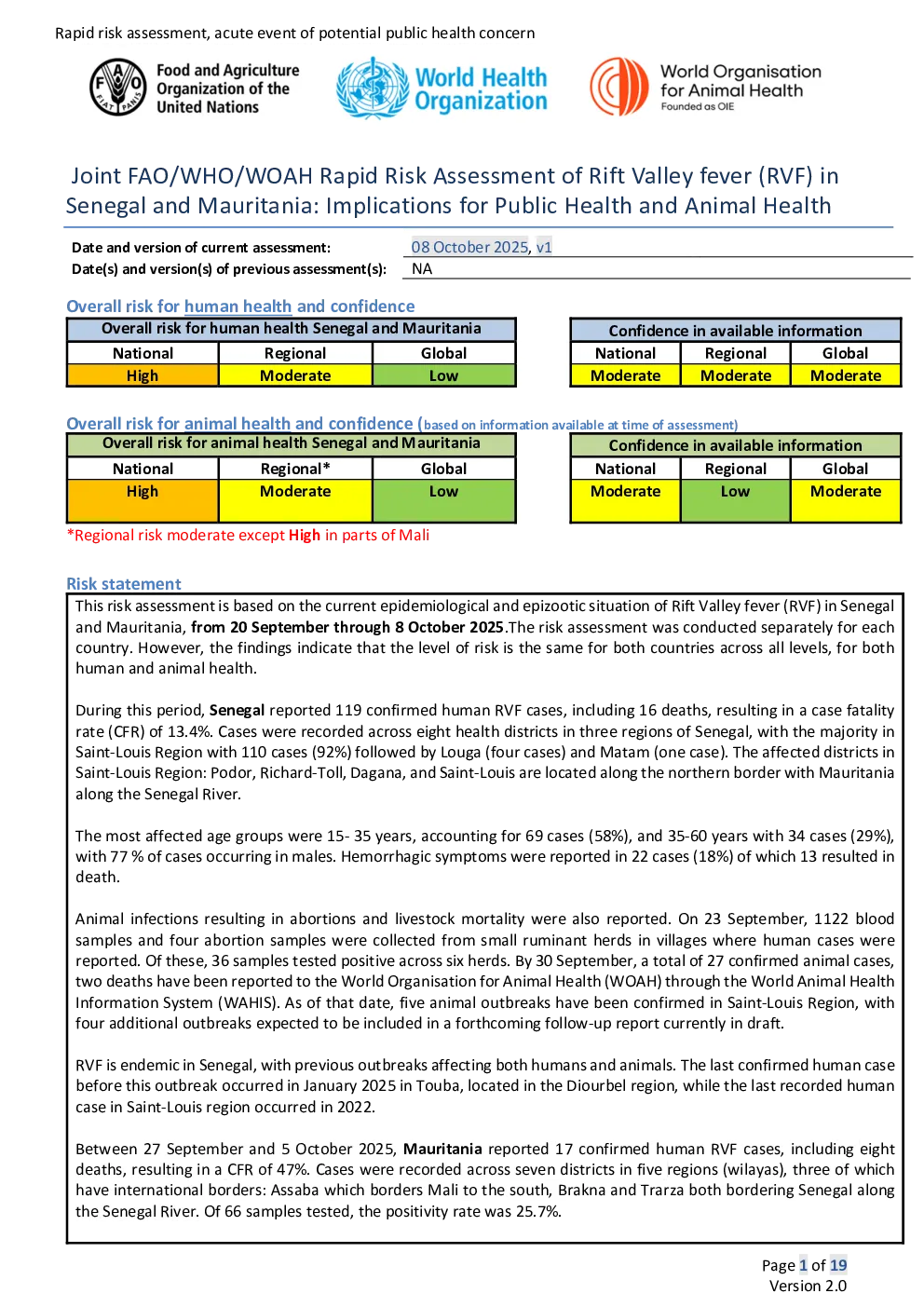
Joint FAO/WHO/WOAH Rapid Risk Assessment of Rift Valley fever (RVF) inSenegal and Mauritania:Implications for PublicHealthand Animal Health 08 October 2025,v1NA Dateandversionof current assessment:Date(s)and version(s)of previous assessment(s): Overallriskforhuman healthand confidenceOverall riskfor human healthSenegal andMauritania Overallrisk foranimal healthand confidence (based on information available at time of assessment)Overall riskfor animal healthSenegaland Mauritania Risk statement This risk assessment is based on the current epidemiological and epizootic situation of Rift Valley fever (RVF) in Senegaland Mauritania,from 20 September through 8 October 2025.The risk assessment was conducted separately for eachcountry. However, the findings indicate that the level of risk is the same for both countries across all levels, for bothhuman and animal health. During this period,Senegalreported119confirmed human RVF cases, including16deaths, resulting in a case fatalityrate (CFR) of13.4%. Cases were recorded acrosseighthealth districtsin three regions of Senegal, with themajorityinSaint-LouisRegionwith110cases(92%) followed by Louga(fourcases)and Matam(onecase).Theaffected districtsinSaint-Louis Region:Podor, Richard-Toll, Dagana, and Saint-Louisare locatedalong the northern border withMauritaniaalong theSenegal River. The most affected age groups were15-35years, accounting for69cases(58%), and 35-60 yearswith34cases(29%),with77%of casesoccurring inmales.Hemorrhagic symptoms were reported in22cases(18%)of which13resulted indeath. Animal infectionsresulting in abortions andlivestockmortalitywere also reported.On 23 September,1122bloodsamples andfourabortion samples were collectedfrom small ruminant herdsinvillages where human cases werereported.Of these,36 samples tested positive across six herds.By30 September, atotal of 27confirmedanimalcases,twodeathshavebeen reported totheWorld Organisation for Animal Health (WOAH)throughtheWorld Animal HealthInformation System (WAHIS).As ofthat date,five animal outbreaks have beenconfirmedin Saint-Louis Region, withfour additional outbreaks expected to be included ina forthcomingfollow-up report currently in draft. RVF is endemic in Senegal,withpreviousoutbreaks affecting bothhumans andanimals. The last confirmed human casebefore this outbreakoccurredinJanuary2025 in Touba, located in theDiourbelregion, while thelast recordedhumancasein Saint-Louisregionoccurred in 2022. Between27 Septemberand5October 2025,Mauritaniareported17confirmed human RVF cases,includingeightdeaths, resulting inaCFRof47%.Caseswere recorded acrossseven districts infiveregions (wilayas), three of whichhave international borders:Assabawhichborders Mali to the south,BraknaandTrarzaboth bordering Senegal alongtheSenegalRiver.Of 66 samples tested, the positivity rate was 25.7%. Page1of19Version 2.0 Rapidrisk assessment, acute event of potential public health concern Multiple active outbreaksin animals have also beenreported.According to theMinistry of Animal Resources ofMauritania,asof6October,17outbreaksacrosseight regions, with86out of307samplestestingpositive.Thefirstanimal cases, involving goats and camels,were reported in August2025.A total of 39 clinical animal cases (including16 deathsintwodromedaries and 14 goats)were reported inAioun, Hodh-Gharbi regionand Timbedra, Hodh-Charghiregion,botharelocated insoutheastern Mauritania near theMaliborder, and inMaghta Lahjar,Braknaregion,incentral Mauritania.In Braknaregion alone,233animalcases and 55 deathshave been reported to WOAHby 3 October2025.Affected animals include sheep, goats, camels and cattle. RVF is endemic inMauritania. Thelastmajor outbreakoccurredin 2022, with 47 confirmed human cases,including 23deaths(CFR 49%), mostly among animal breedersinnine of 15 regions.The virus also affected animals such as cattle,camels, and small ruminants, withsamplepositivity ratesofaround 24%testedduring that outbreak period. The current outbreakin Senegal and Mauritaniais unusual in both its magnitude and severity. It involves multipledistricts in border regions, particularly along the Senegal River, increasing the risk of cross-border transmission betweenSenegal and Mauritania. In Mauritania, the outbreak also extendsto eastern regions bordering Mali, raising concernsabout potential regional spread beyond the Senegal River basin. A notably high proportion of severe andhaemorrhagiccases has been reported. In Senegal, 18% of confirmed humancases presented withhaemorrhagicsymptoms, with 13casesresulting in death.The situation is particularly concerningin Mauritania, where the CFR has reached 47%, reflecting both the severity of illness and potential gaps in earlydetection and clinical management.Further information is needed tobetter understandthe factorscontributing to thishigh fatalityrate.Possible contributing factorsincludedelayed access to adequate care,shortage of essentialmedicalproducts and supplies andunderreporting of mild cases