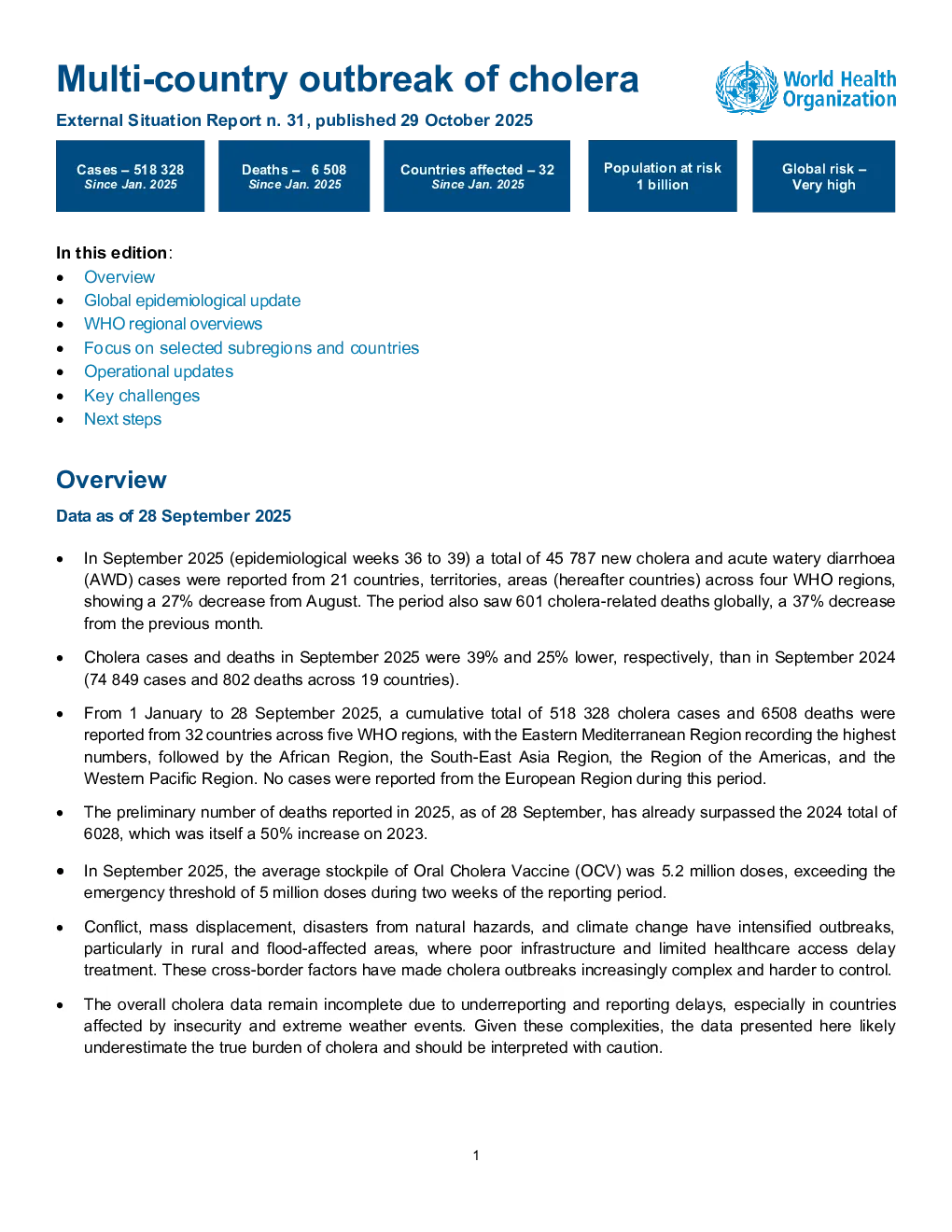
External Situation Report n.31, published29October2025 Inthisedition: •Overview•Global epidemiological update•WHO regional overviews•Focuson selectedsubregions andcountries•Operational updates•Keychallenges•Nextsteps Overview Dataasof28September2025 •InSeptember 2025(epidemiological weeks 36 to39)a total of45787new cholera and acute watery diarrhoea(AWD) cases were reported from21countries, territories, areas (hereafter countries) acrossfourWHO regions,showing a27% decreasefromAugust. The period also saw601cholera-related deaths globally, a37%decreasefrom the previous month. •Cholera cases and deaths inSeptember 2025 were 39% and 25% lower, respectively, than in September 2024(74 849 cases and 802 deaths across 19 countries). •From1 January to28 September2025, a cumulative total of518328cholera cases and6508deaths werereported from32countries acrossfiveWHO regions, with the Eastern Mediterranean Region recording the highestnumbers, followed by the African Region, the South-East Asia Region,the Region of the Americas, and theWestern PacificRegion. No cases were reportedfrom the European Region during this period. •Thepreliminarynumber of deaths reported in 2025, as of 28 September,has already surpassedthe 2024 total of6028, which was itself a 50% increase on 2023. •InSeptember2025, the average stockpile of Oral Cholera Vaccine (OCV) was5.2milliondoses,exceedingtheemergencythresholdof5milliondoses during two weeks of the reporting period. •Conflict, mass displacement, disasters from natural hazards, and climate change have intensified outbreaks,particularly in rural and flood-affected areas, where poor infrastructure and limited healthcare access delaytreatment. These cross-border factors have made cholera outbreaks increasingly complex and harder to control. •The overall cholera data remain incomplete due to underreporting and reporting delays,especiallyin countriesaffected byinsecurity andextreme weather events. Given these complexities, the data presented here likelyunderestimate the true burden of cholera and should be interpreted with caution. Globalepidemiological update InSeptember2025, (epidemiological weeks36to 39), a total of45787new cholera and AWD cases were reportedfrom21countries across four WHO regions, showing a27%decreasefrom the previous month. The EasternMediterranean Region (33 216cases; four countries) reported the highest number of cases, followed by the AfricanRegion (11 672cases, 13countries), the South-East Asia Region (772cases, 3 countries), the Region of the Americas(127 cases, 1 country). In the same period, 601cholera-related deaths were registered, representing a37%decreasecompared toAugust2025. The highest number of deaths was recorded in theEastern Mediterranean Region(326deaths; three countries), followed by theAfricanRegion(273deaths; 10 countries),and the Region of the Americas(2 deaths, one country).No deaths were reported from the South-East Asia Region. From 1 January to 28September2025, a cumulative total of518328cholera and AWD cases and6508deaths werereported globally acrossfiveWHO regions. The Eastern Mediterranean Regionreported the highest case count(306762cases; six countries), followed by the African Region (199724cases, 21 countries), the South-East Asia Region(5343cases; five countries),the Region of the Americas (5231cases; one country),andthe Western Pacific Region(1268 cases; one country). During this period, cholera and AWD deaths were reported inthe African Region (4460deaths), the Eastern Mediterranean Region (1952 deaths), the Region of the Americas (78deaths), the WesternPacific Region (13 deaths),andthe South-East AsiaRegion (5 deaths). Please interpret the data presented here withcaution.Potential underreporting and reporting delays can affecttimeliness and accuracy, whilevariations in surveillance systems, case definitions, and laboratory capacitieslimitdirect comparability between countries.These factors also influencethe globalcase fatality rate (CFR), requiringcareful examination.Unless otherwisespecified, the term 'cholera cases'includesboth suspected and confirmedcases.Data in this reportmay be adjusted retrospectivelyas more information becomes available.For the latest data,pleaseconsultWHO’sGlobal Cholera and AWD Dashboard. *Case and death numbers presented are not directly comparable due to differences in case definitions, reporting systems, and generalunderreporting.All data are subject to verification and change due to data availability and accessibility. Respective figures and numbers will be updated as more informationbecomes available. The data in Table 1 includes suspected, rapid diagnostic test(RDT) positive, and culture-confirmed cholera cases. As multiple countriesreport only total data on deaths, the reported CFR is calculated throughout based on the total number of deaths reported. TheGlobal Task Force onCholera Control (GTFCC) recommendsthat CFR be calculated using only facility deaths, with the number of community