2025年PreACT 9安全规范研究
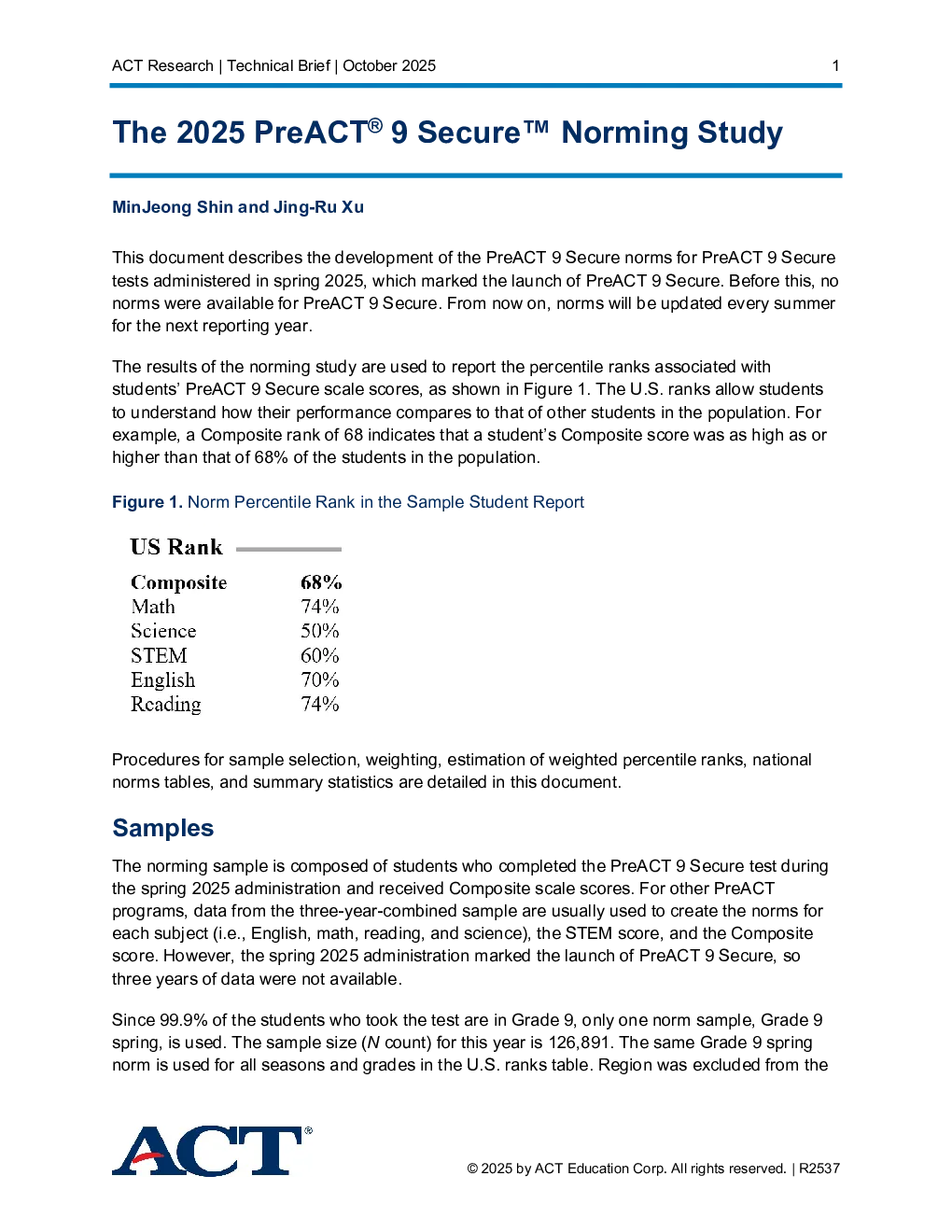
MinJeong Shin and Jing-Ru Xu This document describes the development of the PreACT 9 Secure norms for PreACT 9 Securetests administered in spring 2025, which marked the launch of PreACT 9 Secure. Before this, nonorms were available for PreACT 9 Secure. From now on, norms will be updated every summerfor the next reporting year. The results of the norming study are used to report the percentile ranks associated withstudents’ PreACT 9 Secure scale scores, as shown in Figure 1. The U.S. ranks allow studentsto understand how their performance compares to that of other students in the population. Forexample, a Composite rank of 68 indicates that a student’s Composite score was as high as orhigher than that of 68% of the students in the population. Figure 1.Norm Percentile Rank in the Sample Student Report Procedures for sample selection, weighting, estimation of weighted percentile ranks, nationalnorms tables, and summary statistics are detailed in this document. Samples The norming sample is composed of students who completed the PreACT 9 Secure test duringthe spring 2025 administration and received Composite scale scores. For other PreACTprograms, data from the three-year-combined sample are usually used to create the norms foreach subject (i.e., English, math, reading, and science), the STEM score, and the Compositescore. However, the spring 2025 administration marked the launch of PreACT 9 Secure, sothree years of data were not available. Since 99.9% of the students who took the test are in Grade 9, only one norm sample, Grade 9spring, is used. The sample size (Ncount) for this year is 126,891. The same Grade 9 springnorm is used for all seasons and grades in the U.S. ranks table. Region was excluded from the norming analysis because there were not enough states to support meaningful regionalcategorization. Weighting Methodology The samples were weighted to promote similarity in student and school-level demographicvariables across samples. The samples were weighted to a common population, which we referto as the ACT population. The ACT population includes students who took the ACT test andcompleted high school in the spring of 2024. Because the PreACT 9 Secure samples areweighted to the demographic profile of the ACT population, differences in norms across gradelevels and seasons are more likely to reflect true differences in academic development insteadof underlying differences in schools and demographics across samples. The PreACT 9 Securetest simulates the ACT testing experience and provides students with practice and preparationfor the ACT test. This intended use also supports using the ACT population as the targetpopulation for the development of the PreACT 9 Secure norms. The weighting variablesincluded gender, race/ethnicity, and school category. School category is defined bypublic/nonpublic status and percentage of students eligible for free and reduced-price lunch(FRL). For each combination of the weighting variables, the sample and population percentages werefirst calculated. Then, the weight for each combination was calculated as the populationpercentage divided by the sample percentage (𝑤𝑤𝑤𝑤𝑤𝑤𝑤𝑤ℎ𝑡𝑡=𝐴𝐴𝐴𝐴𝐴𝐴𝑝𝑝𝑝𝑝𝑝𝑝𝑝𝑝𝑝𝑝𝑝𝑝𝑝𝑝𝑝𝑝𝑝𝑝𝑝𝑝𝑃𝑃𝑝𝑝𝑝𝑝𝐴𝐴𝐴𝐴𝐴𝐴9𝑆𝑆𝑝𝑝𝑝𝑝𝑆𝑆𝑝𝑝𝑝𝑝𝑝𝑝𝑝𝑝𝑝𝑝𝑝𝑝𝑝𝑝𝑝𝑝𝑝𝑝𝑝𝑝𝑝𝑝𝑝𝑝for eachcombination within each norm sample). In the cases where weights were very large (greaterthan 5) or very small (less than 0.2), they were truncated to be in the interval [0.2, 5.0]. The finalweights were applied to all students within each combination. To compute weighted frequencytables, we used the wtd.table function in the R package questionr (Barnier et al., 2023). Table 1shows the distributions of the weighting variables for the ACT population and for theunweighted and weighted PreACT 9 Secure samples. Note that the sums of the percentagesgiven in the table may not equal 100 due to rounding. Estimation of Weighted Percentile Ranks and SummaryStatistics The weighted norm samples were used to develop the PreACT 9 Secure norms. A five-degreepolynomial smoothing method was applied to the empirical cumulative percentages to reducesampling error.Table 2presents the cumulative percentages of students who scored at orbelow each scale score point for the English, math, reading, science, STEM, and Compositescale scores. National norms tables are also available at theACT Knowledge Hub. The weighted mean and standard deviation (SD) of each subject scale score are shown inTable 3. Table 4provides the percentages of students in each PreACT 9 Secure Readiness Level foreach subject (English, math, reading, science, and STEM) based on the estimated normsshown inTable 2. The PreACT 9 Secure Readiness Levels predict whether students are ontarget to meet the ACT College Readiness Benchmarks by the time they complete high school. PreACT 9 Secure scores are classified into one of three readiness levels (Table 5): 1.On Target—Students scoring in t