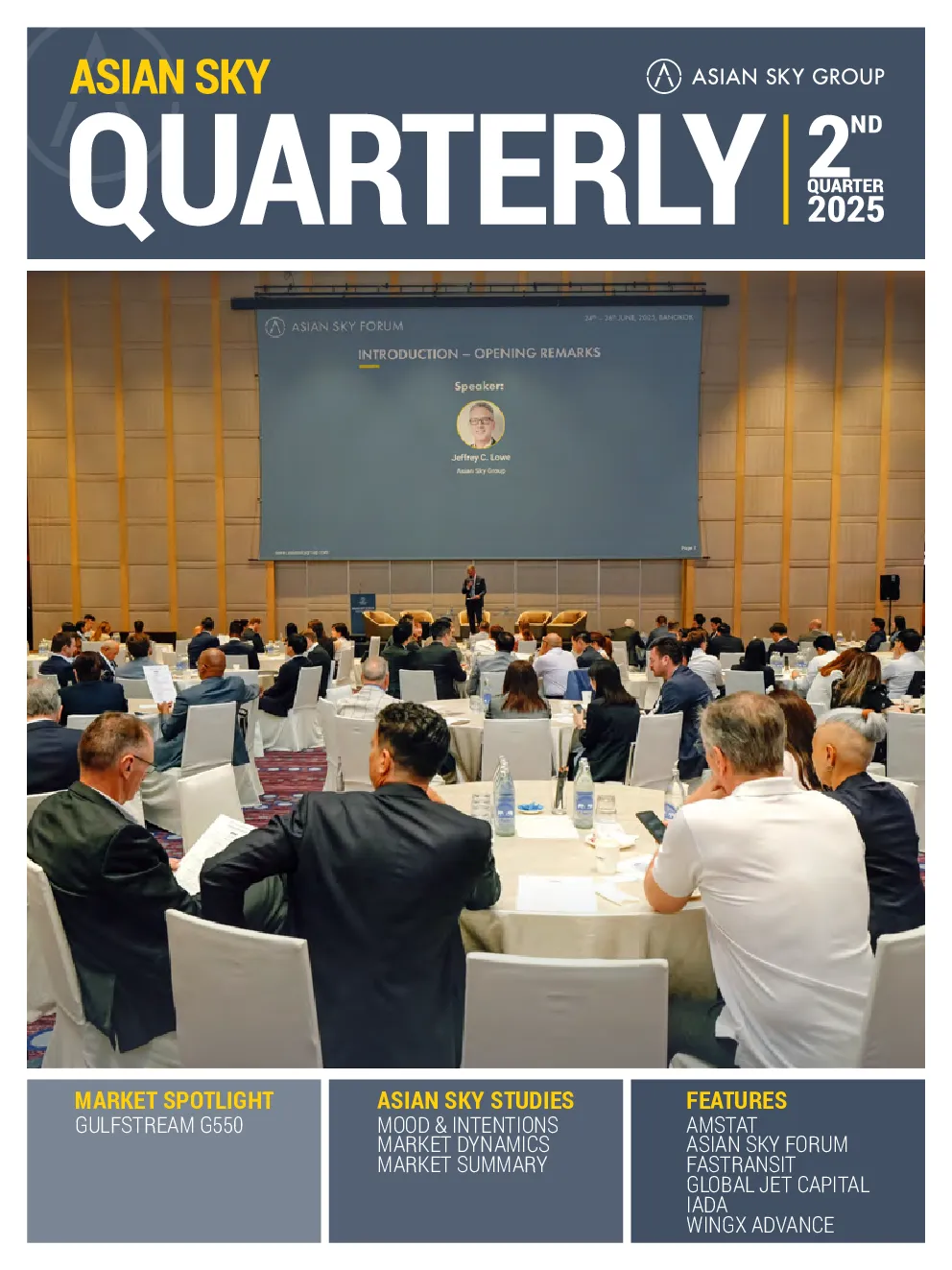
ASIAN SKY STUDIESMOOD & INTENTIONSMARKET DYNAMICSMARKET SUMMARY MARKET SPOTLIGHTGULFSTREAM G550 FEATURESAMSTATASIAN SKY FORUMFASTRANSITGLOBAL JET CAPITALIADAWINGX ADVANCE EDITOR’S NOTE As artificial intelligence continues to permeate various domains, itscapacity to generate analysis has garnered significant attention.While AI's ability to process vast amounts of data rapidly isimpressive, turning to it as a primary source of analysis raisescritical concerns that demand careful scrutiny. Analysis requires more than just data crunching; it involves interpretation,contextual understanding, and the ability to weigh nuances. AI models,despite their sophistication, often lack the depth of human insightnecessary to interpret complex, ambiguous, or conflicting informationaccurately. They may produce oversimplified conclusions that overlooksubtleties, leading to misguided decisions or misleading narratives. Alud DaviesMedia & PublicationsDirector AI systems learn from existing data, which is inherently imperfectand often biased. If historical data contains prejudices or skewedperspectives, AI-generated analysis can perpetuate or even amplifythese biases. Relying on such output risks reinforcing stereotypes,misinformation, or systemic inequalities, undermining the integrityof the analysis. Analysis often involves ethical judgments—considering the societalimpact of policies, recognizing moral dilemmas, or understandingcultural sensitivities. AI lacks moral consciousness and cannotnavigate these ethical dimensions authentically. Its analysis mayinadvertently overlook or dismiss important moral implications,leading to recommendations that are ethically questionable. Overreliance on AI for analysis might diminish the value placed onhuman expertise, critical thinking, and professional judgment. Whenmachines do interpretive work, there is a risk of deskilling humananalysts and reducing diverse perspectives, which are essential forbalanced and comprehensive understanding. Decisions based on AI analysis carry the risk of opacity—algorithmscan be black boxes, making it difficult to trace how conclusions werereached. This lack of transparency complicates accountability andcould undermine public trust, especially if AI-driven analysis leadsto flawed or harmful outcomes. You might ask why I’m telling you this. The truth is that I didn’tactually tell you this at all, everything above this sentence waswritten by AI when I asked it why we shouldn’t use AI in analysis. And therein lies the danger. We have all seenTerminator 3: Rise of the Machines, in which asentient machine sends more machines back in time to prevent humans from messing about and stifling its growth. I’m sure most ofus have also seen the Matrix films or are at least aware of how realityis an illusion, forced upon us whilst the machines farm us for power. PUBLISHER These two Kafkaesque visions of the future might not seem thatfarfetched, after all, AI is here to make our lives easier. We alreadyuse it for many day-to-day things and its use is growing ever wider.The tipping point might not be too far off, there will come a timewhere AI’s main purpose is to protect human life. And what causeshumans the most harm? Other humans. So to protect humans, youhave to remove other humans. EDITORIAL & MARKET RESEARCH Alud DaviesBowen ZhangCharlie XuCynthia NingDennis LauJerry HoJustin YeungWinny Cheng We banned AI here at Asian Sky Group a few years ago, or at least webanned ChatGPT and the likes. Why? It’s just not human. No matterhow much you train AI by feeding it examples of human work, it’snever going to be the same. It’s also frequently wrong. DATA & RESEARCH COORDINATION Iris Lian A great example of this is with the recent Asian Sky Forum – 2025Bangkok. I asked AI to write a short summary of the event for me.Just a quick 500 words. The speed at which it produced the copywas impressive, but that would be the last time I would be impressed. DESIGNAmy Liu-LhuissierLuna Huang The copy that came back was unusable. Not only was the use oflanguage a little flowery, it was also completely wrong. Accordingto the summary, there was a big focus on sustainability, and“Keynote speakers included senior officials from the InternationalCivil Aviation Organization (ICAO) and regional airline CEOs, offeringinsights into policy developments and market trends.” ADVERTISING/ENQUIRIES: Jerry Homedia@asianskygroup.com+852 9199 7751www.asianskygroup.com The materials and information provided by Asian Sky Group in thisreport are for reference only. While such information was compiledusing the best available data as of June 30, 2025, any informationwe provide about how we may interpret the data and market, orhow certain issues may be addressed is provided generally withoutconsidering your specific circumstances. Such information shouldnot be regarded as a substitute for professional advice. Independentprofessional advice should be sought before taking action on anymatte